Lesson 5AM closed with the Reduction of bx to ekx theorem: every base b>0 admits a unique constant k with bx=ekx, and that constant is the unique solution of ek=b. The numerical experiments at the start of that lesson, m2≈0.693, m3≈1.099, m5≈1.609, were exactly these values of k for b=2,3,5. Knowing k exists is enough to differentiate bx, but the constant is still nameless: a tabulation, not a formula. Investing £1000 at 15% per year writes B(t)=1000ekt with ek=1.15, and reading k off requires a procedure for inverting e.
That inverse is the natural logarithm. It names the constants from Lesson 5AM, gives the derivative of lnx, simplifies product differentiation, and extends the power rule from rational exponents to all real exponents.
The Natural Logarithm Function
Recitation 4 established that for every b>0 with b=1, the function bx is strictly monotonic, hence one-to-one. With b=e, the graph of y=ex is strictly increasing, passes through (0,1), approaches 0 as x→−∞, and grows without bound as x→∞. We now use the inverse-function idea.
Definition 38 (Inverse function)
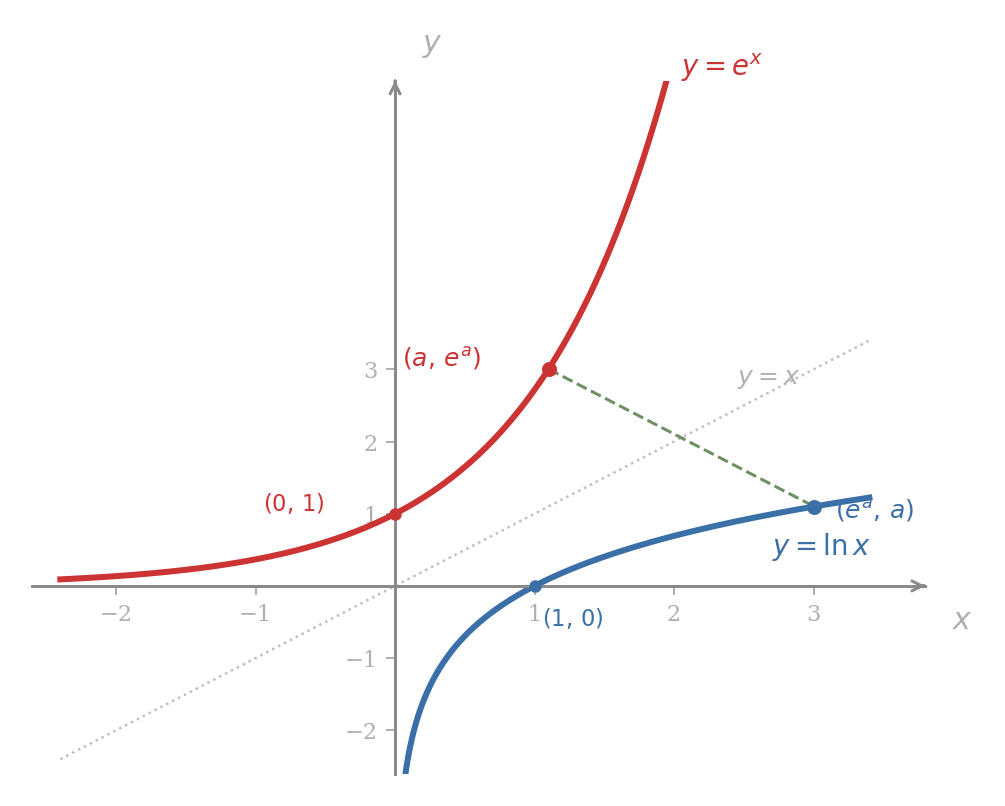
Suppose a function never takes the same output value twice. Its inverse function sends each output back to the input that produced it. Graphically, the inverse is obtained by reflecting the original graph across the line y=x. For example, the inverse of f(x)=x+2 is f−1(x)=x−2.
Applying this to y=ex, the reflected curve is defined for every x>0 (since ey ranges over (0,∞) as y ranges over the real line). For each such positive x, exactly one y satisfies x=ey. That unique y is named lnx.
Definition 39 (Natural logarithm)
For every x>0, the natural logarithm of x, written lnx, is the unique real number y such that
ey=x.
Equivalently, the two equations
y=lnxandx=ey(1)
describe the same pair (x,y): each one is true exactly when the other is.
Five facts read directly off the figure.
lnx is defined only for x>0.
ln1=0, since (0,1) on y=ex reflects to (1,0) on y=lnx.
lnx<0 for 0<x<1, and lnx>0 for x>1.
lnx is strictly increasing.
lnx→−∞ as x shrinks toward 0 from the positive side, and lnx→∞ as x→∞.
The two equations expressing the inverse relationship cancel one function with the other:
Theorem 22 (Inverse identities)
For every real x in the appropriate domain,
elnx=x(x>0),(2)ln(ex)=x(every real x).(3)
Proof
For (2): pick x>0. The point (lnx,x) sits on the graph of y=ex by definition, since the reflected point (x,lnx) sits on y=lnx and the reflection swaps coordinates. So elnx=x.
For (3): pick any real x. The point (x,ex) sits on y=ex, so its reflection (ex,x) sits on y=lnx. Since the second coordinate of a point on y=lnx at first coordinate ex is exactly ln(ex), we read off ln(ex)=x.
■
In words: lnx is the exponent to which e must be raised to get x. Identity (2) says that exponentiating after taking a log returns the original positive input; identity (3) says that taking a log after exponentiating returns the original real input.
Example 141 (Simplifying expressions in ln and e)
Simplify each expression to a number.
eln4+2ln3.
ln(e5⋅e−2).
e3ln2−ln8.
Split using law (i) of exponents from Recitation 4, then use e2ln3=(eln3)2 from law (iv):
eln4+2ln3=eln4⋅(eln3)2=4⋅32=36,
where the last step applied identity (2) to each factor.
Combine the inside using law (i): e5⋅e−2=e3. Then identity (3) gives ln(e3)=3.
Collapse the e-tower in two steps. By law (iv), e3ln2=(eln2)3=23=8. By law (iii), e3ln2−ln8=e3ln2/eln8=8/8=1.
The two identities are also the only tools needed to solve equations involving an exponential or a logarithm.
Example 142 (An exponential equation)
Solve 5ex−3=4 for x.
Divide each side by 5:
ex−3=0.8.
Take the natural logarithm of each side and apply identity (3) on the left:
ln(ex−3)=ln0.8.
The left side is just x−3, so
x−3=ln0.8,x=3+ln0.8.
The closed-form answer is x=3+ln0.8. A scientific calculator returns ln0.8≈−0.22314, so x≈2.77686 to five decimals, but the symbolic value is the lesson here.
Example 143 (A logarithmic equation)
Solve 2lnx+7=0 for x.
Solve the linear equation for lnx:
lnx=−27.
Exponentiate both sides and use identity (2) on the left:
elnx=e−7/2,x=e−7/2.
The strict positivity of e−7/2 confirms x lies in the domain of ln, as it must.
Note (Procedure: solving with $\ln$ and $e$)
If the unknown sits inside an exponential e(⋅), isolate the exponential and take ln of both sides; use (3) to drop the e.
If the unknown sits inside a logarithm ln(⋅), isolate the logarithm and exponentiate both sides; use (2) to drop the ln.
Domain check: any solution involving ln requires the argument to be strictly positive.
Problem 156
Solve each equation for x. Leave answers in closed form involving ln or e.
7e2x=21.
ln(3x−1)=4.
ex2=e4x−3.
lnx+ln(x−2)=ln15. (Use the algebraic property of ln developed below; or verify the answer makes both logarithms defined.)
Algebraic Properties of ln
The four core algebraic identities of natural logarithms transfer directly from the laws of exponents in Recitation 4, by exponentiating both sides and matching exponents.
Note (Real powers with positive base)
For x>0 and real b, we interpret
xb=eblnx.
When b is rational, this agrees with the rational-exponent notation from Recitation 1. For irrational b, this equation is the definition that makes xb meaningful.
Theorem 23 (Properties of ln)
For positive numbers x,y and any real number b:
(LI)ln(xy)=lnx+lny
(LII)ln(x1)=−lnx
(LIII)ln(yx)=lnx−lny
(LIV)ln(xb)=blnx
Proof
LI. Raise e to each side and use (2) three times: eln(xy)=xy=elnx⋅elny=elnx+lny by law (i). Both sides are e(⋅) and equal, and e(⋅) is one-to-one (Recitation 4), so the exponents match: ln(xy)=lnx+lny.
LII. Same template. eln(1/x)=1/x=1/elnx=e−lnx by law (ii). Match exponents.
LIII. Combine LI and LII: ln(x/y)=ln(x⋅1/y)=lnx+ln(1/y)=lnx−lny.
LIV. By the definition of real powers with positive base, xb=eblnx. Applying identity (3) gives
ln(xb)=ln(eblnx)=blnx.■
These four properties are used repeatedly below. They convert products into sums, quotients into differences, and powers into multiplications, which is what makes a stack of factors easier to differentiate one term at a time.
Split each into a sum and difference of logarithms of x, ln2, ln5, etc., as far as the four properties allow. For this problem, take x>1 and take every displayed variable inside a logarithm to be positive.
ln(x+150x3).
ln(2x+5)3x4(x−1).
ln(x2e3x). (Use identity (3) alongside LI.)
Closing the Reduction Theorem
The reduction theorem stated that bx=ekx for the unique k with ek=b. Identity (1) now names that constant.
Theorem 24 (Naming the reduction constant)
For every b>0,
bx=e(lnb)xfor every real x.(4)
Consequently,
dxd(bx)=(lnb)bx.(5)
Proof
The unique k with ek=b is k=lnb, by (1). Substituting into the reduction theorem gives (4). Differentiating bx=e(lnb)x by the formula for ekx, with k=lnb, yields (5).
■
The undetermined slope-at-zero constants mb from Lesson 5AM’s tables are now fully named: mb=lnb. The numerics align: ln2≈0.693, ln3≈1.099, ln5≈1.609, the values the limit table produced.
Example 145 (A British investor's marginal growth)
A British investor’s account balance is B(t)=1000⋅(1.15)t pounds after t years. Find B′(t) in closed form, and compute the value of B′(0).
By (5) with b=1.15,
B′(t)=1000⋅(ln1.15)⋅(1.15)t=(ln1.15)B(t).
The proportionality constant in the rate equation B′(t)=kB(t) is exactly ln1.15≈0.1398, the continuously compounded rate equivalent to a 15% annual return. At t=0, B(0)=1000, so
B′(0)=1000ln1.15≈139.8 £/year.
The closed form ln1.15 replaces the unnamed constant from the analogous problem in Lesson 5AM.
Problem 159
A bacteria culture grows according to N(t)=100⋅3t, where t is in hours. Use (5) to write N′(t) in closed form, and compute the population’s instantaneous rate of growth at the moment the population first reaches 300.
The Derivative of lnx
Identity (2), elnx=x, is an equation between two differentiable functions of x on (0,∞). Differentiating both sides yields the derivative of ln in one stroke.
Theorem 25 (Derivative of lnx)
For every x>0,
dxd(lnx)=x1.(6)
Proof
The right-hand side of (2) has derivative 1:
dxd(x)=1.
The left-hand side, by the chain rule for exponentials with inner function g(x)=lnx, has derivative
dxd(elnx)=elnx⋅dxd(lnx)=x⋅dxd(lnx),
where the last step replaced elnx by x via (2). Setting the two derivatives equal,
x⋅dxd(lnx)=1.
Dividing by x>0 gives dxd(lnx)=x1.
■
The graph of lnx has slope 1 at x=1 (the same point at which y=ex has height 1, by reflection), slope 1/2 at x=2, slope 1/e at x=e, and so on. The slope shrinks toward 0 as x→∞, visible as the flattening on the right of y=lnx in the graph above, and grows without bound as x approaches 0 from the positive side.
Example 146 (Three derivatives involving lnx)
Differentiate:
y=(lnx)5.
y=xlnx.
y=ln(x3+5x2+8).
General power rule with inner function lnx:
dxdy=5(lnx)4⋅dxd(lnx)=5(lnx)4⋅x1=x5(lnx)4.
Product rule:
dxdy=x⋅x1+(lnx)⋅1=1+lnx.
The derivative is zero at lnx=−1, that is, x=e−1=1/e. By the first derivative test, the sign of 1+lnx flips from negative to positive there, so (1/e,−1/e) is a relative minimum.
Chain rule with outer ln(⋅) and inner x3+5x2+8, on the part of the domain where x3+5x2+8>0. The derivative of ln at the inner value is 1/(inner):
dxdy=x3+5x2+81⋅(3x2+10x)=x3+5x2+83x2+10x.
The chain-rule pattern from part (c) generalises in one line.
Theorem 26 (Chain rule for lng(x))
For every differentiable g with g(x)>0,
dxd[lng(x)]=g(x)g′(x).(7)
In Leibniz form with u=g(x):
dxd(lnu)=u1dxdu.
Proof
The chain rule with outer function f(u)=lnu and inner function u=g(x) gives
dxdlng(x)=f′(g(x))⋅g′(x)=g(x)1⋅g′(x),
since f′(u)=1/u by (6).
■
The numerator-over-denominator shape of (7), the derivative of the inside divided by the inside, is the pattern to recognise. Whenever ln wraps a differentiable expression, it is often safest to write g′(x)/g(x) first, then simplify.
Example 147 (Differentiating lng(x))
Differentiate each.
y=lnx2+1.
y=ln(1−xx).
y=ln(e2x+3x).
Two routes. Direct chain rule: g(x)=x2+1=(x2+1)1/2, so
g′(x)=21(x2+1)−1/2⋅2x=x2+1x,
hence
dxdy=g(x)g′(x)=x2+1x/x2+1=x2+1x.
Faster route: rewrite using LIV before differentiating, y=21ln(x2+1), then
dxdy=21⋅x2+12x=x2+1x.
The rewrite is shorter because LIV pulled the square root outside as a constant multiple, and the chain rule then ran over the simpler inside.
Rewrite using LIII: y=lnx−ln(1−x) (valid where both arguments are positive, i.e. 0<x<1). Then
dxdy=x1−1−x−1=x1+1−x1=x(1−x)1.
No simplification by LI-LIV is available because the inside is a sum, not a product. Apply (7) directly with g(x)=e2x+3x, g′(x)=2e2x+3:
dxdy=e2x+3x2e2x+3.
Remark
LI, LIII, and LIV exchange a single ln of a complicated argument for a sum or difference of lns of simpler arguments, and the derivative is then the sum or difference of simpler 1/u terms. Always inspect a ln for products, quotients, and powers in its argument before differentiating; every product, quotient, or power that LI-LIV can split usually saves one chain-rule step.
Problem 160
Differentiate. Use LI-LIV to simplify the argument before differentiating wherever possible, working on the indicated interval.
y=ln(x2(x+1)3) on x>0.
y=ln31−x1+x on −1<x<1.
y=ln(lnx) on x>1. (Two nested chain rules.)
y=ln(x2+1ex) for all real x.
A Relative Maximum of (lnx)/x
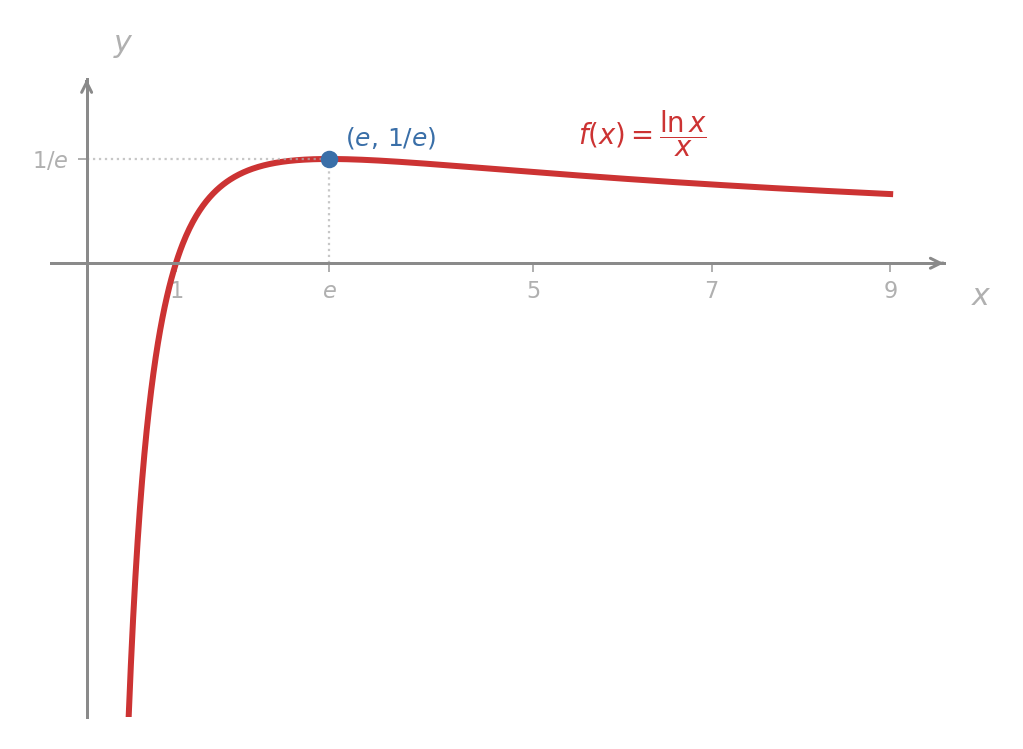
The function f(x)=(lnx)/x has a single critical number on (0,∞). Locating it shows the chain rule, the quotient rule, and the algebraic properties of ln working together.
Example 148 (Relative extreme of (lnx)/x)
Find every relative extreme point of f(x)=(lnx)/x on (0,∞), and classify each.
By the quotient rule with u=lnx and v=x:
f′(x)=x2x⋅(1/x)−(lnx)⋅1=x21−lnx.
Set f′(x)=0: the denominator never vanishes on (0,∞), so the critical numbers solve 1−lnx=0, that is, lnx=1. Exponentiating both sides and using (2),
x=e1=e.
Apply the second derivative test. By the quotient rule again,
So f is concave down at x=e, and the critical point is a relative maximum. The value there is
f(e)=elne=e1.
The relative maximum at (e,1/e) is also the absolute maximum on (0,∞): the curve crosses zero at x=1 and decays back toward zero as x→∞ (a fact that follows from the asymptotic flattening of lnx, made rigorous in a later analysis course). The simple constant 1/e that appears repeatedly in exponential-decay applications is exactly this peak height.
Problem 161
Find and classify every relative extreme point of f(x)=x2lnx on (0,∞). Use the sign of f′(x) on the intervals separated by the critical number to show that this point is also an absolute minimum.
Problem 162
A pharmacology team models the bloodstream concentration of a single dose of a drug by
C(t)=ln(1+4t)−21tmg/L,t≥0,
where t is measured in hours. Find the time at which the concentration peaks, the peak concentration, and the rate at which the concentration is changing at t=0. State the unit of each rate.
The Derivative of ln∣x∣
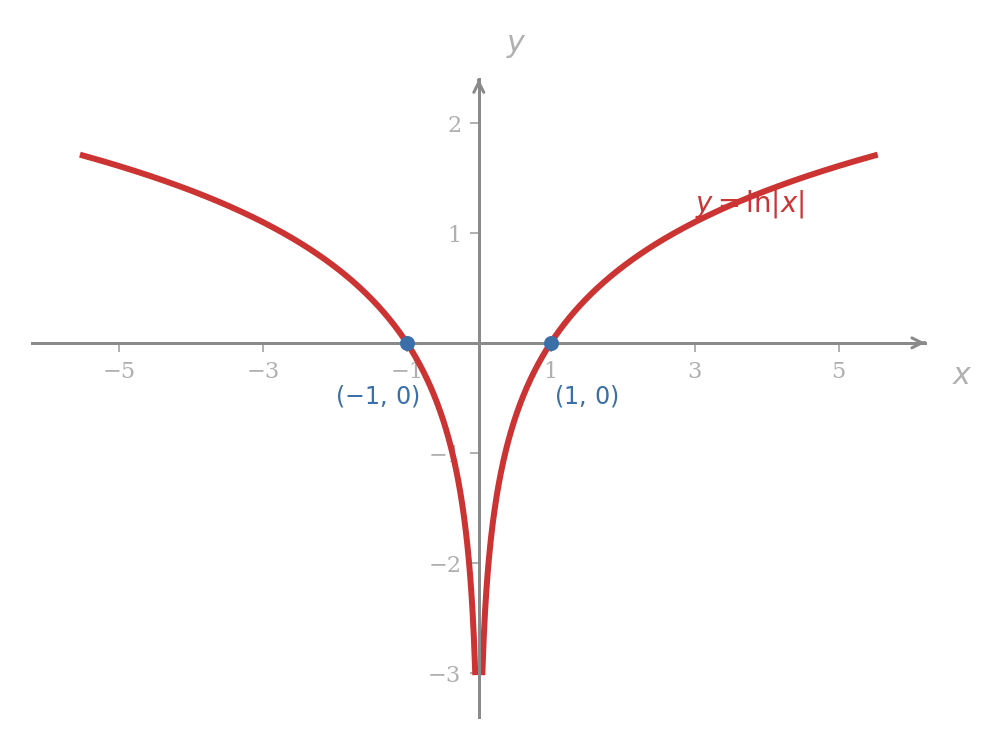
The function lnx is defined only for x>0. The function ln∣x∣ is defined for every nonzero x, and its graph is the union of y=lnx on x>0 with its reflection across the y-axis.
A two-case computation, using the chain rule on the negative side, collapses to a single formula.
Theorem 27 (Derivative of ln∣x∣)
For every x=0,
dxdln∣x∣=x1.(8)
Proof
Case x>0.∣x∣=x, so ln∣x∣=lnx, and (6) gives dxdlnx=1/x.
Case x<0.∣x∣=−x, so ln∣x∣=ln(−x). Apply (7) with g(x)=−x, g′(x)=−1:
dxdln(−x)=g(x)g′(x)=−x−1=x1.
Both cases give 1/x, identical formulas on either side of zero.
■
Equation (8) matters because the same derivative formula now works on both sides of zero, provided the logarithm is written as ln∣x∣. The point for this lesson is the derivative identity; the integration use of this formula belongs to MA0B.
Problem 163
Differentiate each function. Each requires identifying the appropriate branch and applying (8) or (7) as needed.
y=ln∣x2−4∣, on each interval where the argument is nonzero.
y=xln∣x∣ for x=0. Show that y has a single critical number on each of (−∞,0) and (0,∞), and locate them.
y=ln∣1−2x∣ for x=1/2.
Logarithmic Differentiation
A product of three or more factors fed through the product rule produces a long expression, each term containing a derivative of one factor multiplied by every other factor. The four properties LI-LIV convert that product into a sum before differentiation, and the derivative becomes a sum of 1/u-type terms.
Example 149 (Splitting before differentiating)
Differentiate f(x)=ln[x(x+1)(x+2)] on x>0.
By LI applied twice,
f(x)=lnx+ln(x+1)+ln(x+2).
Differentiating term by term:
f′(x)=x1+x+11+x+21.
Three one-term derivatives replace one product-rule cascade.
The same method also differentiates the underlying product itself, by applying (7) in reverse: if g(x)=x(x+1)(x+2), then dxdlng(x)=g′(x)/g(x), and the example above computed exactly the left-hand side. So
g(x)g′(x)=x1+x+11+x+21,
and multiplying both sides by g(x) yields
g′(x)=x(x+1)(x+2)⋅[x1+x+11+x+21].
This is the derivative of a three-factor product written without ever invoking the product rule directly. The method is to take ln, differentiate, then multiply through; this is logarithmic differentiation.
Note (Procedure: logarithmic differentiation)
To differentiate g(x) when g is a product, quotient, or power of factors:
Take ln of both sides of y=g(x), valid wherever g(x)>0.
Use LI-LIV to split the right side into a sum/difference of simpler logarithms.
Differentiate both sides; the left side becomes y′/y by (7).
Multiply through by y=g(x) to solve for y′.
For g that takes negative values, take ln∣g(x)∣ instead and use (8) in place of (6). The final formula for g′ is the same.
Example 150 (A three-factor derivative)
Differentiate g(x)=(x2+1)(x3−3)(2x+5) by logarithmic differentiation.
Step 1. Work on the interval x>33, where all three displayed factors are positive, and take ln of both sides:
The same derivative computed by direct triple application of the product rule would have produced three terms, each a product of three factors and a derivative; the logarithmic form keeps the answer in a single readable structure.
Example 151 (A quotient with roots and powers)
Differentiate y=(2x+7)5x4x2+1 by logarithmic differentiation, on the interval x>0.
By LIII, LI, and LIV in sequence,
lny=4lnx+21ln(x2+1)−5ln(2x+7).
Each factor contributes a ln, with the exponent pulled out front by LIV; the denominator picks up a minus sign by LIII.
Differentiate by (7):
yy′=x4+21⋅x2+12x−5⋅2x+72=x4+x2+1x−2x+710.
Multiply by y:
y′=(2x+7)5x4x2+1⋅[x4+x2+1x−2x+710].
The logarithmic form keeps each factor’s contribution visible. A direct quotient-rule computation is longer because it also needs a chain rule on the square root and a separate chain rule on (2x+7)5.
Problem 164
Differentiate each function by logarithmic differentiation. Show every step.
y=(x+1)(x−2)(x+5) on x>2.
y=(x−1)2(x+3)(x2+4)3 on x>1.
y=x⋅1+x2⋅31−x on 0<x<1.
The Power Rule for Every Real Exponent
The general power rule from Recitation 2 differentiated xr for rationalr. Logarithmic differentiation extends the formula to every real r in one move.
Theorem 28 (Power rule, all real exponents)
For every real number r and every x>0,
dxd(xr)=rxr−1.(9)
Proof
Let f(x)=xr for x>0. By LIV,
lnf(x)=ln(xr)=rlnx.
Differentiate both sides on x>0. On the left, by (7), dxdlnf(x)=f′(x)/f(x). On the right, r is a constant and dxd(rlnx)=r/x. So
f(x)f′(x)=xr.
Multiplying both sides by f(x)=xr,
f′(x)=r⋅xf(x)=r⋅xxr=rxr−1.■
For rational exponents, this agrees with the computational power rule already used earlier in MA0A. The verification above has no rationality hypothesis: it works whenever LIV applies, which is for every real r. So dxd(x2)=2x2−1 and dxd(xπ)=πxπ−1 now sit on the same line as the polynomial cases.
Example 152 (A function with an irrational exponent)
Differentiate y=xπ at x=2, and write the equation of the tangent line there.
By (9) with r=π,
dxdy=πxπ−1.
At x=2, the slope is π⋅2π−1, and the point of tangency is (2,2π). Point-slope form gives
y−2π=π⋅2π−1(x−2).
Simplifying the slope: π⋅2π−1=21π⋅2π≈0.5⋅3.14⋅8.82≈13.86, so the tangent line at x=2 rises about 13.86 units per unit gain in x.
The same method, taking ln, differentiating, and multiplying back, also handles expressions in which the variable appears in both the base and the exponent.
Example 153 (y=xx)
Differentiate y=xx on x>0.
The expression is neither a fixed-base exponential (bx) nor a fixed-exponent power (xr); (5) and (9) both fail. Take ln:
lny=xlnx.
Differentiate by the product rule on the right and by (7) on the left:
yy′=1⋅lnx+x⋅x1=lnx+1.
Multiply by y=xx:
dxd(xx)=xx(lnx+1).
The derivative is zero where lnx+1=0, that is, x=e−1=1/e. Computing f(1/e)=(1/e)1/e and applying the first derivative test confirms a relative minimum at x=1/e.
Problem 165
Differentiate each function on the indicated domain.
y=x3, x>0.
y=(3x+1)x, x>−1/3.
y=(lnx)x, x>1.
y=x1/x, x>0. Find the unique critical number.
Problem 166
Let f(x)=xr on (0,∞), where r is a fixed real exponent. Show, using (9) and the second derivative test, that f is concave up if and only if r<0 or r>1, and concave down if 0<r<1. State the cases r=0 and r=1 separately.
A Worked Application
The closing application revisits the radioactive-decay setup from Recitation 4 with the new tools in place.
Example 154 (Half-life of carbon-14)
A pile of carbon-14 has half-life T years. Its mass at time t is M(t)=M0e−kt for some constant k>0. Express T as a closed form in terms of k, and the rate of decay at time t as a closed form in terms of M(t) and k.
The half-life is the unique T>0 with M(T)=M0/2. Substituting and dividing by M0,
e−kT=21.
Take ln of both sides and apply (3) on the left and LII on the right:
−kT=ln21=−ln2.
Dividing by −k,
T=kln2.
The half-life is therefore T=(ln2)/k, a closed form replacing the previously unnamed half-life from Lesson 5AM.
The rate of decay is M′(t)=−ke−kt⋅M0=−kM(t) by the chain rule (or by Lesson 5AM’s dxd(Cekx)=Ckekx). At every t,
M′(t)=kM(t)=Tln2⋅M(t).
So the fractional rate of decay ∣M′(t)∣/M(t) is exactly (ln2)/T, a constant independent of t. Twice the half-life corresponds to half the fractional rate; the expression (ln2)/T is the standard quantity for comparing decay rates of different isotopes.
Problem 167
A culture of E. coli doubles every 20 minutes. Model the population as N(t)=N0ekt with t in minutes. Find k in closed form (in terms of ln2), and compute the time at which the population first reaches 10N0, in closed form.
Problem 168
A British investor is offered two accounts:
Account A: 5% continuous interest, modelled by A(t)=Pe0.05t.
Account B: a 2% setup fee followed by 5.5% annual interest compounded once per year, modelled by B(t)=0.98P(1.055)t.
Determine the time at which the two balances are equal, in closed form involving natural logarithms. Determine which account grows faster at that time, in absolute terms (£ per year). Compare the fractional rates of growth of the two accounts and state which is larger.
Problem 169
A vat of liquid is stirred so that its temperature T(t) in ∘C above ambient satisfies T′(t)=−kT(t) for a constant k>0, with T(0)=T0. Show, using (5) or the chain rule, that any time interval over which the temperature halves has the same length, and that this length is (ln2)/k. The vat’s temperature at t=5 minutes is 40∘C above ambient and at t=25 minutes is 5∘C above ambient. Find k and T0 in closed form.
Problem 170
Let f(x)=xe−x2 on the real line. Find every relative extreme point of f and classify each. Determine the maximum value of ∣f∣, and the x-values at which it is attained. State, with reasons drawn from this lesson and Lesson 5AM, whether f has any inflection points, and locate them in closed form.