
Lesson assets
No linked assets.
Exponential Models and Logarithmic Differentiation
Lesson 5AM produced the family as the solutions of the rate equation , and Lesson 5PM named and gave the four log identities together with logarithmic differentiation. Two pieces of data fix and for any application; one piece of data fixes one of them when the other is read off the model. This recitation applies those tools to two-data-point growth, half-life, the time constant of a decay curve, mixed-rule expressions involving and , and higher-derivative patterns.
We use the labels from Lesson 5PM: LI is , LII is , LIII is , and LIV is , with positive logarithm arguments.
Two Data Points Fix
A measurement at one time fixes . A measurement at a second time then fixes through one application of .
A bacteria culture grows so that for some constant , with measured in hours. At time there are bacteria, and at time there are bacteria. Find in closed form.
By the solutions theorem, . The reading at gives
so .
The reading at gives
Take logarithms of both sides. Since , this gives
Hence
The growth rate at any moment is , with per hour.
A colony of fruit flies grows so that , with in days. The colony’s size doubles in days. Find .
The doubling condition is . Substituting the model and dividing by ,
Take of both sides:
The initial population never appeared. The growth constant of an exponential model is fixed by any ratio of values at two times, not by the absolute scale.
Problem 1
A continuation of the fruit-fly example. The initial population is .
- Use to write explicitly.
- Compute the size of the colony at days, in closed form involving a power of . Compute the rate of growth at that moment in flies per day, leaving the answer in terms of .
- Find the time at which the colony first contains flies. Reduce the equation to one of the form , then solve in closed form using .
Problem 2
A British investor opens an account at time with pounds. The balance grows continuously at a fixed rate, so . After years the balance is £1500, and after years it is £3000.
- Use the ratio to find in closed form, without computing .
- Use either reading to find .
- Show, using the answer to part (1) and the doubling-time logic of the fruit-fly example, that the doubling time of this account is exactly years.
Problem 3
A laboratory yeast culture in early growth phase has cell count , with in hours. Two technicians take readings: and .
- Find by using the ratio of the two readings, expressing in closed form involving .
- Find in closed form.
- Find the time at which the cell count first reaches , in closed form.
Half-Life Applications
For a decay model with , the half-life formula from Lesson 5PM converts every decay constant into a half-life and back. The fractional rate of decay is constant in , so every interval of length removes half of whatever is present at its start.
Strontium- decays at rate with per year. Find the half-life , and the fraction of the original mass remaining after years.
By the half-life formula,
The mass remaining after years is
so about of the strontium- remains. Equivalently, , so the sample has passed through just over three and a half half-lives.
Iodine- has half-life days. Hay collected after a nuclear test contains times the maximum allowable level of iodine- for use as cattle fodder. How many days must the hay be stored before it is safe?
The decay constant is per day, and the iodine content at time is . The first safe time occurs at the threshold , so we solve
Take logarithms of both sides. Since and LII gives , we get
Numerically, days. The hay must be stored at least days.
The bound ” for all later ” is automatic once first reaches , because is strictly decreasing. The strict monotonicity of for is one application of the formula for with .
Problem 4
Carbon- has half-life years. A parchment fragment contains of the carbon- that a comparable living organism would have today. Estimate the age of the parchment in closed form, then compute it numerically to the nearest year using .
Set with , and solve for .
Problem 5
A radioactive sample drops from grams to grams over a -hour interval, following .
- Use the ratio to find in closed form involving .
- Find the half-life of the isotope. Confirm hours equals exactly.
- Predict the mass at hours, in closed form, by computing .
Problem 6
Two radioactive isotopes A and B have decay constants and . Both samples have the same initial mass .
- Express the ratio in closed form using the formula for , and show that the ratio is itself an exponential decay .
- Show that the time required for B’s mass to fall to half of A’s mass is the half-life of A.
- Compute the time at which equals one-eighth of , in closed form involving .
The Time Constant of a Decay Curve
A common shorthand for an exponential decay is the time constant. For with , the tangent line at has slope and passes through , so its equation is
The tangent meets the -axis when , that is, at .
For an exponential decay with , the time constant is
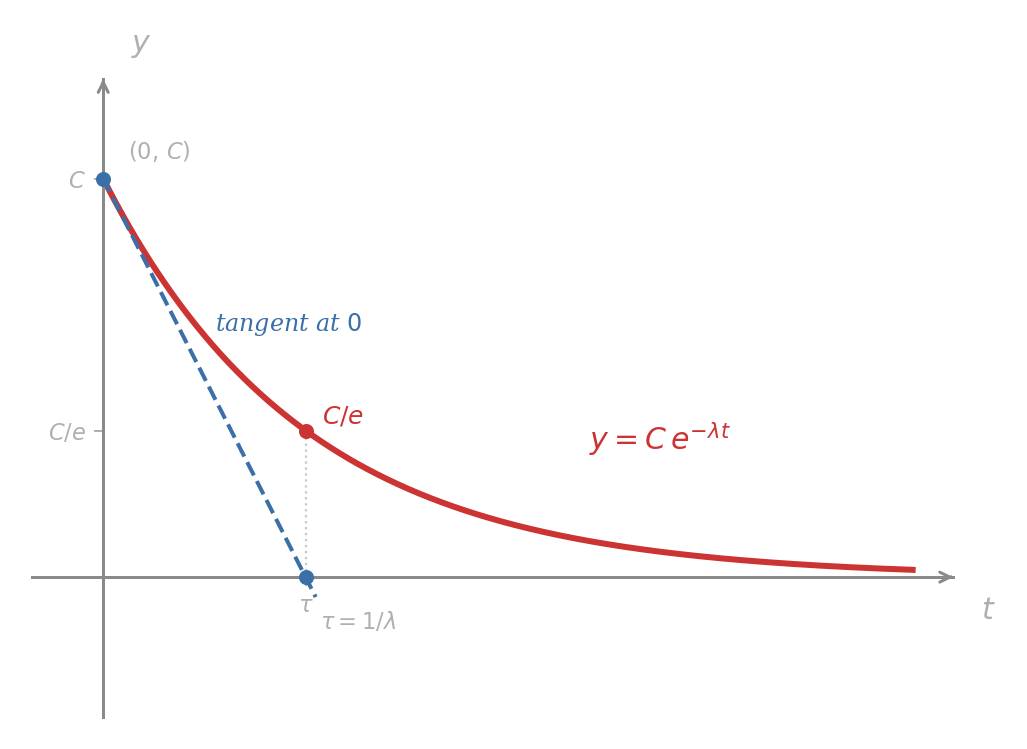
The curve at has height , while the tangent line is already at zero. Thus the time constant is the tangent-line intercept, not the actual time at which the decay reaches zero.
The relationship between and the half-life is one substitution:
The half-life is shorter than the time constant by the factor .
A clothing retailer’s monthly sales fall along the curve in the months following the end of a promotional campaign. In the last month of advertising, sales were units. Six months after the campaign ended, sales had fallen to units. Find the time constant and the half-life of the sales decay.
The reading at gives
Take logarithms of both sides; LII gives :
The time constant is
and the half-life is months. By month , sales have fallen to , the standard ” remaining” reading on a decay tangent.
Problem 7
A drug’s bloodstream concentration after intravenous injection follows , with in hours. The time constant for the clearance is hours.
- State in closed form.
- Compute the half-life of the clearance, in closed form involving .
- Compute the fraction of the initial dose remaining at , , and . Express each in the form for an integer .
Problem 8
A capacitor in an electronics circuit discharges so that its voltage satisfies for a fixed positive constant . Show, using only the formula for , that the fractional rate of discharge is constant in and equals . Hence any time interval of length multiplies the voltage by , regardless of where the interval starts.
Mixed-Rule Applications
The two functions below are useful test cases for the new rules. Each is one chain rule away from the tools of Lessons 5AM and 5PM.
The function is a Gaussian-shaped curve. Find , locate every critical number, and find every inflection point.
By the chain rule for exponentials with ,
The factor is strictly positive, so exactly when . The first derivative test applies: is positive for and negative for , so there is a relative maximum at . The maximum point is , and the maximum value is .
For inflection points, differentiate again. By the product rule on and ,
Since always, exactly when , that is, when . The sign of flips at each value, so by the inflection criterion the inflection points are and .
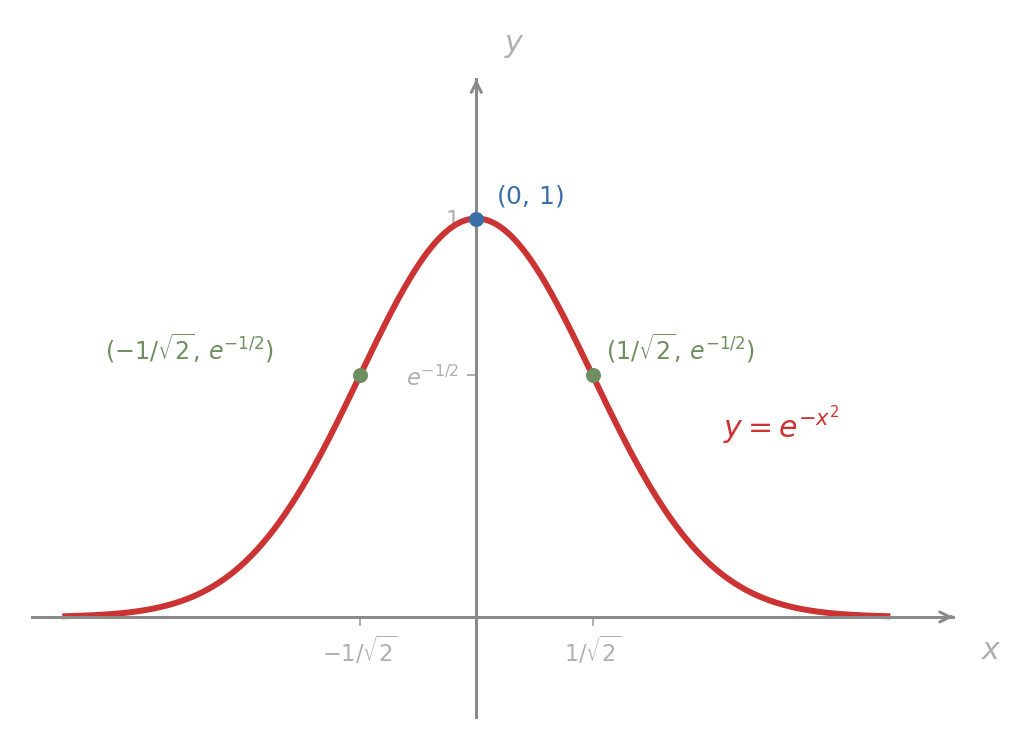
The calculus locates the two bending changes with one application each of the chain rule and the product rule.
The function is often called the softplus function. Show that for every real , and identify the asymptotic behaviour of as and as .
By the chain rule for with , ,
Both numerator and denominator are positive for every real , and the numerator is strictly less than the denominator, so .
For the asymptotic behaviour, factor out of the argument of the logarithm:
As , (Lesson 5AM, decreasing-curve case of with ), so . Therefore , so the graph approaches the line on the right. As , , so ; the horizontal line is the asymptote on the left.
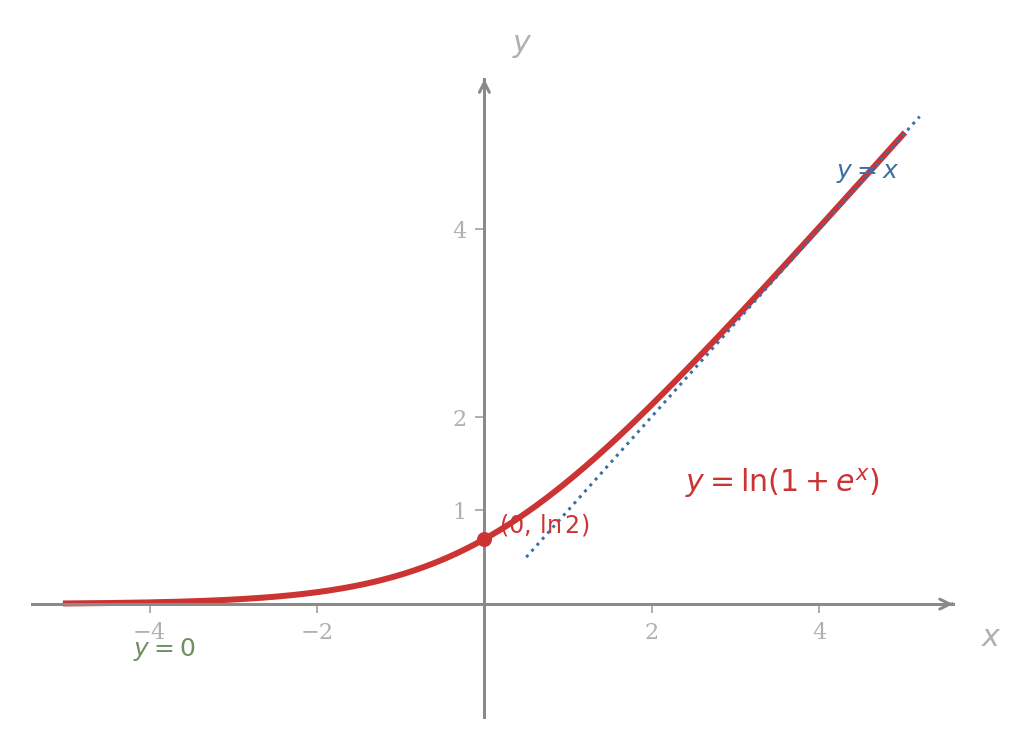
The softplus is a smooth replacement for the kinked piecewise function that equals for and equals for : it has the same limiting shape, but its derivative exists everywhere.
Problem 9
Differentiate. Each is one or two applications of the rules from Lessons 5AM and 5PM.
- , then factor .
- , simplifying as a single fraction.
- on . Split using LIII before differentiating.
- .
- . Simplify using LI and LIV first.
Problem 10
The sigmoid function is
Show by direct differentiation that
This identity expresses the derivative entirely in terms of .
Problem 11
For each of the following, find every relative extreme point on the indicated domain and classify it using either the first or the second derivative test.
- on the real line.
- on .
- on the real line.
- on .
Higher Derivatives
The derivative formulas and are stable enough under repeated differentiation to admit closed-form th derivatives.
Recitation 2 named the first two derivatives of a position function : the velocity and the acceleration . The pattern continues. The third derivative is the rate at which acceleration itself changes. For our purposes, higher derivatives are simply the functions obtained by differentiating more than twice.
The notation
means applying to a total of times. Thus gives , gives , and gives .
Find a closed form for the th derivative of .
By the product rule,
Differentiating again,
and once more,
Each application of the product rule introduces a new from the derivative of the polynomial factor and leaves the polynomial part unchanged, so the constant term grows by each round. Differentiating by the product rule produces
so once the formula holds at level , the same product rule applied once more delivers it at level . The first three derivatives above start the chain at , and every subsequent level continues by the same one-step calculation:
Problem 12
For with constant , compute , , , and directly, identify the pattern, and write down the closed form for the th derivative
together with a one-line argument that differentiating once more produces , so each level forces the next. Use the formula to compute the third and fourth derivatives of at .
Problem 13
Find the th derivative of on , for . Compute the first four derivatives, identify the pattern, and express the closed form using , a factorial of , and a power of . Here means the product , with .
Problem 14
For , compute , , and , factoring the polynomial part each time. Predict from the pattern, then differentiate to verify.
Exercises
Exercise 1
A bacteria culture grows so that and , with .
- Find in closed form involving .
- Find the doubling time of the culture, in closed form. Verify it equals hour.
- Predict in closed form, leaving the answer as a power of multiplied by .
Exercise 2
A radioactive isotope has half-life years. Working only from , show that:
- The fraction of the original mass remaining after years is exactly , for every positive integer .
- The time required for the mass to decay to of its original value is .
- The fractional rate of decay is the constant at every .
Exercise 3
The function is a line multiplied by a Gaussian-shaped factor.
- Find every relative extreme point of on the real line, and classify each.
- Determine the maximum value of and the points at which it is attained.
- Find every inflection point of , in closed form.
Exercise 4
A British investor places pounds in an account earning continuous interest at rate per year, so the balance is .
- Determine if the balance doubles in years; leave the answer in closed form.
- Using that , find the time at which the balance first reaches pounds, in closed form involving and .
- Compute the rate of growth at the moment the balance first reaches pounds, in closed form involving and .
Exercise 5
For the softplus :
- Compute and show that is concave up everywhere on the real line.
- Use the rewrite from the worked example to verify directly that as .
- Find every at which , in closed form. Compute at that point.
Exercise 6
A drug’s bloodstream concentration is modelled by
the same delay-then-decay family that appeared as a problem in Lesson 5AM.
- Find and locate the time at which the concentration peaks.
- Express the peak concentration in closed form in terms of , , and .
- Show that the peak time equals the time constant of the underlying decay . Interpret in one sentence.
Exercise 7
Let on , and let on . Differentiate each by logarithmic differentiation, then locate every critical number of and of in closed form. State, with reasons drawn from this recitation and Lesson 5PM, whether each critical number is a relative minimum, maximum, or neither.
Exercise 8
Find the th derivative of in closed form for constants and . Your formula should also work when . Verify it by specialising to to recover , and to to recover .