
The Exponential Function
Recitation 4 previewed the pattern that every tangent slope on is a fixed multiple of the slope at . The 15% investment, the doubling bacteria culture, and the decaying pile all share the proportionality , and the only quantity left to pin down is the slope of at . Once that slope is named, the derivative is forced everywhere.
Three differentiation rules from Lesson 4AM stand ready: the product rule, the quotient rule, and the chain rule. None of them apply to as written, because is not a polynomial, not a quotient of polynomials, and not a composition involving such pieces. The limit definition of the derivative from Lesson 2PM is the only tool that reaches it.
The Slope of at
Denote the slope of at by . By the limit definition from Lesson 2PM, applied at ,
Each value of produces a secant line through and , with slope ; as , the secant tilts toward the tangent.
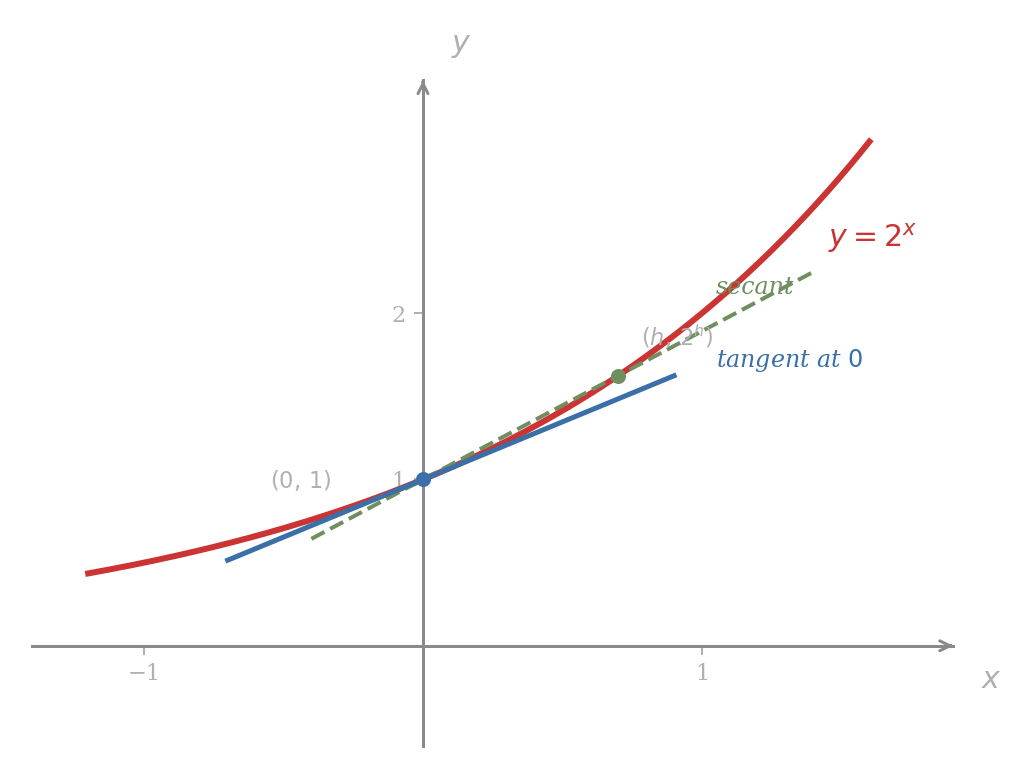
The right-hand side of has the indeterminate form at , and the algebraic moves available, namely the laws of exponents from Recitation 4, give no useful factorisation. The limit must be estimated numerically. Tabulating for :
The values stabilise at to five decimal places. The full proof that the limiting process converges belongs to the later analysis course; here we record the limiting value supplied by the table:
The same construction performed for would tabulate and stabilise near ; for , near . These values match the qualitative ranking visible in Recitation 4’s five-curve figure: larger bases give steeper exponential curves near .
The Derivative of at Every
The slope at propagates to every by Recitation 4’s structural observation. To turn that into a proof, run the limit definition at an arbitrary and use law (i) of Recitation 4 to peel off the .
By the limit definition,
Law (i) of exponents from Recitation 4 gives , so
Substituting into and pulling the constant outside the limit (the variable of the limit is , not ):
The unknown is the same constant from , the slope at zero, and it factors out of every other derivative computation involving . Compactly,
Compute:
- .
- .
By ,
The derivative eight units to the right is sixteen times the derivative one unit to the left, because . The function and its derivative grow in lockstep.
The argument that produced used only law (i) of Recitation 4, the exponential add-then-multiply identity. Replacing by any base leaves every step intact:
The slope at zero is base-dependent; the form of the derivative, function multiplied by a constant, is not.
Problem 141
Use together with the numerical values , , and to compute each derivative.
- .
- and .
- The ratio , simplified by cancellation of before any numerical work.
Problem 142
Tabulate at to confirm to three decimal places. Compare with the value of suggested by Recitation 4’s five-curve figure.
The Number
Equation is awkward because every base carries its own undetermined constant . The numerical experiments above show and . More detailed tables show that exactly one base between and has slope at . A full proof of this existence and uniqueness is part of real analysis; in MA0A we take it as the defining fact of the number below.
The number is the unique base for which
equivalently, the unique for which the graph of has slope exactly at .
To ten significant digits, . For most purposes, suffices.
Substituting into collapses the formula:
For every real ,
Equivalently, the function satisfies .
Geometrically, at every point on the curve the slope of the tangent line equals the height of the curve.
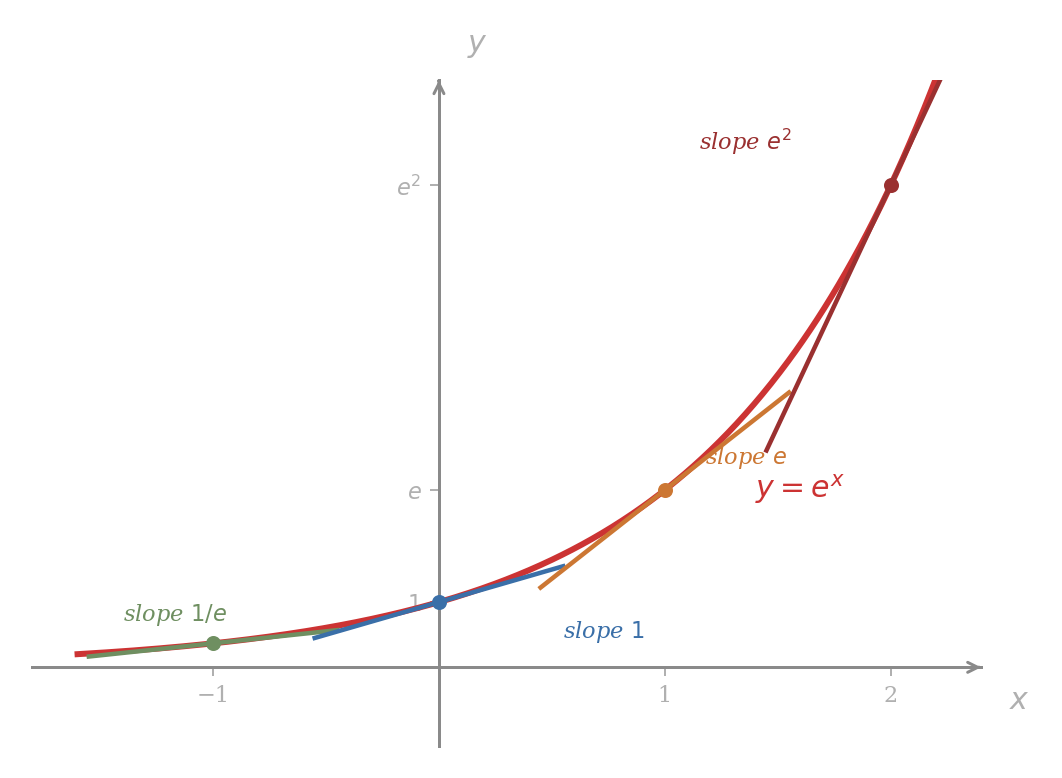
At , the height equals the slope. At , the height equals the slope. At , the height equals the slope. At , the height equals the slope.
Find the tangent line to at .
The point of tangency is . The slope is . Point-slope form gives
so .
The tangent line passes through the origin with slope . In rate-of-change language, near a small input change changes the output by approximately , and the tangent line is the linear approximation at that point.
Problem 143
Find the tangent line to at and at . In each case, state where the tangent line meets the -axis.
Problem 144
Show that the tangent line to at the point has -intercept . Conclude that, as varies, the foot of the tangent line slides along the -axis at the same rate as itself moves.
in the Toolkit
The derivative formula for , combined with the product, quotient, and chain rules from Lesson 4AM, differentiates every expression built from and the polynomial/rational pieces of earlier lessons.
Write each expression in the form for constants and .
-
.
-
.
The laws of exponents from Recitation 4 transfer unchanged to base .
- Square the inside, then collect:
So , .
- Pull law (iii) inside the square root, then law (iv):
So , .
Putting an expression in the form before differentiating makes the later derivative step short once the formula for has been established. Whenever a stack of ‘s appears with sums, products, or roots in the exponent, collapse it first.
Problem 145
Reduce each expression to the form and state and .
- .
- .
- .
- .
Differentiate:
-
.
-
.
-
By the product rule with and :
The factored form has a useful consequence. Since and for every , the derivative is non-negative everywhere, and zero only at . By the first derivative rule, is non-decreasing on the entire real line. The derivative does not change sign around , so the horizontal tangent there is neither a relative maximum nor a relative minimum. The product structure made this readable; expanding would have hidden it.
- By the quotient rule with and :
The numerator does not factor over the elementary tools from this course; the answer is left in the cleaned-up form.
Problem 146
Differentiate each function. Where the answer factors over the polynomial-times- family, factor it.
- .
- .
- .
- (write the denominator as first; the next section turns this into a one-line chain-rule problem instead).
via the General Power Rule
The function is an exponential with base , hence falls under the decreasing-curve case of Recitation 4’s graph discussion. By law (ii) of Recitation 4,
The general power rule (Recitation 2 / Lesson 4AM toolkit) with and inner function supplies the derivative directly, without yet introducing the chain rule for exponentials.
Differentiate .
Write . By the general power rule applied to the inner function , with :
The derivative of is . The function reproduces itself under differentiation up to a sign. Geometrically, the slope at every point on is the negative of the height. The curve falls everywhere, and its rate of fall scales with how far above the axis it currently sits.
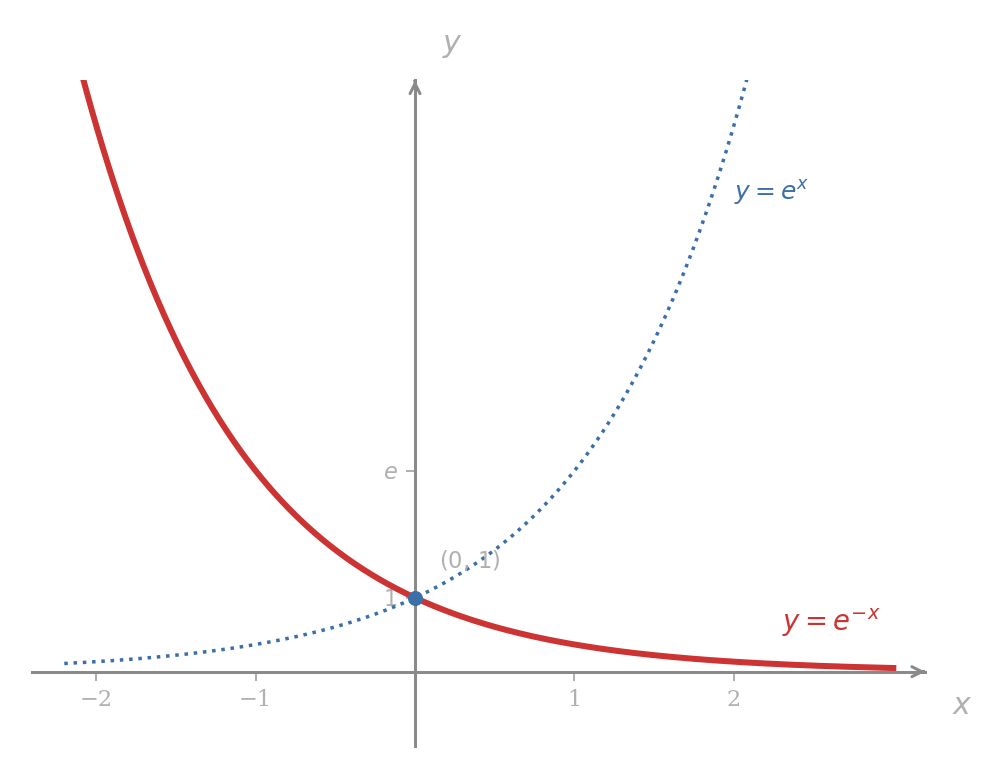
The solid red curve is the reflection of across the -axis, exactly as predicted by law (ii). Both pass through with slopes and respectively, mirroring each other.
Problem 147
Differentiate each function by the same trick: rewrite as a power of and apply the general power rule.
- .
- (write as ).
- .
- Compare answers (1) and (3); explain in one sentence why they are equal.
The general-power-rule manoeuvre runs out as soon as the exponent is anything more interesting than a constant times . For or , no choice of recovers the function. The chain rule is needed.
The Chain Rule for Exponentials
The composition is the outer function applied to the inner function . The chain rule applied to this composition uses the fact :
For every differentiable function ,
In Leibniz form with :
The rule says: leave the exponential expression in place, then multiply by the derivative of the inside. The exponential is the only outer function in this course that survives differentiation unchanged; for every other outer function, must be looked up separately.
Differentiate:
-
.
-
.
-
.
-
, . So
- , . So
- , . So
Part (c) generalises in one sentence: differentiating for any constant pulls a factor of out front. This is the formula that powers every applied use in this lesson.
For every constant ,
Differentiate:
- .
- , with constant.
- , with constants.
By the constant-multiple rule and the formula for :
-
.
-
.
-
.
Part (c) earns its own line because, writing ,
The function satisfies the rate equation (its own derivative is times itself) that opened the exponential section of Recitation 4.
Problem 148
Differentiate each function. Each is a one-line application of the formula for or its chain-rule generalisation.
- .
- .
- .
- .
- . Factor the answer; identify every at which .
Problem 149
A drug’s bloodstream concentration after hours is modelled by
- Use the product rule and the formula for to find , factoring fully.
- Find the time at which the concentration peaks, and compute the peak value.
- By the first derivative test, classify the critical number you found in part (2). State on which intervals the drug is being absorbed faster than it is being eliminated, and on which it is being eliminated faster than it is being absorbed.
The Equation
Equation produced solutions of the proportionality from formulas of the form . The converse, that every solution looks like this, is the content of the theorem below.
A differential equation is an equation expressing a relationship between an unknown function and one or more of its derivatives. A solution is any function that satisfies the equation when substituted in.
Let be a constant. The differentiable functions on the real line satisfying
are exactly the functions of the form
where is an arbitrary constant.
Specifying any single value determines uniquely.
One direction. If , then by the formula for and the constant-multiple rule, . The substitution checks.
Other direction. Suppose is differentiable and satisfies . Define a new function
By the product rule applied to and , with :
The hypothesis makes the bracket zero. Hence for every .
A standard consequence of the derivative theory is that a differentiable function whose derivative is zero at every point of an interval is constant on that interval. Applying that fact on the real line, is constant. Call the constant . Then for every , and unwinding the definition of gives
The single initial condition forces , hence , a unique value.
■The proof’s main move is the substitution , which extracts the exponential factor through a single derivative computation. The same idea, divide the unknown function by a candidate solution and check that the quotient is constant, reappears in later differential-equation problems.
Find every function such that .
The equation has the form with . By the solutions theorem above,
For these are decreasing exponentials. For the solution is the zero function, and for the graph lies below the axis and increases toward .
Find such that and .
The equation is with , so . The initial condition gives
so and
The general family from the solutions theorem has one free parameter ; one data point fixes it.
- Read off the equation .
- Write the general solution .
- Plug in the initial condition to solve for .
- Substitute back to obtain the unique solution.
Recitation 4’s exponential scenarios, the 15% investment, the doubling bacteria culture, and the decaying pile, each fit the solutions theorem with a different value of .
A bacteria culture in a Petri dish grows so that its population satisfies , with measured in hours. The initial population is . Find and express the time at which the population first reaches in terms of the doubling time.
By the solutions theorem, . The initial condition gives , so
The population reaches when , that is, . Without logarithms, the equation can be reduced as follows. The population-doubling time satisfies , so . By the injectivity of from Recitation 4, , so .
The numeric value of requires a tabulation of until the entry first appears. The structural answer is that the population first reaches four times its initial value at exactly twice its doubling time.
Problem 150
A radioactive sample has mass in grams at time years, satisfying . Initially grams.
- Write explicitly using the solutions theorem.
- Express the half-life , the time at which , by the equation , and explain why no further elementary simplification is possible with the tools introduced so far.
- Use the injectivity of to compute, in terms of , the time at which only one-eighth of the original sample remains.
Problem 151
An investment of pounds at continuously compounded annual interest rate has balance satisfying with .
- Write .
- Compare two investments at the same time , one at rate and one at rate . Show that the ratio of the two balances is , while the ratio of their time-rates of growth is . Conclude that the faster investment is growing more than twice as fast for every , and that its balance is more than twice as large once exceeds the unique time for which . Leave as the solution of .
- Two investors start with the same principal at the same time. One earns rate , the other earns rate . Show that the first investor’s balance at time equals the square of the second investor’s balance divided by for every . Set up the two balances, reduce both sides to a single by laws of exponents, and conclude by inspection.
Functions
The formula for plus the solutions theorem set up the family as the standard language of proportional rates of change. Two qualitative regimes appear depending on the sign of .
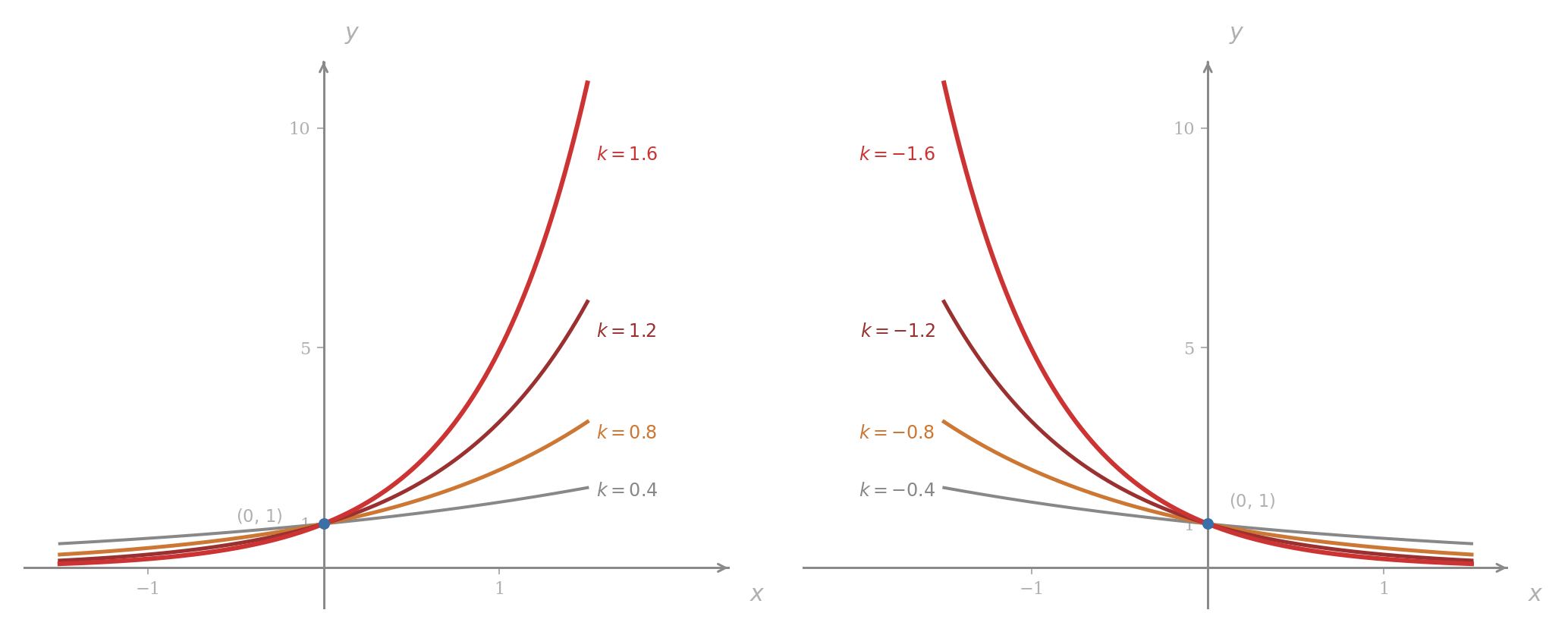
For (left panel), every curve shares four features:
- The graph passes through , since .
- The graph lies strictly above the -axis: for every real and every real .
- The -axis is a horizontal asymptote as , as seen from the graph of exponential decay in Recitation 4.
- The graph is increasing and concave up. The formula for gives and .
For (right panel), the same four facts hold with one reversal:
- The graph passes through .
- The graph lies strictly above the -axis.
- The -axis is a horizontal asymptote as , as seen from the graph of exponential decay in Recitation 4.
- The graph is decreasing and concave up. Now but .
The graph is concave up in both regimes because depends on only through . The exponential family is concave up for every nonzero .
Problem 152
For each function below, identify and state whether the curve is increasing or decreasing. Confirm that everywhere by computing explicitly.
- .
- .
- .
- .
Every Is an
The opening computation reduced to with an undetermined limit. The formula for reduces to with free. The two formulas agree if and only if can be rewritten as for the right .
The graph of is strictly increasing, stays positive, approaches on the left, and grows without bound on the right. We use the standard exponential fact, visible in that graph, that takes every positive value exactly once. So for every base there is a unique real number with
Once is named, law (iv) of exponents from Recitation 4 supplies the rewrite:
For every base , there is a unique constant such that
The constant is the unique solution of .
Consequently,
where is the same constant.
The undetermined constant from is forced to coincide with . The numerical experiments at the start of the lesson, , , , are exactly the values of for which respectively. Without logarithms, this lesson cannot compute algebraically; the existence of , however, is enough to bring every inside the chain-rule machinery.
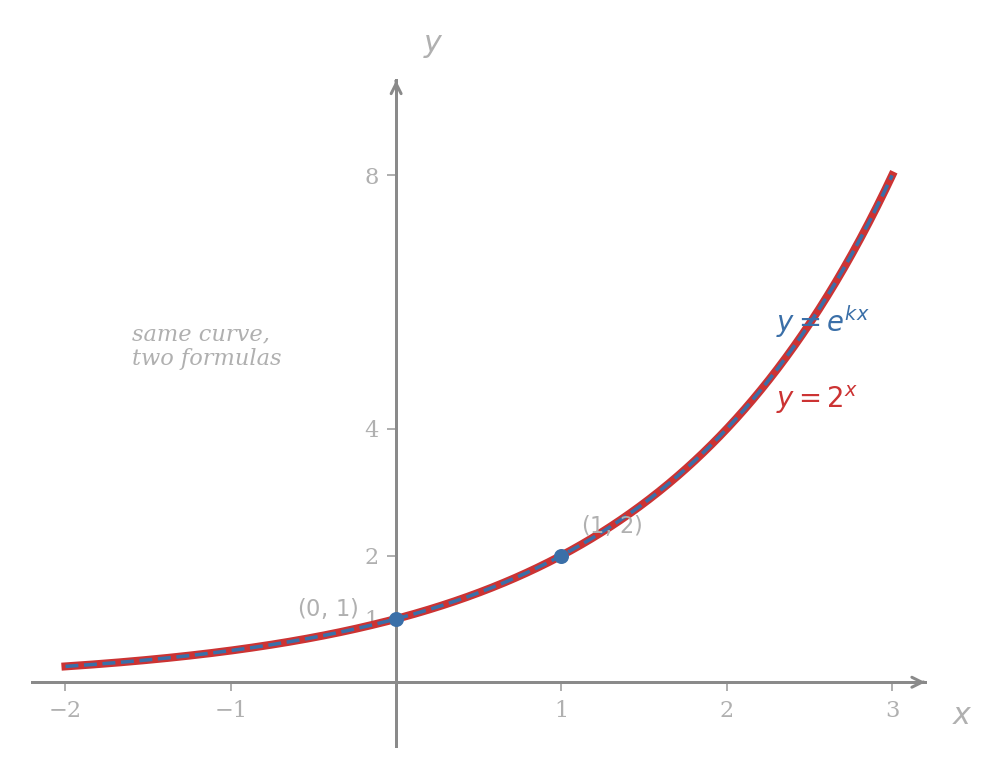
The two formulas and , with , draw the same curve. The choice between them is one of bookkeeping: slots into the chain rule and the differential equation without any leftover constants; stays close to the original problem statement.
Differentiate using the reduction theorem, and compare with the result of .
By the reduction theorem, where is the unique constant with . By the formula for ,
Comparing with equation , , the constant from the limit-table calculation must equal the from the rewrite: , where . The two derivations describe the same number through different machinery.
Problem 153
Recitation 4 modelled a British investor’s account balance as pounds.
- Use the reduction theorem to write for the unique with .
- State both as and as . Identify the proportionality constant in the rate equation .
- Without computing numerically, explain why : since and is increasing, the unique input with must lie between and .
Problem 154
A bacteria culture grows according to , so the population triples each unit of time.
- Use the reduction theorem to rewrite as for some .
- Write the rate equation that satisfies, with left as the unique constant satisfying .
- Numerically, from the slope-at-zero table earlier in this lesson. Compute and when .
Problem 155
Let , , and let be the unique constant with . Show that the function has a single critical number, and locate it. Use the first derivative test to classify the critical point. Then prove that, at that critical , the height of is the negative of the height of .
| Rule | Form |
|---|---|
| Derivative of | |
| Chain rule for | |
| Derivative of | |
| Solutions of | , arbitrary |
| Reduction of | where |