
Implicit Differentiation and Related Rates
Lesson 4AM closed with the chain rule and a small toolkit for time rates of change: pick an inner variable that depends on , an outer quantity that depends on the inner variable, and multiply the two derivatives. Every example there shared a structural feature — the relationship between the variables was given by an honest function, , , and so on. The slope formula came out of differentiating that function once.
Plenty of curves in geometry and economics are not given as a function. The circle assigns two values of to most in , and so fails the vertical-line test from Lesson 1AM. The production isoquant that an economist scrawls on a board is a curve in the plane, but solving for algebraically is rarely what one wants to do. These equations implicitly define a relationship; the question is whether the slope of that relationship can be read off without first untangling from .
The chain rule (already in hand) handles the job, and it lets us answer two different questions about the same equation. Treating as an unknown function and differentiating with respect to produces a linear equation in , solvable by ordinary algebra. Treating both and as unknown functions of a third variable (typically time) and differentiating with respect to produces a linear equation in and , expressing the related rates of two quantities tied together by the curve. The first half of this lesson develops the static slope picture; the second half upgrades it to motion.
Curves That Aren’t Function Graphs
Consider the circle
Its graph (Fig. 1) is the set of points two units from the origin. Because there are two points with -coordinate , namely and , the relation is not the graph of any function .
Locally, however, it behaves like one. Stay near : the upper half of the circle close to that point is the graph of , a perfectly good function on . Stay near and the relevant local function is . Wherever the tangent line is not vertical, the curve looks like a function graph in a small enough neighborhood, and the slope of the curve at is the slope of that local function at . Standard notation isolates the point at which the slope is read:
Both coordinates appear because, on a curve like the circle, the slope at is ambiguous until we say which of or we mean.
An equation is said to define implicitly as a function of near a point on the curve if there is a function , defined on an open interval around , such that and for every in that interval. The slope is the derivative .
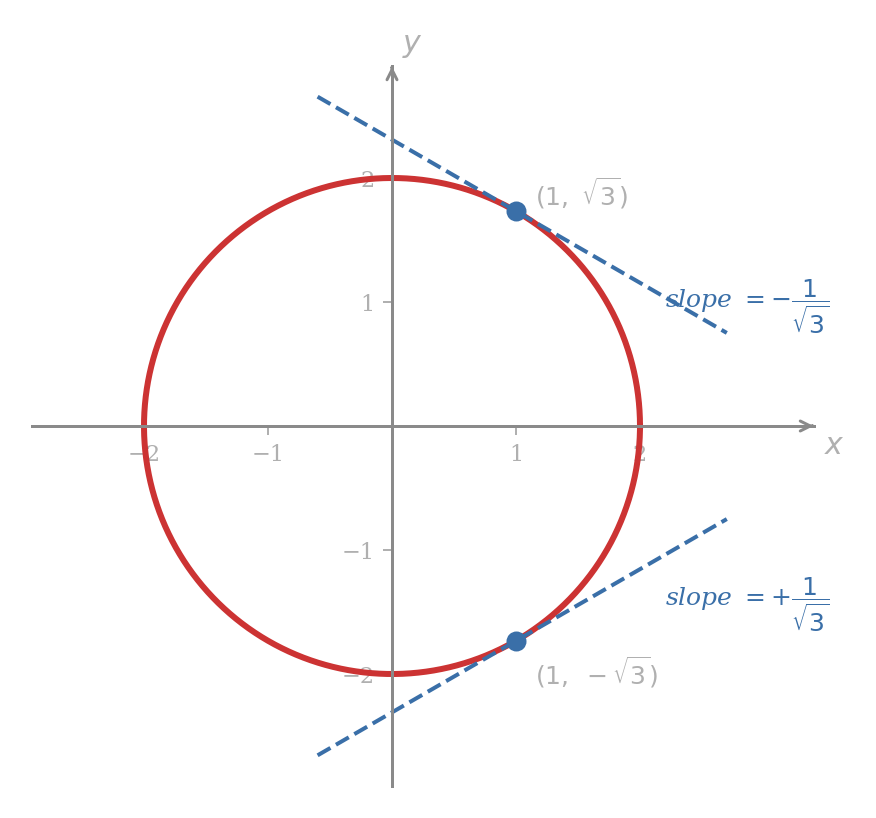
The figure shows the two tangent slopes that this lesson is about to compute. Throughout, we assume the equation in question implicitly defines a differentiable function near every point we sample; the points where this fails (the leftmost and rightmost points of the circle, where the tangent is vertical) appear as the points at which the slope formula divides by zero.
The Implicit Differentiation Move
Treat as an unspecified differentiable function of , write in your head, and apply the chain rule whenever a power or composition of is differentiated. Every other rule from the toolkit table at the end of Lesson 4AM applies as before.
The single new pattern is this: differentiating with respect to is not the same as differentiating it with respect to . The general power rule, with playing the role of the inner function, gives
Substituting and yields the working form.
If is a differentiable function of and is a constant for which makes sense at the point in question, then
Set and . The composition is differentiated by the chain rule of Lesson 4AM:
The last equality only restates and .
■The factor is the bookkeeping that distinguishes a -power from an -power: an -power gets no such factor because . Forgetting it is the single most common error, and every implicit differentiation in the rest of this lesson contains at least one application of .
A First Slope: The Circle
Use implicit differentiation to find for the circle from . Then evaluate the slope at the points and .
Differentiate both sides of with respect to . The left side splits by the sum rule. The first piece has derivative as usual. The second piece is a power of , so by ,
The right side, the constant , has derivative . Thus
Solving for when ,
Dividing both sides by gives
Equation depends on both coordinates, which is exactly right: the slope at is genuinely two-valued on the circle, and the formula resolves the ambiguity by asking for as well.
At :
At :
The two slopes are negatives of each other; geometrically, the upper and lower tangents reflect across the -axis, and their slopes flip sign. The slope formula fails at the points because the denominator vanishes there; those are precisely the two points at which the tangent is vertical and the slope is undefined.
The same answer is obtained, with more work, by solving for on each half of the circle and differentiating the explicit formula. On the upper half , the chain rule gives
The implicit answer contains both halves at once. Two cases collapse into one expression — that is the structural payoff.
Find the tangent line to the circle
at the point .
The slope formula from gives
The tangent line is the line through with this slope, so the point-slope form is
If desired, multiply through by to remove the fraction:
or equivalently
The final form has a geometric reading: the radius from the origin to has slope , while the tangent slope is , so the radius and tangent are perpendicular.
Problem 127
For the ellipse :
- Use implicit differentiation to find .
- Compute the slopes of the tangent lines at and . Confirm they are negatives of each other and explain why geometrically.
- Locate the points at which the tangent is horizontal and the points at which it is vertical, by reading off when the numerator and denominator of vanish.
Products, Sums, and Mixed Terms
Two short examples cover the rest of the technique. Whenever multiplies , the product rule applies; whenever is raised to a power, applies; and the two combine without surprises.
Use implicit differentiation to compute for .
Differentiate each side with respect to . The left side is a product, so the product rule supplies
The first is a power of , evaluated by with , giving . The second is the ordinary power rule, giving . The right side has derivative . Combining,
Move the term without to the right and divide by the coefficient of :
Dividing both sides by and simplifying,
Provided and — both forced by the original constraint — the slope is given by a tidy ratio. No part of the calculation required isolating as a function of .
Use implicit differentiation to find when .
Differentiate term by term. Both and are products and need the product rule. The term contributes , and the constant contributes :
That is the entire calculus content of the calculation. What remains is algebra: collect on the left, send everything else to the right, and divide.
Step 1 — keep the terms together:
Step 2 — factor out :
Step 3 — divide by the coefficient:
The answer mixes and , just as did for the circle. The original equation does not factor; the slope formula is forced to depend on both coordinates because the curve does.
Three of these calculations are enough to pull out the procedure that runs them all.
- Differentiate every term of the equation with respect to . Use the product rule for any term that contains both and as factors. Use for any pure power of .
- Move every term containing to one side and every term without it to the other.
- Factor out of the side it lives on.
- Divide by the factor that multiplies .
The end product is a formula for in terms of and . To evaluate the slope at a specific point, substitute both coordinates of that point.
Problem 128
Find for each curve and state the points (if any) at which the formula breaks down.
- .
- .
- .
- .
Problem 129
The curve is an elliptic curve (a class central to modern number theory and cryptography).
- Use implicit differentiation to express in terms of and .
- The point lies on the curve. Find the equation of the tangent line at .
- Find every point on the curve at which the tangent is horizontal.
Problem 130
Two curves are orthogonal at a point of intersection if their tangent lines there are perpendicular — equivalently, if the product of their slopes is . Show that the family of circles () and the family of lines () are orthogonal at every point where they cross. Use implicit differentiation on the circle and explicit differentiation on the line.
Problem 131
Consider the curve
- Show that for every real , equation has exactly one real solution . (Hint: the function is strictly increasing for every real — verify with its derivative — and takes every real value, so it is invertible.) Conclude that defines implicitly as a function of at every real .
- Use implicit differentiation to find in terms of and .
- Show that for and for , and identify the unique point on the curve at which . Tie the sign-change picture to the symmetry of equation .
Production Isoquants and the Marginal Rate of Substitution
Two production inputs — labor and capital , say — combine through a Cobb–Douglas technology to produce a fixed level of output. Holding the output constant traces out a curve in the -plane called an isoquant: every on the curve produces the same total. The slope of the isoquant tells the firm how much of one input must be sacrificed to gain one extra unit of the other while keeping output unchanged.
A production process satisfies
where and are the amounts of two basic inputs and is the fixed output level. Find the slope of the isoquant at the point , and interpret the answer economically.
Differentiate with respect to . The left side is a product of and , so the product rule gives
The two derivatives:
Substituting,
which tidies to
Dividing,
Plugging in :
The economic reading is direct. Increasing input by one unit while staying on the isoquant requires decreasing input by approximately unit, since the slope is negative. The absolute value is the marginal rate of substitution of the first input for the second. It depends on the current mix : at higher levels of relative to , the curve is steeper and a small extra unit of frees up more .
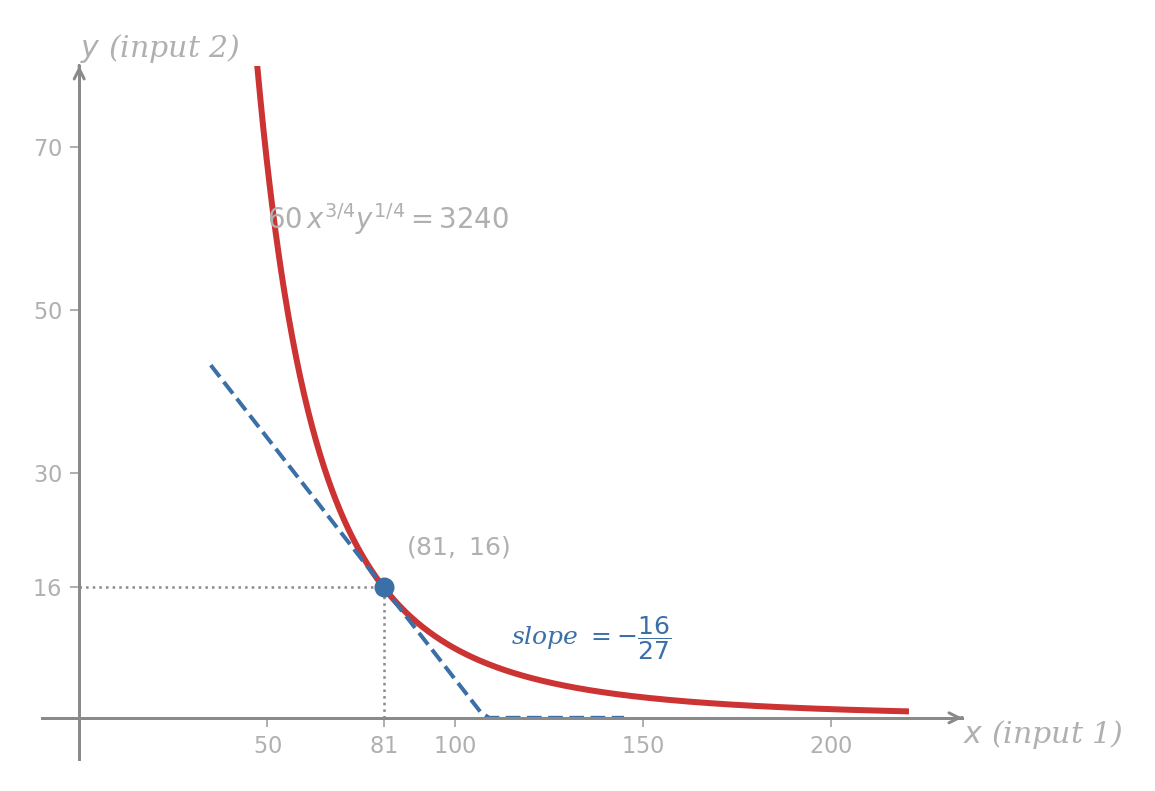
The curve slopes down everywhere — increasing one input lets you reduce the other — and is convex toward the origin. Convexity has a direct economic translation: replacing each unit of input requires more and more of input as becomes scarce, exactly the diminishing-returns behavior the Cobb–Douglas exponent split is designed to capture. The slope formula encodes this. As falls and rises along the isoquant, the ratio shrinks, so shrinks — each additional unit of buys back less and less of .
Problem 132
A bakery’s daily output (in dozens) of bread depends on flour (in kilograms) and oven-hours via the Cobb–Douglas relation
- Use implicit differentiation to find as a function of and .
- Compute the marginal rate of substitution at and interpret in plain English.
- Confirm part (1) by solving the equation explicitly for and differentiating, and check that the two answers agree on the curve.
Problem 133
A consumer’s preferences are summarized by the indifference curve
where is the quantity of one good and is the quantity of another. Use implicit differentiation to compute and find the marginal rate of substitution at the bundle . State, in plain English, what the answer says about the consumer’s willingness to swap goods.
A Curve from the 17th Century
Implicit differentiation is older than the limit-based theory of derivatives. Descartes communicated the curve below to Fermat in 1638, asking for its tangent at a non-trivial point, and the answer is a single line of implicit differentiation today.
The folium of Descartes is the curve
Find in terms of and , and use it to determine the slope at the point .
Differentiate with respect to . The left side is a sum, so each term yields its own derivative; uses . The right side is a product:
Cancel the common factor :
Move terms to one side:
Factoring out gives
Therefore
At :
The tangent at has slope , which agrees with the symmetry of the curve under the swap : the line is an axis of symmetry, and the tangent at any point on that axis must be perpendicular to it, hence slope .
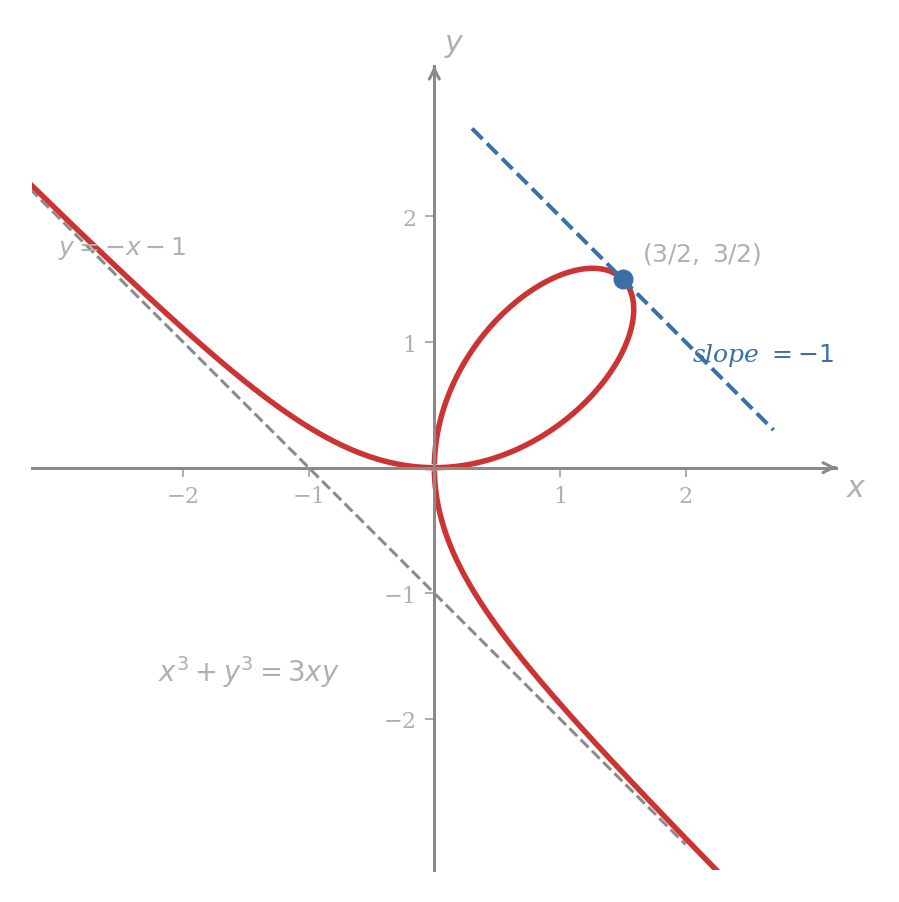
Two structural features of the folium are visible in the picture and explained by . The numerator vanishes when , giving horizontal tangents; the denominator vanishes when , giving vertical tangents. The point is special — both vanish at once, so degenerates to there and the curve has two distinct tangent directions through the origin (visible in the figure as the curve crossing itself).
Problem 134
For the folium :
- Find every nonsingular point on the curve at which the tangent is horizontal. Combine the equations (numerator zero) and , excluding the origin for now.
- Find every nonsingular point at which the tangent is vertical, by combining with the curve equation, again excluding the origin for now.
- The point is on the curve. Substitute to find the non-vertical tangent direction at the origin, then use symmetry or substitute to find the vertical tangent direction. State the two tangent lines.
Problem 135
The lemniscate of Bernoulli is the curve
- Use implicit differentiation to find .
- The point lies on the lemniscate (verify). Find the slope of the tangent line at and write the equation of that tangent in point-slope form.
Problem 136
The circle and the parabola intersect at the points — verify by substituting.
- Use implicit differentiation on the circle and the power rule on the parabola to find both tangent slopes at .
- Two curves are orthogonal at a common point if their tangent slopes there satisfy . Decide whether the circle and the parabola meet orthogonally at .
- Without further computation, state the corresponding result at , citing the symmetry shared by both curves.
Related Rates
In the work so far, has been a function of . In many applications the natural independent variable is neither — it is time. A point traces an ellipse as advances; a market drifts along a demand curve as the price slowly slips; a chemical reaction moves a system along a constraint surface in concentration space. In each case, and are both functions of , neither is given by a formula, and the only relation we have is an equation in and that holds at every instant.
The same chain rule that powered implicit differentiation handles this. Differentiating an equation with respect to , and treating and as unknown functions and , produces a linear equation in the two rates and . The equation says nothing about the size of either rate on its own — both can be large or small — but it constrains how they relate. Hence the name: and are related rates.
The single bookkeeping change from earlier in the lesson is what plays the role of in . Now that the independent variable is , the chain rule applied to and gives
and the product rule applied to gives
Both and now generate their own derivative factor, because both depend on .
The variables and are both differentiable functions of that satisfy
at every instant.
-
Differentiate with respect to and solve for .
-
Evaluate at the moment when , , and .
-
Differentiating each term of with respect to , the chain rule supplies one factor of for the term and one factor of for the term:
Solving for (whenever ),
- Substituting , , and :
At this instant, the point is moving so that its -coordinate is decreasing at units per unit time while the -coordinate is increasing at units per unit time. The signs encode direction along the curve.
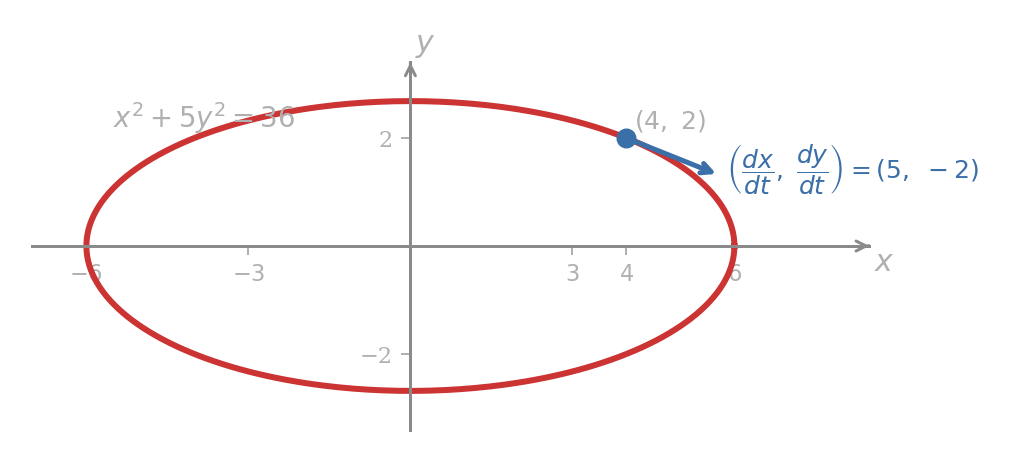
The figure shows the ellipse with the velocity vector at . The vector points down-and-right because the point is in the upper half and moving clockwise; the slope of the velocity vector, , equals at from the static implicit-differentiation calculation: differentiating with respect to gives , so at . The static slope and the related-rate ratio are not independent calculations; the related rate at any instant equals the slope times the rate of horizontal motion:
This is the chain rule in its bare form, and it is the conceptual fact that makes related rates related rather than free.
A commodity sells at the rate of thousand units per week when the unit price is pounds. The price–quantity pair satisfies the demand equation
At a moment when , , and the price is falling at the rate of £0.40 per week, find the rate at which weekly sales are changing.
Treat and as differentiable functions of . Differentiate with respect to , applying the product rule to the term:
Equation is a linear equation in the two rates. Two routes are available: solve symbolically for first, or substitute the given values now and solve the numerical equation. The values are concrete, so substitution first is faster:
The weekly sales rate is increasing at thousand units per week per week, equivalently 250 units per week each week, at the moment the price is at £6 and falling at £0.40 per week.
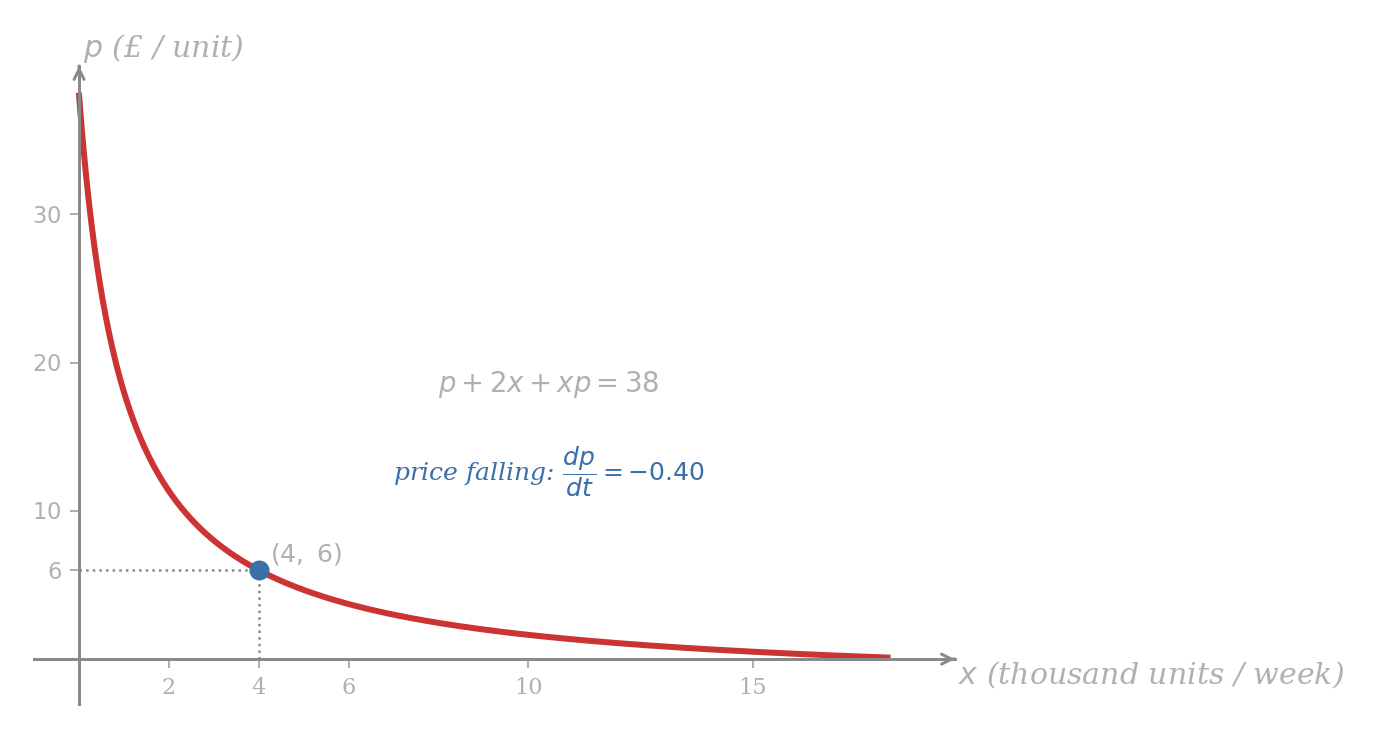
The economic reading of the answer comes from the sign and magnitude. The price drop pulls the market downward along the demand curve from toward larger . The chain rule converts the price rate, in pounds per week, into a quantity rate, in thousand units per week. Because the demand curve’s slope at is (verifiable by implicit differentiation of ), the conversion factor is , giving , matching the calculation above.
A related-rates problem typically arrives in plain English with a geometric or economic configuration. Five steps turn it into the algebra of .
- Sketch the configuration. Label every quantity that varies; do not label fixed numbers as variables.
- Name the variables and pick the independent one. Usually . Decide which of the named quantities are functions of and which are constants of the problem.
- Find one equation that relates the variables. Geometry, the demand law, the gas law — whatever ties the named quantities together at every instant.
- Differentiate the equation with respect to . Apply the chain rule to every power of a -dependent variable; apply the product rule to every product of two -dependent variables.
- Substitute the known values and solve for the unknown rate. Substituting before solving is usually faster than solving symbolically and substituting at the end, unless the same problem is asked at multiple instants.
The temptation to plug in numbers before differentiating is the single most common error in related-rates problems. Numerical values are true only at one instant; the differentiated equation must describe motion at nearby instants too.
For example, if a circle has radius at one moment, replacing by before differentiating would make look constant and would incorrectly give . Keep the variables as variables, differentiate the relation, and only then substitute the data for the particular instant.
Problem 137
A ladder meters long leans against a vertical wall. The bottom of the ladder slides away from the wall at a rate of meters per second. Let be the distance from the wall to the foot of the ladder and the height of the top of the ladder above the ground.
- State the equation that relates and at every instant. Differentiate it with respect to and solve symbolically for in terms of , , and .
- Find at the moment when meters. Interpret the sign.
- Show that, as the foot of the ladder approaches , the rate approaches . Tie this to the geometric statement that the top of the ladder hits the ground at .
Problem 138
Pollution flows into a circular pond at a steady rate of cubic meters per second, spreading uniformly so the surface remains a circle of constant depth meters. Let denote the radius of the spill in meters at time in seconds.
- Express the volume of polluted water as a function of alone, using the constant-depth assumption.
- Use the chain rule to relate to .
- Find at the instant the radius is meters. Confirm that the rate decreases as grows, and explain in plain English why the spreading slows even though the inflow is steady.
Problem 139
The price (in pounds) and weekly sales (in thousands of units) of a commodity are tied by the demand equation
At a particular moment, , , and the manufacturer is raising the price at pounds per week.
- Differentiate the demand equation with respect to and solve symbolically for in terms of , , and .
- Compute at the given instant. State, in plain English, whether sales are rising or falling and by how much.
- The total weekly revenue is (in thousand pounds). Use the product rule to compute at the same instant. Tie the answer to the time-rate machinery from Lesson 4AM.
Problem 140
A spherical balloon is being inflated so that the surface area increases at square centimeters per second, where . The balloon’s volume is .
- Differentiate with respect to and write in terms of and .
- Use the chain rule to find in terms of and alone (eliminate ).
- Compute when centimeters. Compare with the corresponding calculation in Lesson 4AM’s A balloon inflating example, where the input was rather than .
Problem 141
A boat is being pulled toward a dock by a rope passing over a pulley fixed meters above the water level at the dock. The rope is reeled in at a steady meter per second, where is the length of rope from the pulley to the boat (negative because the rope is shortening). Let be the horizontal distance from the boat to the dock, with .
- Use the right triangle formed by the rope, the pulley height, and the horizontal distance to write the relation . Differentiate with respect to and solve symbolically for in terms of , , and .
- Find at the moment the boat is meters from the dock.
- Show that as from the positive side. Reconcile this with physical reality: the boat does not actually accelerate to infinite speed at the dock, so where does the model break down?
Why It Works
Implicit differentiation has been used in this lesson without a separate justification, because there isn’t one to give beyond the chain rule of Lesson 4AM. A short derivation makes the reliance explicit.
Suppose an equation implicitly defines a differentiable function on an interval, in the sense of the Implicit function definition above. Substitute into the equation:
The left side is a function of alone, and it is the constant . Differentiate both sides with respect to . The right side gives . The left side, being a composition of with the pair , gets differentiated by the chain rule, producing a linear equation in the unknown .
Concretely, every term of that contains alone or in a product with contributes a when differentiated, via the rule applied to powers of and the product rule applied to products. Every term containing only contributes nothing involving . Collecting and solving for — the move named Step 2 through Step 4 of the procedure — completes the calculation.
■The full statement of the implicit function theorem — which says exactly when an equation defines as a differentiable function of near a given solution — is a multivariable result and is left to a later course. For every example in this lesson, the relevant condition holds at every point we sample, and the procedure above produces the slope.
The related-rates version uses the same machinery. If and are differentiable functions of that satisfy at every instant, then differentiating both sides with respect to gives a linear equation in and . Each -power and -power in contributes a chain-rule factor; each product contributes a product-rule pair. If is nonzero, dividing the related-rates equation by turns it back into the static slope equation for . There is no new content, only a different read of the same equation.
Problem 142
A spherical mirror is described by the equation in three dimensions. Holding fixed traces out the latitude curve at that height. Use implicit differentiation on the latitude curve to find , evaluate it at , and state the result as a tangent direction in the plane .
Problem 143
A market’s demand and supply equilibrium for a luxury good is modeled by
where is the unit price in pounds and is the quantity sold per week. The curve traces the locus of -pairs at which the market clears.
- Use implicit differentiation to find in terms of and . (Note the role swap: now is the independent variable.)
- The pair lies on the curve. Compute and interpret it as a marginal sensitivity in plain English.
- State, without further computation, the value of at the same point, by reciprocity.
Problem 144
For the curve :
- Find by implicit differentiation.
- Find the second derivative at the point , by differentiating your answer to part (1) implicitly a second time and substituting both and the coordinates.
- Use the sign of at to say whether the curve is concave up or concave down at that point. Tie the result to the Concavity discussion of Lesson 3AM.