
Differentiation Techniques: Product, Quotient, and chain rules
The differentiation rules from Lesson 2PM and Recitation 2 — power, sum, constant multiple, general power — handle every polynomial we wrote down in Lesson 3. They run out the moment two functions are multiplied together, divided by one another, or composed in a way not already covered by the general power rule. Three expressions flag the gap:
The first is a product, the second a ratio, the third a composition. Brute expansion of has many terms, and the answer we want, , factors back into a clean form anyway. Re-writing as turns the ratio into a product but does not remove the need for a product rule. The expression can be handled by the general power rule because the outside function is a half-power; the full chain rule explains why that same outside-inside pattern works beyond powers.
This lesson develops three rules in turn: the product rule for expressions like , the quotient rule for expressions like , and the chain rule for expressions like . The chain rule turns out to be the umbrella under which the general power rule and the quotient-rule proof both sit; once it is in hand, every expression built from finitely many sums, differences, products, quotients, and compositions of differentiable elementary pieces is itself differentiable.
When the Naive Guess Fails
The sum rule stated that the derivative of a sum is the sum of the derivatives. A natural reflex is to try the same for products: guess that . A single counterexample buries the guess.
Take and . Their product is , and the power rule gives
The naive guess gives . Not even the same degree. Whatever the correct rule is, it must mix , , , and in a more substantial way.
The rectangle picture below explains why. If and are the side lengths of a rectangle, then the product is its area. Increase slightly, so that grows by and grows by . The new area decomposes into four rectangles: the original , a thin top strip of area , a thin right strip of area , and a tiny corner of area .
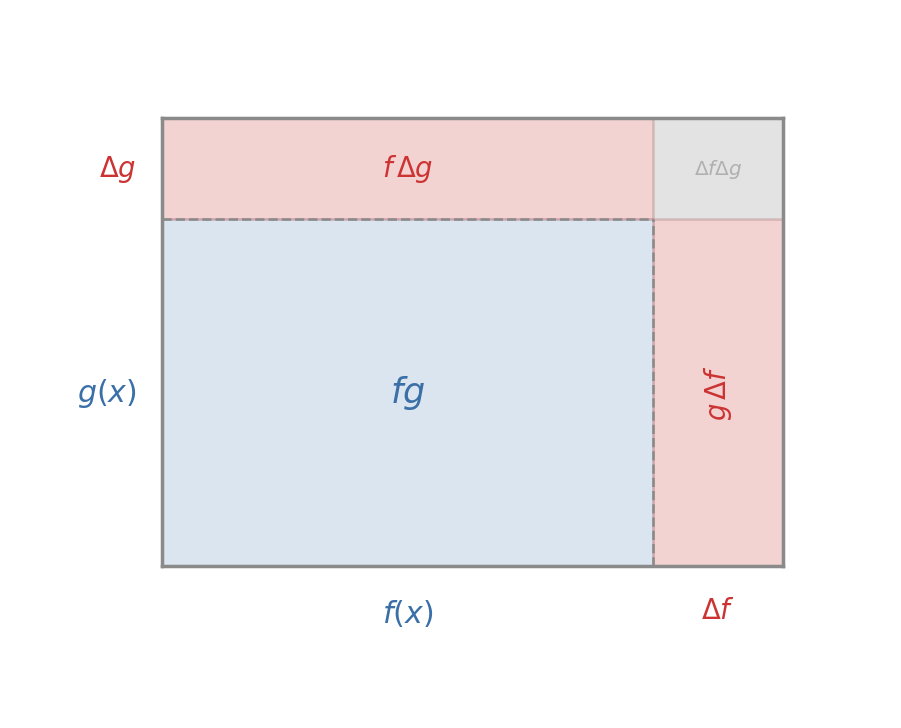
The change in area is . Dividing by the change in input and letting , the corner term carries an extra factor of and vanishes, leaving exactly . The naive guess corresponds to the corner alone, which is precisely the term that drops out.
The Product Rule
If and are differentiable at , then so is the product , and
In words: the derivative of a product is the first function times the derivative of the second, plus the second function times the derivative of the first.
Let . By the limit definition of the derivative,
Add and subtract in the numerator:
The two difference quotients tend to and . Because is differentiable at , it is continuous there (Lesson 2PM), so . Splitting the limit of the sum into a sum of limits and the limit of the product into a product of limits (both moves justified because every individual limit exists),
■The trick of adding and subtracting is what isolates the two strips in the rectangle picture. Without that intermediate step, and change together inside a single difference quotient, and the rules from Lesson 2 do not separate them.
For and , the product rule should reproduce . Compute
The rule recovers the answer the power rule already supplied. The genuine work begins where the power rule alone cannot reach.
Differentiate .
Set and . Then and , so
Multiplying out the original product first and then differentiating term by term gives the same answer. The product rule simply skips the algebra.
The product rule is symmetric: . Some texts state it the other way round. Pick one ordering and keep it: the first function times the derivative of the second, plus the second function times the derivative of the first. Mixing orderings inside one calculation is where signs get lost.
Problem 102
Differentiate using the product rule. Leave the answer in the unsimplified form first, then expand and collect like terms. Verify by multiplying the two factors out before differentiating.
Problem 103
A rectangular sheet of metal expands under heat. After seconds, its length is centimeters and its width is centimeters. The area is .
- Without expanding, write using the product rule.
- Compute . Which side contributes more to the initial rate of growth, length or width? Tie the answer to the rectangle picture in When the Naive Guess Fails.
Recovering the General Power Rule
Apply the product rule to a function multiplied by itself.
Apply the product rule to :
The general power rule, applied to the same expression , gives . The two rules agree.
For positive integer powers, the general power rule agrees with what the product rule would give if we applied it repeatedly to . Recitation 2 stated the general power rule more broadly, including fractional and negative rational powers, so the product rule does not replace it. The point is narrower but useful: when a product contains powers of differentiable expressions, the two rules are designed to fit together.
Combining the Product Rule with the General Power Rule
The product rule rarely arrives alone. Most product expressions involve composite pieces, and the general power rule supplies and for those pieces.
Find where .
Set and . Apply the general power rule to each:
By the product rule,
Equation is sufficient if the goal is a numerical value at a single point — substituting is straightforward. The work begins when the goal is to find where the derivative vanishes, because as written is a sum of two products, not one expression set equal to zero.
Both terms share , a power of , and a power of . The largest factor common to both is . Pulling it out,
The bracketed factor simplifies: . Hence
Form exposes every critical number at a glance: when , , or (giving ). The same information was buried inside but not visible.
The unsimplified form is right for substitution; the factored form is right for solving . Each new product–rule answer should usually be left in the form that matches the next step. Force-simplifying every derivative expands harmless factored expressions back into long polynomials and then needs them factored again to find critical numbers.
Problem 104
Find for and factor the result so that all critical numbers are visible without further work. Identify the values of at which .
Problem 105
Let .
- Compute using the product rule and the general power rule.
- Factor over the integers as far as possible, then use the quadratic formula for any remaining zeros.
- List the critical numbers and classify each as a relative maximum, relative minimum, or neither using the first derivative test.
Two Applied Settings
The product rule answers questions that Lesson 3 raised but could not finish: tracking how a product of two changing quantities evolves when neither factor is fixed.
A small workshop’s listed inventory after hours of a six-hour shift is units. The current unit price falls during the shift as competing suppliers post lower offers, modeled by pounds per unit. The marked value of the inventory at time is in pounds. Find and interpret it.
By the product rule,
Differentiating each factor,
At :
Therefore
Two hours into the shift, the marked value of the inventory is rising at £25.60 per hour. The price slip contributes (-£21.60) per hour to the value rate, while inventory growth contributes (£47.20) per hour; the second effect dominates, but only just.
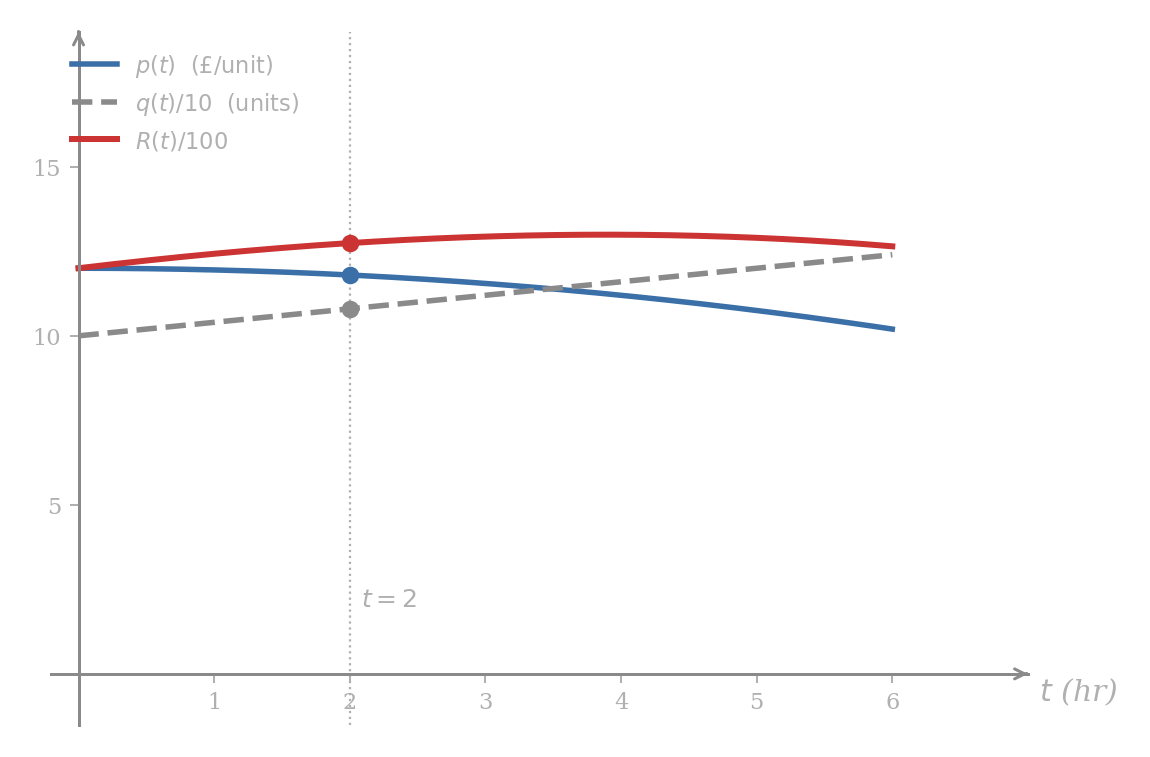
The figure makes a structural point. The price curve slopes down throughout the shift, yet the value curve slopes up at . Looking at alone or alone misses the answer. The product rule is what fuses the two contributions into a single rate.
Problem 106
A retailer’s sales volume weeks after launching a campaign is units per week, while the unit margin (profit per unit) is pounds. The total weekly profit is .
- Use the product rule to find .
- Compute and explain in plain language whether weekly profit is rising or falling four weeks in, and at what rate, in pounds per week per week.
- Find the time at which weekly profit is maximized on the interval .
A bolus injection produces a bloodstream concentration of
with measured in hours. Find the time at which peaks.
Set and . Then , and the general power rule gives . By the product rule,
The bracket simplifies to , so
Critical numbers come from , giving (outside the domain), and , giving . The endpoints contribute and , while
The concentration peaks at hours, well above either endpoint.
![Concentration curve C(t) = (3t+1)² (2 - t) on [0, 2]. The curve starts at (0, 2), peaks near (11/9, 16.94) with dotted reference lines, and falls to (2, 0).](/pdfs/MA0/Imgs/ma0-4-10.png)
The factored form of also encodes the sign of the derivative directly: on both factors are positive so rises; past the second factor flips sign and falls. The first derivative test confirms the maximum without a separate sign chart.
Problem 107
A particle moves so that its position at time is meters for . The velocity is .
- Find using the product rule and the general power rule, factoring fully.
- Determine when the particle is momentarily at rest.
- On which interval is the particle moving in the positive direction?
A Three-Factor Product
Applying the product rule twice handles three-factor products. Write and differentiate:
Each factor, in turn, gets differentiated while the other two are held; the three contributions are summed. The same pattern extends to any number of factors.
Differentiate .
By the three-factor pattern with , , :
Each term keeps two factors intact and replaces the third with its derivative.
For solving , multiply out:
Expanding gives . The grouped form is more compact than expanding first into a degree-four polynomial and applying the power rule term by term, especially when one factor is itself a composite that the general power rule can absorb.
Problem 108
Differentiate as a three-factor product. Then simplify, factor over the integers as far as possible, and use the quadratic formula to list every for which .
Problem 109
Let where , , , , , . Compute using the three-factor product rule.
Problem 110
Let be differentiable. Show that
by applying the three-factor pattern from the A three-factor product example to .
Then use the four-factor formula to compute for — without expanding the polynomial — and verify directly by expanding and using the power rule.
Products are now handled. Ratios remain. The denominator in from the opening can be moved upstairs as and absorbed into a product, but the bookkeeping is fragile and the simplification messy. A direct rule for is cleaner and handles every applied ratio — cost per unit, density per area, return per pound invested, concentration per volume — without rewriting. The deeper payoff is structural: with a direct rule, the rate of change of an average has a clean relationship to the marginal, and that relationship falls out of the algebra automatically.
The Quotient Rule
If and are differentiable at and , then is differentiable at , and
The order of the two terms in the numerator matters: there is a minus sign between them. A standard mnemonic is “low d-high minus high d-low, square the bottom and away we go”: the denominator (“low”) times the derivative of the numerator (“d-high”), minus the numerator (“high”) times the derivative of the denominator (“d-low”), all over the denominator squared. Reversing the two products in the numerator changes the sign of the answer.
We postpone the proof until the rule has earned its keep through examples; the derivation appears later in this lesson, built directly on the product rule above together with the general power rule from Recitation 2.
Worked Quotient Examples
Differentiate .
Set and . Then and . By the quotient rule,
The cancellation in the numerator is the feature: even though both and contribute, their linear pieces meet so cleanly that the derivative reduces to a single constant over the squared denominator. That is the rule behaving well.
Problem 111
Differentiate each function using the quotient rule. Where simplification reveals critical numbers, leave the answer in fully factored form.
- .
- .
- .
- .
Find where .
Set and . Then , and the general power rule gives . The quotient rule supplies
Numerator and denominator share the factor . Cancelling it once,
Critical numbers come from the numerator: (a double root) or , giving . None of these would have been visible without the simplification.
Problem 112
Find where . Simplify the answer by cancelling the largest factor common to the entire numerator and denominator, and identify every at which .
Cancelling here works because is a factor of the whole numerator and the whole denominator. A common term that appears as a summand — not as a factor — never cancels. The next example exists to make this crystal clear.
Differentiate .
Set and . Then , and by the sum rule and general power rule . The quotient rule gives
Expanding the numerator:
The numerator does have a clean factor of :
The denominator does not factor as , even though shows up inside it after expansion: is a sum, not a product. A trainee instinct to “cancel the from top and bottom” would silently invent a wrong derivative. Cancellation is a property of factorizations, not of shared substrings.
Problem 113
Differentiate . Identify which factors do and do not cancel — recall the warning in the When nothing cancels example above — and simplify only as far as is justified.
Layered Rules
The quotient rule almost always cooperates with the product and general power rules. Decomposing the work cleanly is the only difficulty; the individual derivatives are routine.
Differentiate .
On the real differentiable domain , write as a power: . The general power rule with gives
The inner derivative is the genuine quotient computation. Set and . Then and , so
Substituting back into :
To simplify, use :
Combining the factors of :
The full computation took three rules layered: the general power rule on the outside, the quotient rule on the inside, and elementary exponent identities to put the answer in standard form. The architecture — outer rule first, inner pieces afterwards — is the same for every nested differentiation problem in this course.
Problem 114
Differentiate by writing as a power and combining the general power rule with the quotient rule. State with no negative exponents, writing fractional powers as square roots.
Problem 115
The tangent line to the curve at the point with is the line for unique constants and .
- Use the general power rule and the chain rule to compute , then find from the point-slope form.
- Show that the equation — equating the curve to its tangent line — has as a double root by squaring both sides and reducing to a polynomial. (A simple root would mean the tangent crosses the curve transversally; a double root reflects the tangent’s first-order contact with the curve.)
- State, in one sentence, why a double root at is the algebraic version of the geometric fact that the tangent line touches the curve there.
At a Minimum, Average Cost Equals Marginal Cost
The quotient rule’s most repeated economic application is to averages. Average cost is, by definition, the ratio of total cost to output. Marginal cost is the derivative of total cost. The quotient rule produces a precise relationship between the two at the optimum.
Suppose the total cost of producing units is . Define the average cost per unit and the marginal cost . Show that, at any positive output level where has a local minimum, the equality holds.
Differentiate using the quotient rule with and :
At such a minimum of , we must have . With the denominator is positive, so the equation reduces to
Adding to both sides and then dividing by gives
that is, .
The two cost curves cross at any positive output where the average cost is minimized.
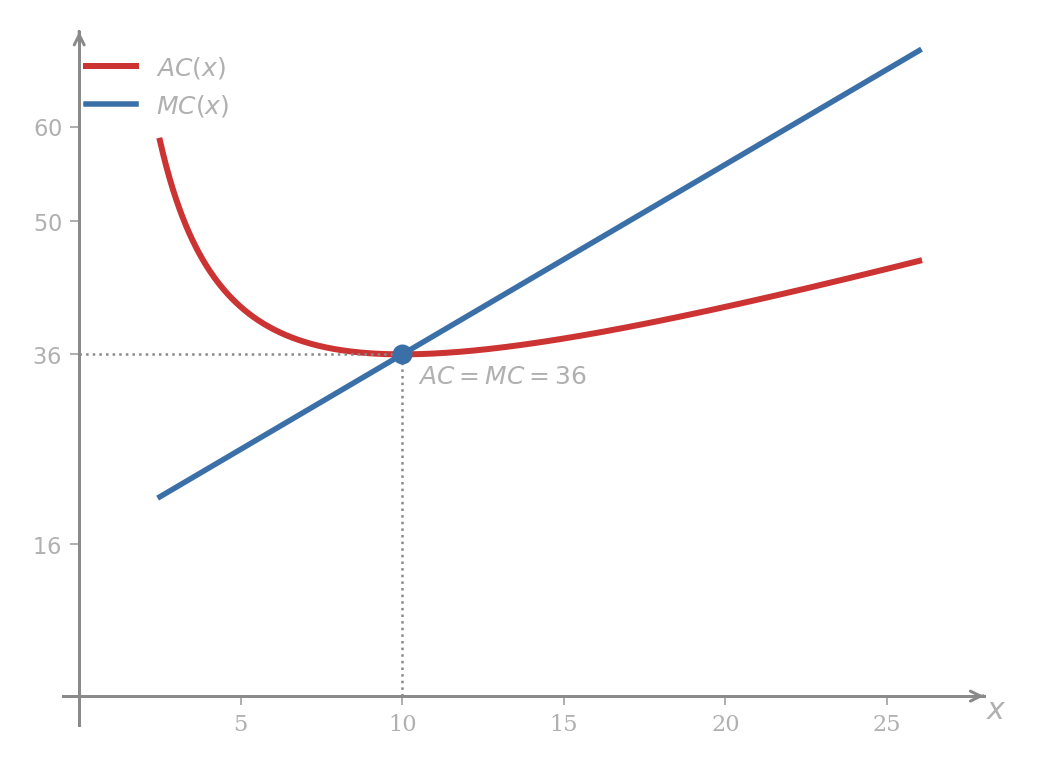
The figure makes the geometry concrete. With , the average cost is the structurally familiar curve of Lesson 3PM (a linear term plus a reciprocal term, single minimum at , where ). The marginal cost is a straight line with slope , hitting exactly at . The intersection point and the minimum point coincide.
The economic reading is immediate: while the cost of producing the next unit is below the average, additional production pulls the average down; when the next unit costs more than the average, additional production pushes the average up. Equality is the fixed point.
Problem 116
A factory’s daily total cost in pounds, when producing units per day, is
- Write and .
- Use the quotient rule to find and the production level minimizing .
- Verify directly that at the optimum, in line with the Average cost meets marginal cost result.
Problem 117
The result at a positive-output minimum of used only that and that . Adapt the argument to show that, for any differentiable function with , every relative extremum of occurs where . State, in plain English, what this says about averages of any non-negative quantity that varies with .
A Quotient Optimization
A small firm’s monthly return on each pound invested, months after the initial outlay, is modeled by
in pence per pound (i.e. units of pound). Find the time at which the return is highest.
Set and , so and . By the quotient rule,
The denominator is positive for every , so the sign of is determined by . Setting gives , so (the negative root is outside the domain). For , and is increasing; for , is decreasing. By the first derivative test, is the absolute maximum on .
The peak return is
The investment yields its highest monthly return — 5 pence per pound — exactly five months after the outlay.
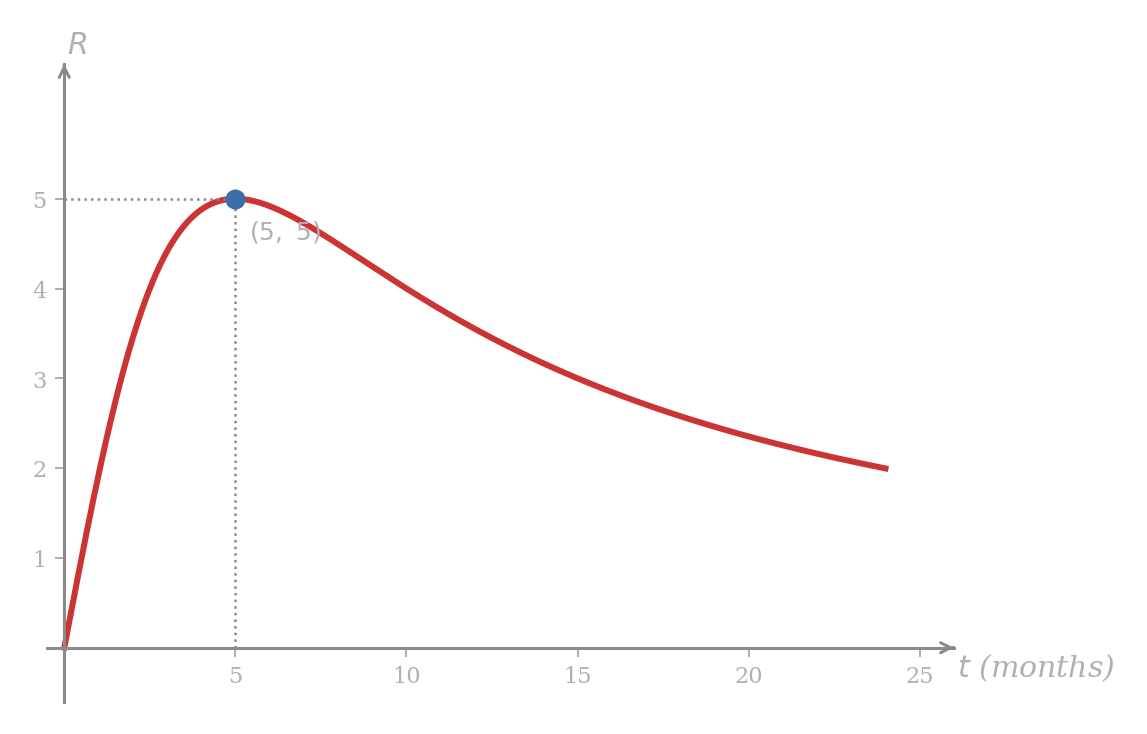
The shape has a structural lesson. For small positive , the linear numerator outpaces the denominator (which is dominated by its constant ). For large , the denominator’s quadratic term takes over and the ratio decays like . In this model, those two effects balance at one peak, and the quotient rule locates it.
Problem 118
Pollutant concentration in a tank, minutes after a spill, is modeled by
- Find using the quotient rule and factor it.
- Determine the time at which concentration peaks and the peak value.
- The clean-up team must intervene before exceeds ppm. Has the peak been reached at the moment first hits ppm, or is it still rising?
Problem 119
A daily delivery service models its profit per kilometer driven by
in pounds per kilometer.
- Use the quotient rule to find and simplify.
- Find every critical number on the open interval and classify each.
- Compare each critical value with the endpoint values and identify the absolute maximum.
Proof of the Quotient Rule
The quotient rule does not need its own limit-definition argument. It follows from the product rule above and the general power rule applied to .
Step 1: a reciprocal derivative. The general power rule from Recitation 2 extends to negative integer exponents. Since and is continuous at , the reciprocal is defined for inputs near . With ,
Step 2: write the quotient as a product and apply the product rule. For ,
so by the product rule,
Substituting Step 1:
■The minus sign in the numerator now has a clear origin: it tracks back to the exponent in , which is the only minus sign in the entire chain of substitutions. Forgetting the minus sign in the rule is forgetting that one is differentiating the reciprocal, not multiplying by it.
Problem 120
Use the reciprocal-derivative formula from Step 1 of the proof above to differentiate
in two ways: first by writing as and applying the general power rule directly, second by writing as and applying the quotient rule. Confirm that the two answers agree.
Quotients are now handled. The remaining structural gap from the opening is composition: an outer function applied to an inner function , written . The general power rule above is the special case where the outer function is a power, ; for example, is already covered by taking . The chain rule is the same idea generalized: any differentiable outer function applied to any differentiable inner function gets a clean derivative.
Composition
Two functions and compose into a third by feeding the output of into the input of .
Given functions and , the composition is the function defined by
on the set of for which lies in the domain of . We call the outside function and the inside function.
Recognizing a function as a composite is half the work; the chain rule then differentiates it mechanically.
Let and . Then
Each occurrence of in is replaced by .
Identify each function as and name the outer and inner pieces.
-
. Outside: . Inside: .
-
. Outside: . Inside: .
The decomposition is rarely unique — above can also be read as to the power , with — but every decomposition leads to the same derivative when the chain rule is applied.
A function of the form is the composite with outside . The general power rule already gave its derivative,
and the chain rule has the same shape, with free to be anything differentiable.
The Chain Rule
If is differentiable at and is differentiable at , then is differentiable at , and
In words: differentiate the outside, leave the inside alone, then multiply by the derivative of the inside.
The two factors play different roles. asks how fast the outside function is changing at the value the inside has just produced; asks how fast the inside function is changing at . The product is the rate of change of the composition.
Use the chain rule on with and .
We have and , so
and the chain rule gives
The outside is a power, so the answer matches what the general power rule produces directly. The chain rule does not change the answer; it labels the structure of the calculation in a way that survives when the outside is no longer a power.
Let for some differentiable (no formula given). Find in terms of .
Set , so . The general power rule gives , and the chain rule supplies
The outside function is opaque, yet the chain rule still tells us exactly how the rate of change of depends on the rate of change of . This pattern — passing through an unknown outer function — is the central maneuver when implicit and inverse functions enter the course.
Problem 121
Let where is differentiable.
- Express in terms of .
- Given , compute .
Problem 122
Let where and . Use the chain rule to compute .
Problem 123
For each function, identify the outside and the inside , then differentiate using the chain rule.
- .
- .
- .
- (a chain of two compositions; treat the inner composite as ).
Leibniz Form
Setting and converts the chain rule into a notation that mirrors how rates compose physically. Then and , and the chain rule becomes
The derivative symbols are not literal fractions, but the apparent cancellation of the symbols is a faithful mnemonic.
The interpretation is direct. If varies three times as fast as and varies twice as fast as , then varies six times as fast as :
Rates compose by multiplication, just as scaling factors do.
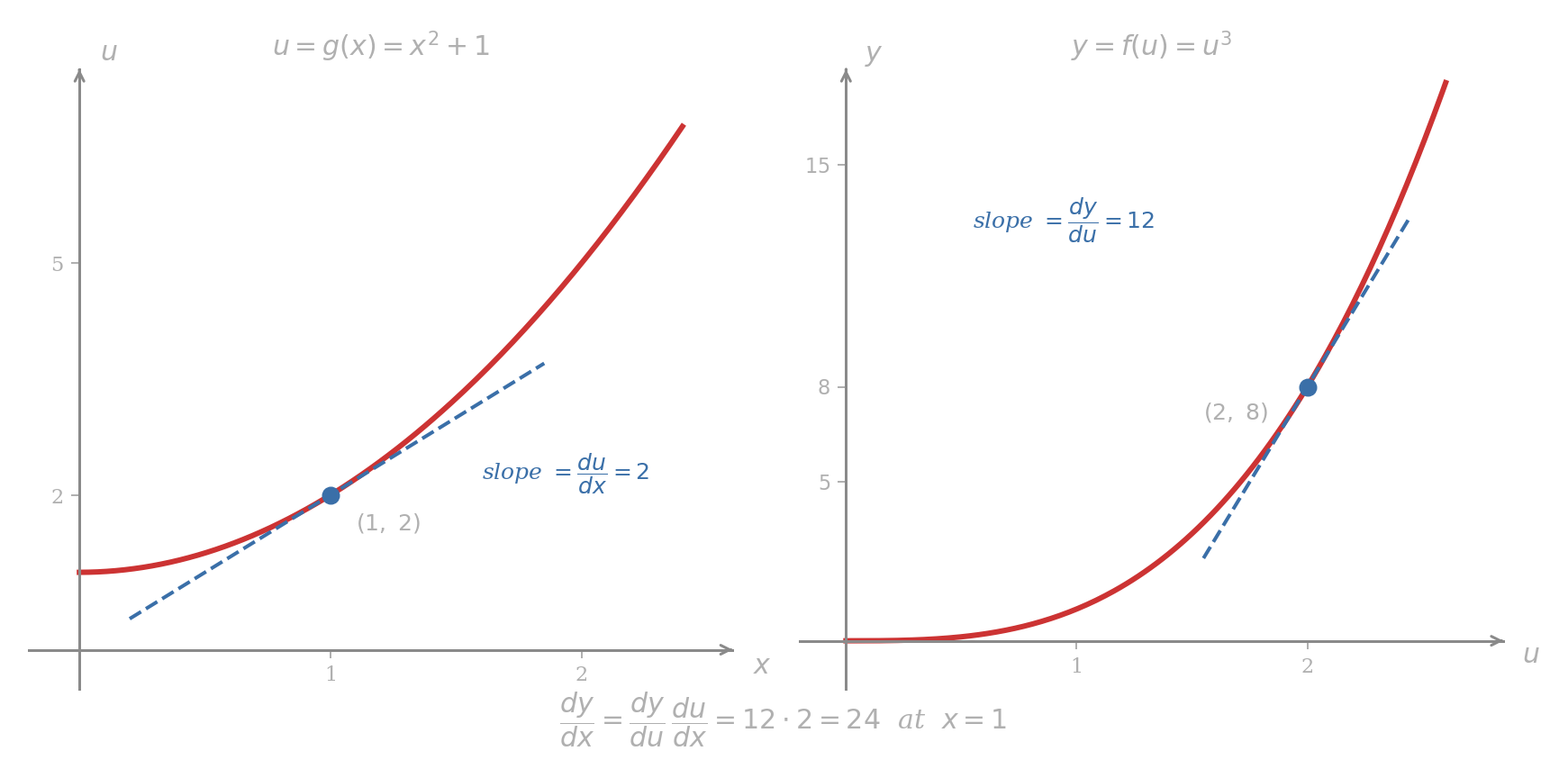
The figure makes the rule visible. With , at we have and . With , at we have and . The chain rule says at , and substituting the composition confirms it: at .
Find if and .
The relation is not given directly. Differentiate with respect to and with respect to :
By ,
Expressing in alone via :
Substituting into first and then differentiating using only the rules above gives the same answer; it is just a longer calculation. The Leibniz form is preferred because the next two examples — and most of the applied work in later lessons — present the variables in exactly the layered way that exploits.
Problem 124
Find in two ways: first by substituting and differentiating directly, second by the chain rule via . Confirm the answers agree.
- , .
- , .
- , .
Problem 125
Suppose , , , so that depends on through two compositions. Show that
by applying the two-link chain rule twice. Use this three-link form to differentiate .
Time Rates of Change
The chain rule’s most repeated applied use is to convert a rate of change with respect to one variable into a rate of change with respect to time. If is a function of and is a function of , then is a function of , and
The factor is the marginal quantity already studied in Lessons 2 and 3; the factor is how fast the input is moving in real time. Their product is the real-time rate of change of .
A shop sells ties for £12 each. Let be the cumulative number of ties sold by time , and let be the corresponding revenue. If sales are rising at four ties per day, how fast is revenue rising?
Each extra tie brings in £12, and four extras a day brings in £48 a day; the answer is intuitively £48 per day. The chain rule reproduces it:
The factor is the marginal revenue per tie; is the sales rate in ties per day. The chain rule asserts that the time rate of revenue is always the product of these two — the marginal multiplied by the time rate of the input.
The demand equation for a brand of graphing calculator is pounds per unit, where is the cumulative number of calculators produced and sold during the current run. The firm is currently at and is increasing production by calculators per day. Find the time rate of change of total revenue at this production level.
Total revenue is
The marginal revenue is
By the chain rule,
At and :
Revenue is rising at £12,400 per day at this production level.
![Revenue parabola R(x) = -0.002x² + 86x for x in [0, 43000], with R rescaled by 1/1000. The current production point at x = 6000 is marked, with R = £444,000 and a tangent line of slope dR/dx = 62 (£ per unit).](/pdfs/MA0/Imgs/ma0-4-14.png)
The figure isolates the two factors visually. The slope of the tangent line at is pounds per unit. That number is fixed by the demand model and the current production level; it has nothing to do with time. Plugging in — the production schedule — converts that marginal into a daily rate. Different schedules yield different time rates while leaving the marginal unchanged: doubling the production speed to per day would double the time rate of revenue to £24,800 per day.
Air is being pumped into a spherical balloon, and the radius is observed to grow at centimeters per second when centimeters. How fast is the volume changing at that instant?
The volume of a sphere is . Differentiating with respect to ,
By the chain rule,
At and :
The factor is the surface area of the sphere — geometrically, the rate at which volume changes per unit increase in radius is the area of the boundary. The chain rule turns that geometric fact into a time rate.
Problem 126
A circular oil slick is spreading. Its radius grows at meters per minute when meters. The slick’s area is .
- Write using the chain rule.
- Compute at the moment .
- The slick’s circumference is . Find at the same instant. Why does the circumference rate not depend on the current value of ?
Problem 127
A factory’s daily revenue at production level is pounds per day. The production schedule is units per day, where is in days from the start of the schedule.
- Compute as a function of , and state the marginal revenue at and at .
- Use the chain rule to find .
- At what value of does the time rate of daily revenue equal zero? Interpret what this means in plain English.
Problem 128
A spherical raindrop evaporates so that its radius decreases at millimeters per second when millimeter. Find at that instant, with . Why is the rate negative?
Problem 129
Two ships leave the same harbor at . Ship travels due east at km/h; ship travels due north at km/h. Let and denote their distances from the harbor at time , and let denote the distance between the two ships.
- Use the chain rule on to express in terms of , , , and .
- Compute at hour. Then compute it again at hours. Show the answers are equal.
- Prove that is constant for every , and explain in one sentence why the constancy is forced by the geometry of two perpendicular constant-speed motions.
Proof of the Chain Rule
The chain rule does not follow from earlier rules the way the quotient rule did. It needs its own limit argument, built around the trick of relating the difference quotient of at to the difference quotient of at .
Suppose is differentiable at and is differentiable at . Set . Since is differentiable at , its change near can be written as
where tends to as tends to . For , this is just the difference quotient rewritten:
and at we may set , so the displayed change formula remains true.
Now put . Since is differentiable at , it is continuous at , so this tends to as tends to . Also . Therefore
Divide by :
Taking the limit as tends to , the first factor tends to and the second factor tends to . Hence
which is the chain rule at .
■The proof’s central trick is the same one that powered the product rule: a single difference quotient is too tangled to evaluate, so we rewrite it using a bridge term whose limit we understand. For the product rule, the bridge term was ; for the chain rule, the bridge is the inner change .
Combining the rules from Lessons 2, Recitation 2, and this lesson, every differentiable expression in this course can be reduced. Apply the rules from the outside in.
| Rule | Form |
|---|---|
| Constant multiple | |
| Sum | |
| Power | |
| Product | |
| Quotient | |
| Chain | |
| General power (chain ∘ power) |
The general power rule is now formally what it always was structurally: the chain rule with .