
Limits and Derivatives
The Derivative
Lesson 2AM attached a slope to every point of a smooth curve through the construction of its tangent line. When the curve is the graph of a function , that slope at the input is determined by alone, so it defines a new function of : the rule that sends each input to the slope of there.
Let be a function whose graph admits a tangent line at the point . The derivative of at is the slope of the curve at that point, written . The function whose value at each such input is is itself called the derivative of , and its domain is the collection of inputs at which admits a tangent. The process of computing from is called differentiation.
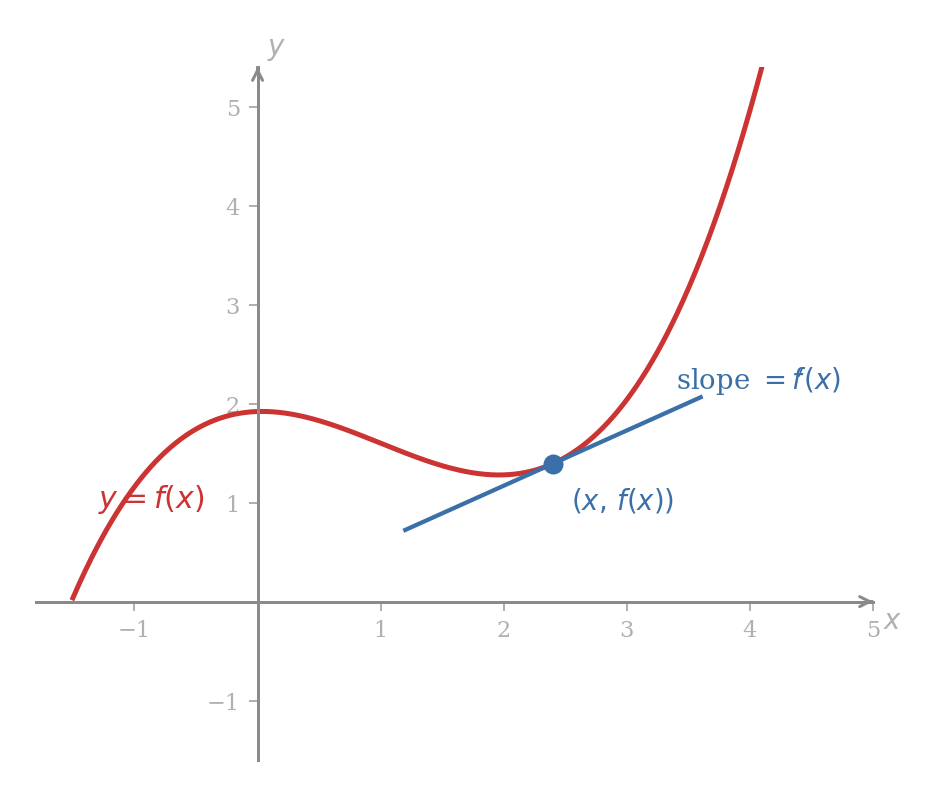
The notation depends on as the original does, so is itself a function and may be evaluated, plotted, and combined exactly as was. Its domain consists of those inputs at which the curve admits a tangent; at points of the absolute-value type singled out in Lesson 2AM, no tangent exists and is left undefined there.
Linear and constant functions
For a linear function the graph is the line of slope . The tangent line to a line at any of its points is the line itself, since no other straight line approximates a straight line better than the line does, so the slope of the graph at every input is . The derivative is therefore the constant function with value :
The case collapses to the constant function , whose graph is the horizontal line at height and whose tangent at every point is that horizontal line itself, of slope . So
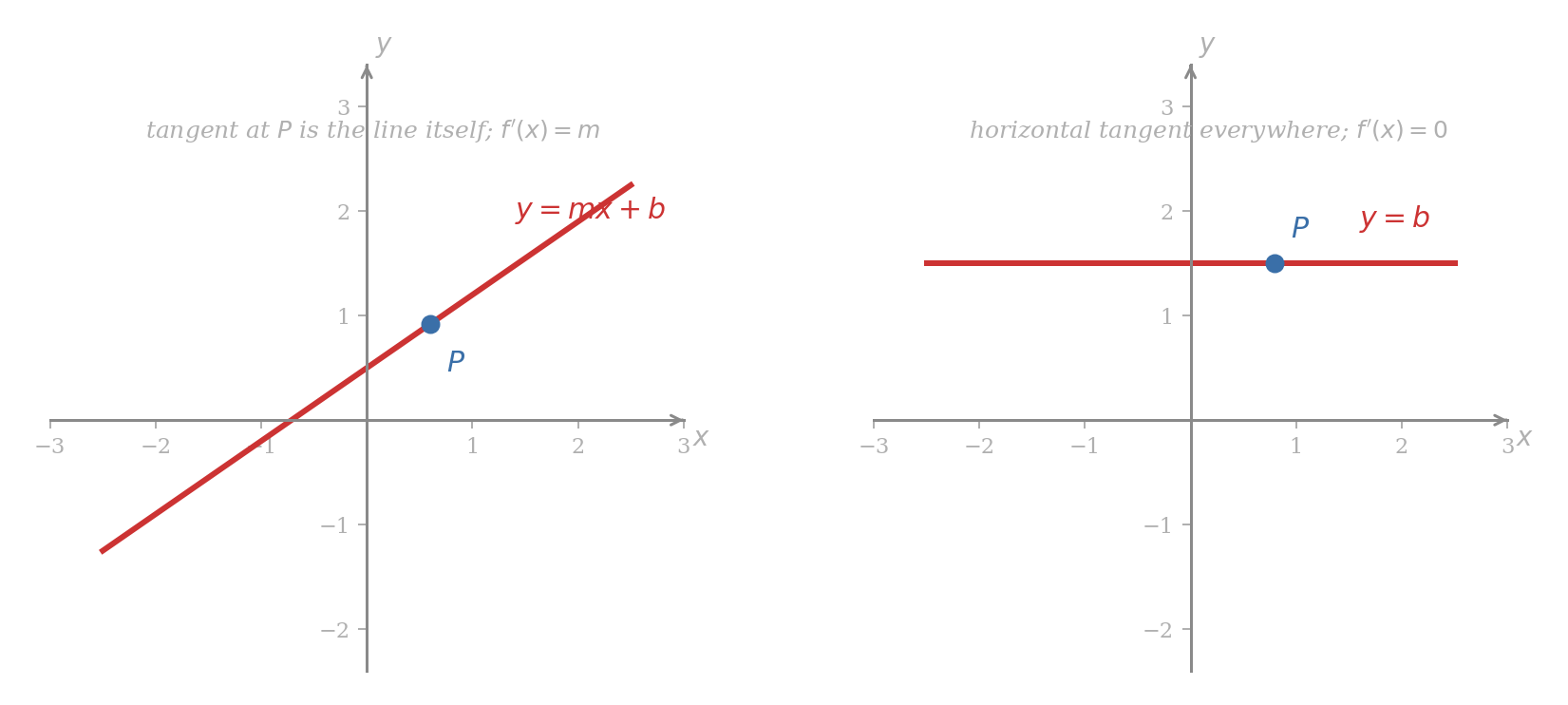
Differentiation strips a linear function down to its slope, sending the constant term to zero. The two facts will be invoked silently throughout the rest of the course.
The cases and
The slope formula recorded as a Theorem in Lesson 2AM, that the slope of at the point is , translates immediately into the derivative.
If , then .
A parallel calculation, deferred together with the slope formula above to the limit construction later in this lesson, gives the derivative of the cube.
If , then .
Comparing the two,
the exponent dropping by one and reappearing in front. The pattern extends to every power function in the sense of Lesson 1PM and supplies the most useful single rule of elementary differentiation.
The Power Rule
Let be a rational number, and let on the inputs at which the power is defined. Then on the inputs at which the curve admits a tangent line,
The proof requires the limit construction developed later in this lesson, and the full rational-exponent case is deferred to a later MA0A lesson. The special cases recover the linear, parabolic, and cubic results already obtained, and recovers the constant-function result via on with . The remaining rational extend the toolkit to every root and reciprocal of a root.
Writing as in Recitation 1, the power rule with gives
The derivative is defined for every . At the original is defined but the curve has a vertical tangent there, so the slope is not a real number and is not defined at the origin.
Writing , the power rule with gives
The derivative is defined for every , the same restriction itself carries.
The power rule with gives
The original is defined on every real , since has odd denominator, but the curve has a vertical tangent at the origin and so excludes .
Problem 35
Use the power rule to compute for each of the following, and state the inputs at which the derivative is defined.
- .
- .
- .
- .
The slope of at is, by the previous example with ,
By slope property 3 of Lesson 2AM, the tangent line at has equation
The line meets the curve at with the same direction the curve has there, by construction.
Problem 36
Find the slope of the curve at the point , and write the equation of the tangent line at that point in slope-intercept form.
The power rule was stated above without proof, in the same spirit the slope formula for was stated in Lesson 2AM: enough to compute with, not yet enough to justify. The justification rests on the limit, developed later in this lesson, which makes precise the informal “approaches under successively higher magnification” used so far to describe a tangent line.
Geometric Meaning and the Tangent Line
The slope reading of the derivative is central enough to be packaged as a single working formula. Before stating it, a confusion worth heading off: at the same input , the two numbers and are entirely separate quantities, and using one in place of the other is the most common source of early error.
For a function admitting a tangent line at ,
- is the height of the graph at , that is, the -coordinate of the point .
- is the slope of the graph at that same point, that is, the slope of its tangent line there.
The two numbers may agree for a particular and by coincidence, but in general they differ in sign, magnitude, and physical units. Replacing one by the other turns a correct computation into a wrong one.
For the function at ,
so the curve passes through with slope : the height is positive while the slope is negative, recording that the graph is on its way down through that point. Asking for when one wants would supply the wrong number with the wrong sign.
Equation of the tangent line at
Combining the point of contact with the slope in slope property 3 of Lesson 2AM supplies the line uniquely.
The tangent line to the graph of at the point with first coordinate has equation
The slope is and the point of contact is .
The formula assembles two pieces, both extracted from . The procedure is in two steps:
- Locate the point of contact by evaluating at , giving .
- Compute the slope by evaluating the derivative at , giving .
Substituting both into the point-slope form completes the equation. There is nothing to memorise beyond the two evaluations.
Step 1. The height is , so the point of contact is .
Step 2. Writing and applying the power rule with ,
so the slope at is .
The tangent line therefore has equation
or, isolating , .
Find the point on the parabola at which the tangent line is perpendicular to the line , and write the tangent line at that point.
The given line has slope ; by slope property 5 of Lesson 2AM, the perpendicular slope is . The derivative of is , so the perpendicular condition becomes , giving and the point of contact .
By the formula above, the tangent line at with slope is
Problem 37
For each curve and input below, write the equation of the tangent line in point-slope form, then convert it to slope-intercept form.
- at .
- at .
- at .
Problem 38
The line is tangent to the graph of at a single point of the form with . Find , identify the point of contact, and determine .
Operator notation
The derivative produced from a function admits a second notation, more compact when the function does not carry a name and especially convenient once chain-like manipulations enter the toolkit.
The derivative of may be written in either of two forms,
the symbol read “the derivative with respect to ”. When the function carries a name , the derivative may also be written
All three notations , , and denote the same function and are used interchangeably.
In the new notation the power rule reads
which is convenient because no auxiliary name has to be introduced before differentiating. The equality is read only at inputs where the expression involved makes sense.
The derivatives already computed acquire shorter expressions:
The last identity uses and .
Problem 39
Compute each of the following using the operator notation, and state the inputs at which the result is defined.
- .
- .
- .
The Secant Line and the Derivative
The power rule of the previous section was stated without justification, and the slope formula for was deferred from Lesson 2AM on the same grounds. This section supplies the missing construction: a procedure that derives the slope of any smooth curve at any point from the function alone, using only the algebra of the line through two points and the geometric idea of one point approaching another along the curve.
Secant lines
A secant line to a curve at a point on it is a straight line that passes through and through one other point on the curve.
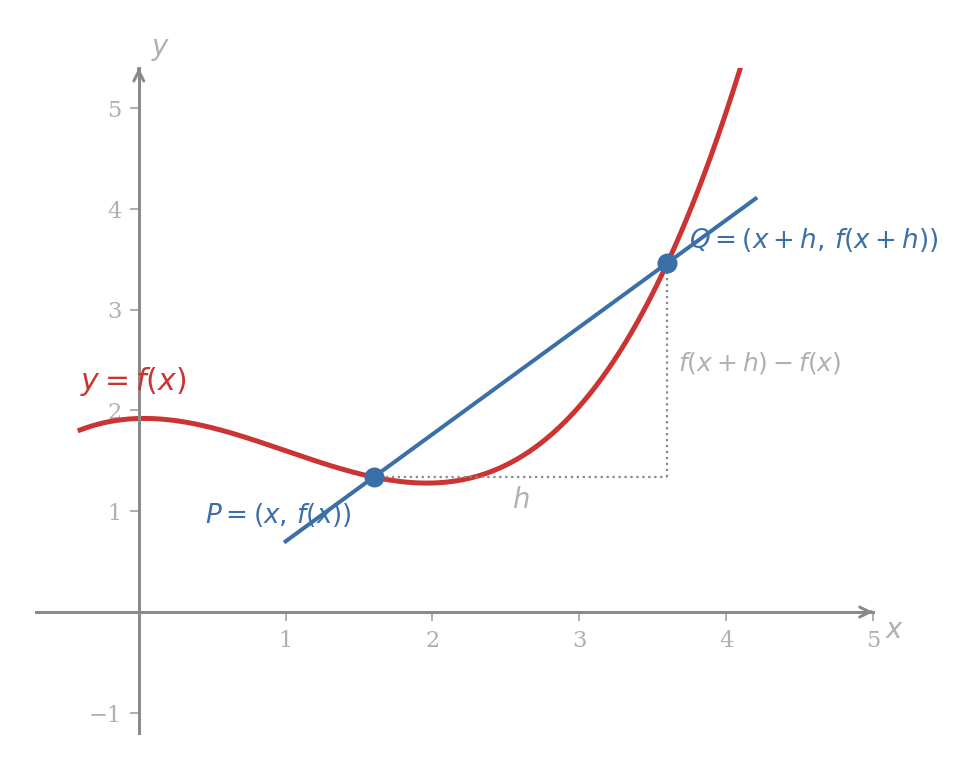
The slope of the secant through and is determined by the two points alone, and slope property 2 of Lesson 2AM supplies it directly. Writing and for some non-zero displacement , the slope of the secant is
the difference quotient. The secant line is the geometric object whose slope this quotient computes.
From secant to tangent
Hold fixed and slide along the curve towards , so that shrinks towards zero. The secant pivots about , and if the curve has a tangent line at the secant approaches that tangent in the same magnification sense as in Lesson 2AM: at progressively smaller the secant and the tangent become indistinguishable. Translated into numbers, the slope of the secant approaches the slope of the tangent, which is by definition .
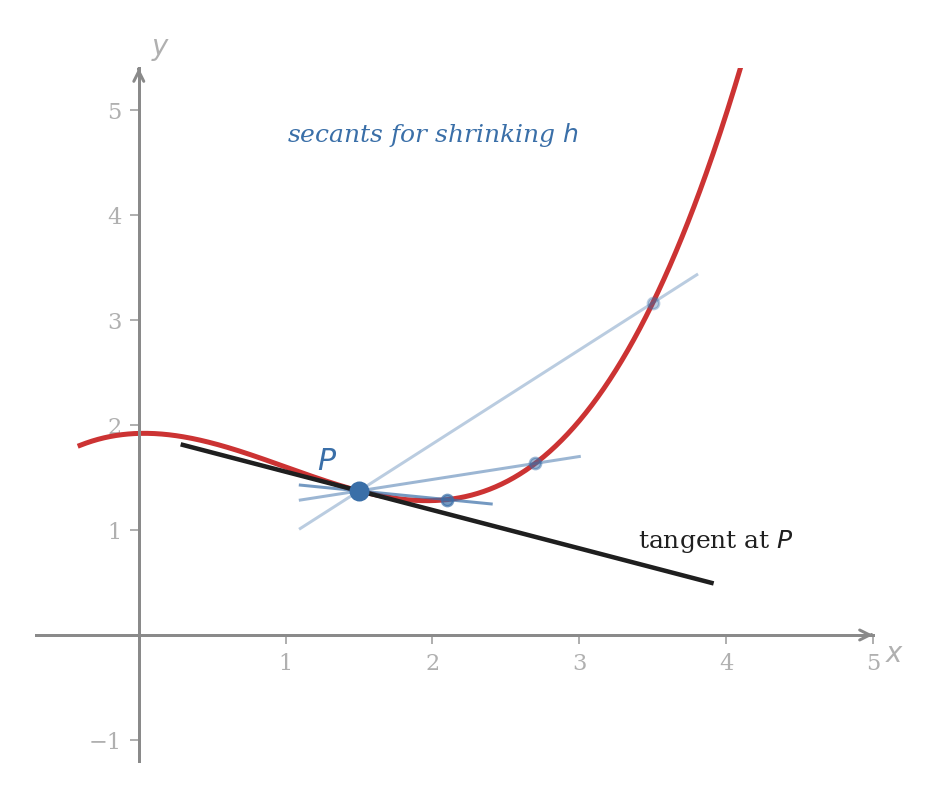
We record the relationship in standard limit notation,
the symbol being read “the limit as approaches of”. The notion of an expression approaching a value will be made more precise in the next section; for now the secant picture is the working intuition.
The substitution is forbidden in the difference quotient because both numerator and denominator then vanish, leaving the meaningless . The limit allows us nevertheless to read off the value the quotient settles on as tends to , without ever setting .
Three-step recipe
The recipe converts a problem about tangent lines into a problem of algebraic simplification.
- Write the difference quotient for .
- Simplify until the apparent has been removed by algebraic cancellation.
- Read off the value the simplified expression approaches as . That value is .
The first three special cases of the power rule, together with formulas (1) and (2) of the previous section, fall out at once.
Verifying the special cases
Constant case. Let for some fixed real number . Then for every , so for every ,
The constant approaches as , hence .
■Linear case. Let . Then
and the difference quotient simplifies to for every , the cancellation being legitimate since . The constant approaches as , so .
■The case . Expanding ,
for every . As the expression approaches , so , which is the slope formula stated as a Theorem in Lesson 2AM and recovered as formula (3) above.
■The case . Expanding ,
for every . As both terms involving vanish, so .
■For on , the difference quotient is
Combining the inner fractions over the common denominator ,
and substituting back,
for every with , the cancellation of relying on . As the denominator approaches , and the difference quotient approaches . Hence for , in agreement with the power rule at .
Problem 40
Apply the three-step recipe to compute the derivative of each function below. Indicate at each step where the cancellation is used.
- .
- .
- on .
The derivations above prove the power rule for and for directly from the limit. The same secant argument with the binomial expansion of handles every positive integer exponent at once, and slightly more elaborate manipulations recover the rule for negative integers and for rational . The general statement, together with a more careful theory of limits to back the informal “approaches” used here, awaits a later MA0A lesson.
Limits
The previous section used the phrase “approaches as ” without committing to a definition. This section gives a working definition, lists the algebraic rules limits obey, and demonstrates the standard computational tricks for cases where direct substitution fails. A fully formal treatment is left to a later MA0A lesson; for the present we are after enough machinery to compute.
Definition
Let be a function defined on some interval containing the real number , except possibly at itself. The number is the limit of as approaches if can be made arbitrarily close to by taking sufficiently close, but not equal, to . We write
If no such number exists, the limit is said to not exist.
The definition examines only the values of at inputs near , never at itself, so need not be defined at for the limit to exist. When is defined at , the value may or may not equal the limit; the equality of the two is precisely the property of being continuous at , taken up below.
Define
For inputs near but not equal to , the rule governing is simply . Those nearby values approach as approaches , so
This does not contradict : the limit ignores the value at the point itself and reads only the behaviour around it.
Computing a limit from a table
Compute .
Tabulating at inputs progressively closer to from each side,
the outputs from both sides plainly approach , and they can be made as close to as desired by taking close enough to . Hence .
Computing a limit from a graph
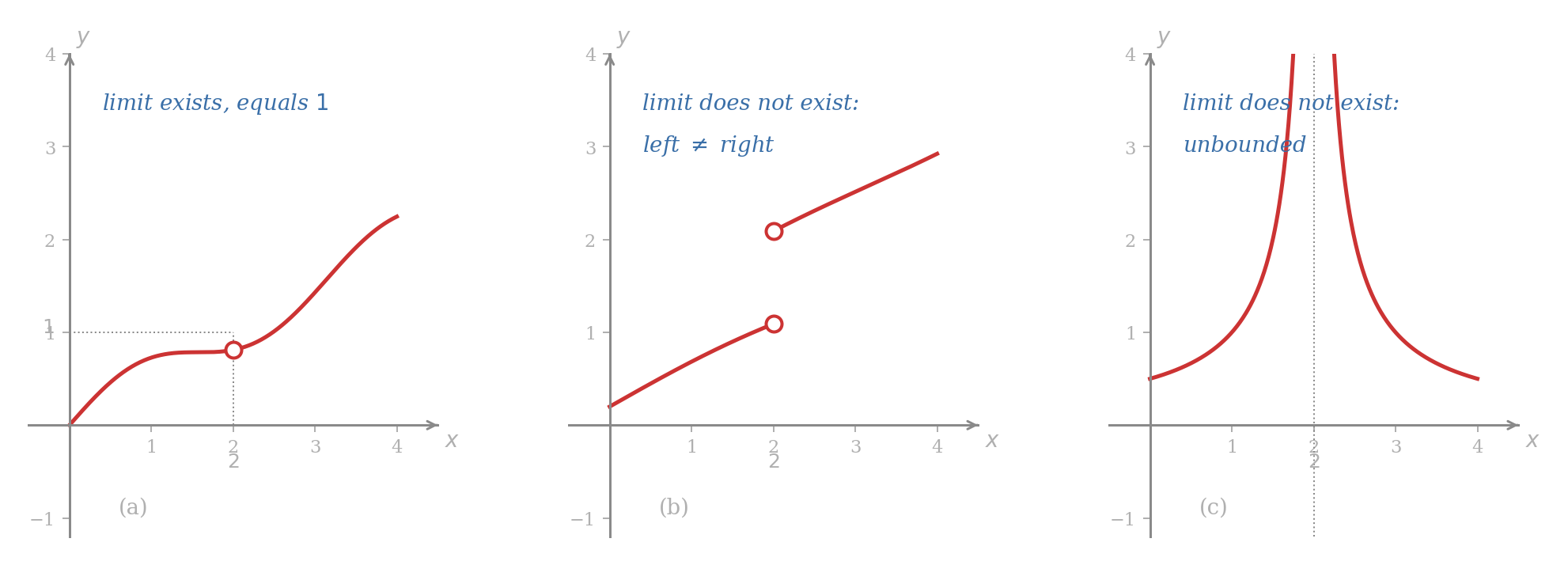
The three panels illustrate the three behaviours that decide whether exists.
In panel (a) the values approach the single number from both sides, even though is not defined at , so the limit exists and equals . In panel (b) the values approach from the left and from the right; the two approaches disagree, so no single number satisfies the definition and the limit does not exist. In panel (c) the values grow without bound as approaches from either side; no real number is approached, and again the limit does not exist.
Limit theorems
The arithmetic operations on functions interact with limits in the most natural way. We list the rules now, deferring the detailed verifications to the later MA0A lesson where the fully formal definition is in place.
Suppose and both exist. Then:
(I) For every constant , .
(II) For every positive rational such that is defined and is defined on inputs near other than itself, .
(III) .
(IV) .
(V) .
(VI) If , .
The two further consequences below are the most often invoked and are derived from the rules above without further input.
Let be a real number.
(VII) For every polynomial function , .
(VIII) For every rational function with , .
In short: for polynomial and rational functions, the limit at any point of the natural domain is found by direct substitution.
(VII) The constant function with value has , since the constant value is already arbitrarily close to itself for every input. The identity function has by inspection, since taking close to makes itself close to . Limit Theorem II applied to the identity gives for every positive integer , since the integer power is the rational power . Limit Theorem I then gives for each coefficient, and Limit Theorem III applied across the finite sum that defines recombines these into .
(VIII) With and , Limit Theorem VI gives .
■Worked computations
By Theorem VII applied to the polynomial ,
Limit Theorem II with then gives
and Limit Theorem VI with the polynomial in the denominator (non-zero at ) supplies
When direct substitution returns the indeterminate form , no theorem applies until algebra has cleared the obstruction. Two algebraic moves cover almost every elementary case: factoring, and rationalising.
Compute .
Direct substitution gives . Factoring the numerator,
the cancellation legitimate because the limit examines only . The right-hand side is a polynomial, so by Theorem VII its limit at is , and so the original limit equals .
The two formulas
agree at every , but they are not the same function. The natural domain of excludes , where the denominator vanishes; the domain of is the whole real line. The graph of therefore matches that of everywhere except for a single missing point at .
Because the limit ignores the value at entirely, the two functions have the same limit there: . Direct substitution succeeds for but fails for , even though the answer it would yield, were it permitted, is correct. The cancellation step in the example above is the formal acknowledgement that the limit cares only about the agreement of and on the inputs near but not equal to .
Compute .
Direct substitution again gives . Multiplying numerator and denominator by the conjugate ,
for every , the cancellation again legitimate because the limit excludes . The denominator is now a sum of a square root and a constant, both well-behaved at , and Limit Theorem VI together with Theorem II gives
Problem 41
Compute each limit, citing the theorem or algebraic step used at each line.
- .
- .
- .
- .
The cancellation step in each algebraic move rests on the fact that the limit ignores the value of the function at the point itself, examining only the surrounding inputs. The same move was at the heart of the difference-quotient calculations of the previous section: cancelling in was legitimate precisely because throughout the limit. Limits and the difference-quotient computations are therefore the same algebraic procedure dressed in different geometric clothing.
The Limit Definition of the Derivative
The two previous sections together supply the missing ingredient. The limit is now defined, and the informal “approaches” used in the secant construction admit a precise reading. The derivative therefore admits a definition that no longer relies on the geometric picture of the tangent line; the picture is recovered as a consequence whenever the curve has a tangent at the point in question.
A function is differentiable at the input if the difference quotient
has a limit as approaches . When this limit exists, its value is the derivative of at , written
If the limit does not exist, is nondifferentiable at .
The geometric reading of as the slope of the tangent line is recovered whenever the curve has a tangent at , since the secant slopes then approach the tangent slope as . Most functions in the early part of this course are differentiable at most inputs of their natural domains; exceptions include corners such as at , vertical tangents such as at , and points excluded from the natural domain in the first place. These exceptions are catalogued below and treated more systematically in later MA0A lessons.
The three-step recipe in limit notation
The recipe of the previous section restates without change, now backed by the limit definition.
- Write the difference quotient for .
- Simplify algebraically until the cancellation has done its work.
- Take the limit as , using limit theorems VII and VIII where applicable. The value is .
The recipe produces either a number or a function depending on what is asked: holding throughout produces the derivative at , the single number ; carrying symbolically produces the derivative function , whose value at any chosen input can then be read off. The two outputs are distinct objects and should be kept apart.
Computing at a specific input
Step 1. With and ,
Step 2. Cancelling ,
Step 3. By Limit Theorem VII applied to the polynomial ,
Step 1. With and ,
Step 2. Combining the inner fractions over the common denominator ,
so the difference quotient simplifies to
the cancellation of legitimate because .
Step 3. By Limit Theorem VIII applied to the rational function ,
A car begins to move at time , and its distance from the start in feet after seconds is recorded as . The average speed over any interval from to seconds is the distance covered divided by the elapsed time,
the same difference quotient that defines . The instantaneous speed of the car at is the limit of these average speeds as the interval shrinks, that is, .
Tabulating the average speeds for shrinking gives a numerical sense of the limit:
| average speed (ft/s) | |
|---|---|
The values plainly approach . To confirm by direct computation, expand
so the average speed is for . By Limit Theorem VII applied to the polynomial in ,
feet per second. The reading of as instantaneous speed is the temporal counterpart of the slope-of-tangent reading: an average rate over an interval is sent to its limit as the interval shrinks, and the result is the rate at the single instant.
Computing a derivative formula
Step 1. Expanding and subtracting ,
Step 2. Dividing by and cancelling,
Step 3. By Limit Theorem VII applied to the polynomial in the variable ,
The output is a function; evaluating it at any specific input gives the corresponding derivative value, for example , , .
Verifying the Power Rule from the limit
The power rule was stated without proof and verified by hand for in the secant section, and the case was treated alongside as . The case is the next standard one, predicted by the rule to yield .
The case on . Rationalising the difference quotient by multiplying numerator and denominator by the conjugate ,
for every with , the cancellation of legitimate because . As the denominator approaches by limit theorems II and III applied to the square-root expression, so
in agreement with the power rule at .
■Recognising a limit as a derivative
The defining formula reads in both directions. A limit of the form is by definition , so a limit that can be massaged into this shape computes a derivative at a point and yields its value via the power rule or any other available calculation.
Compute .
Renaming the dummy variable as leaves the limit unchanged,
Setting and , the right-hand side is exactly by the limit definition. The power rule with gives , so
and therefore the original limit equals .
Problem 42
Apply the limit definition step by step.
- Compute for .
- Find the derivative formula of on , then evaluate at .
Problem 43
Recognise each limit as for a suitable and , and evaluate it via the power rule.
- .
- .
- .
Limits at Infinity
The limits considered so far have all sent towards a fixed real number . A second style of limit asks what the function does as grows without bound, in either the positive or the negative direction. The behaviour at infinity is what records, for instance, that a graph approaches a fixed horizontal line, called a horizontal asymptote, or that a quantity stabilises in the long run.
Let be a function defined on every input larger than some threshold. The number is the limit of as approaches if can be made arbitrarily close to by taking sufficiently large; we then write
The corresponding statement with “sufficiently large” replaced by “sufficiently large in magnitude with negative” defines .
The symbol is not a real number; the notation describes a direction in which is sent to grow, not a value at which it arrives.
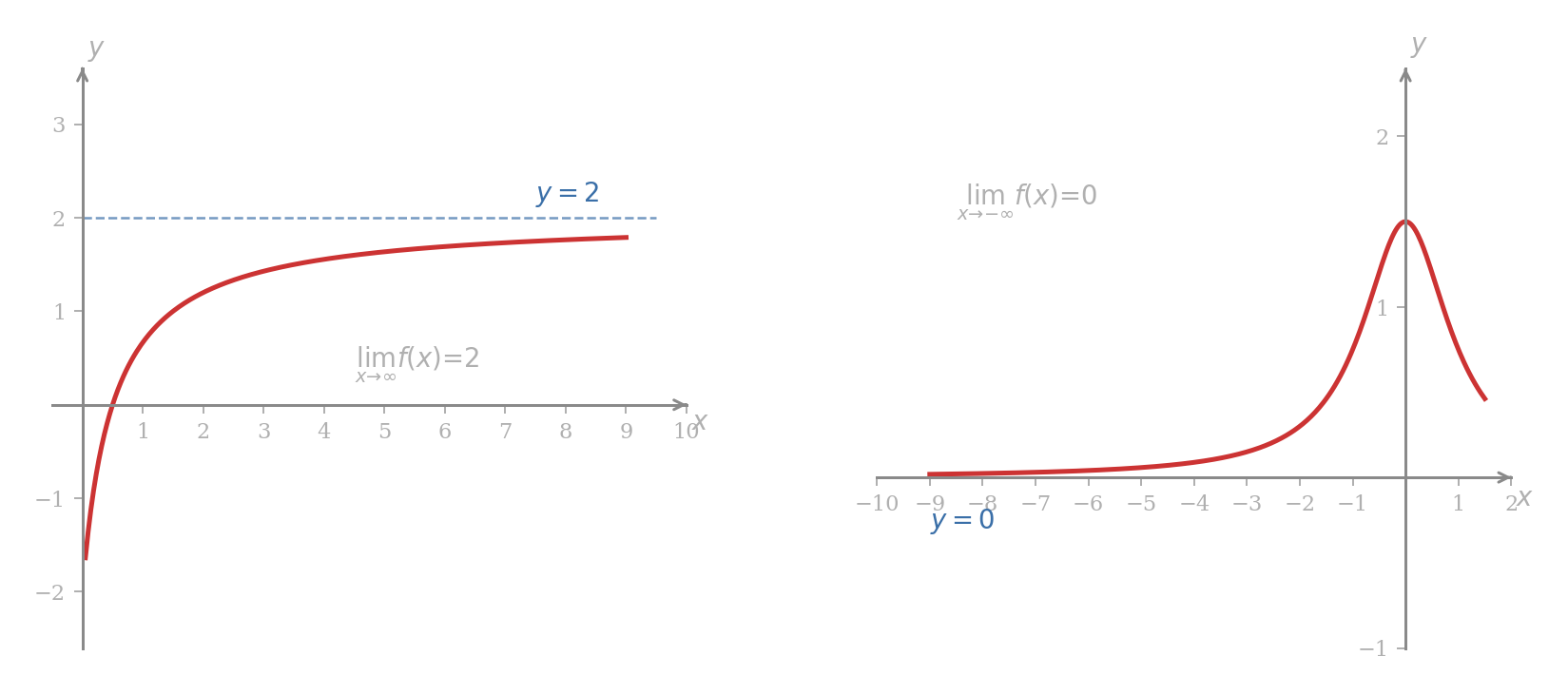
The arithmetic limit theorems of the previous section apply to limits at infinity in the examples below. The polynomial-and-rational direct-substitution rule (Theorem VIII) is replaced, for rational functions, by the algebraic divide-by-the-largest-power trick illustrated below.
Computing limits at infinity
Part (a). Compute .
As grows large the polynomial grows without bound, so its reciprocal becomes arbitrarily small in magnitude. The limit is therefore .
Part (b). Compute .
Both numerator and denominator grow without bound, so direct inspection is inconclusive. Dividing numerator and denominator by (legitimate since once is large),
As , the term approaches , so by limit theorems III and IV the numerator approaches and the denominator approaches , and Limit Theorem VI then gives
Problem 44
Compute each of the following limits.
- .
- .
- .
- .
Limit theorems applied at infinity
The arithmetic rules (I)–(VI) of the previous section read identically for limits at infinity, and the same algebra recombines limits of constituent expressions into the limit of a combination. The next example applies the rules to information read off a graph.
Suppose a function satisfies , as one might read off a horizontal asymptote drawn into a graph. By limit theorems IV and I,
the constant contributing its own value as a constant limit. By Limit Theorem II with ,
Both calculations rest only on the value ; no further information about is needed.
Reading limits from a graph
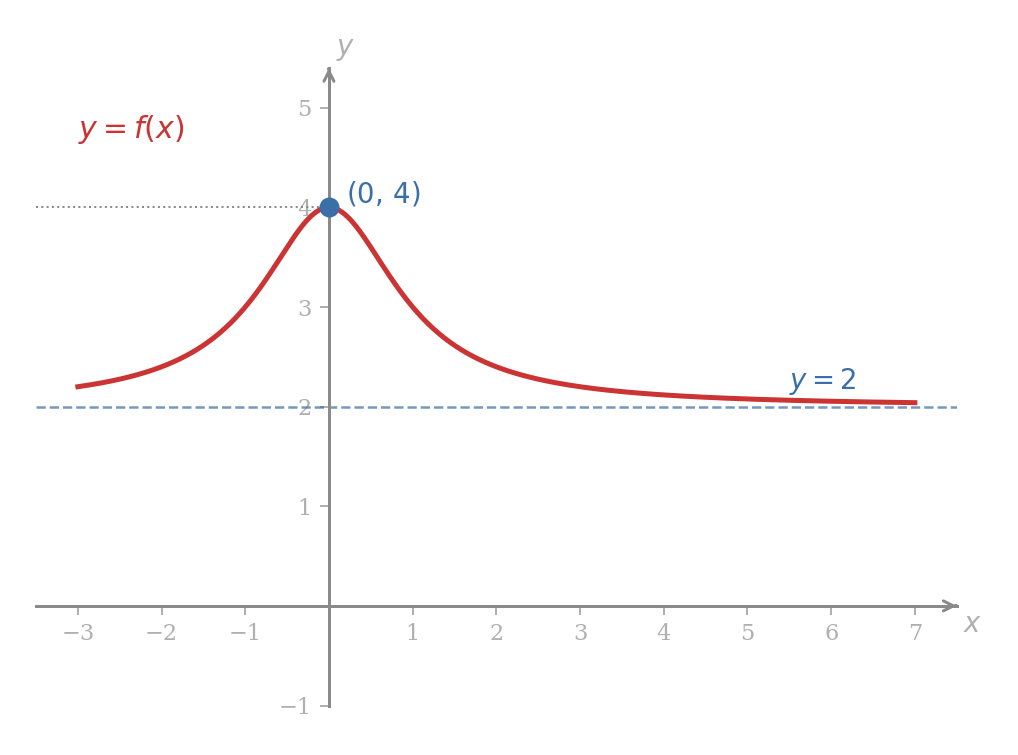
The function graphed above satisfies (the value being attained continuously) and (the horizontal asymptote ). Each of the limits below combines these two facts through the limit theorems of the previous section.
Problem 45
Refer to the graph above for the values of . Compute each limit.
- .
- .
- .
- .
- .
- .
The two limit styles, and , share the same algebraic intuition: the value the function settles on as the input is sent to a chosen limiting position. The mechanical difference is that is not a real number and cannot be substituted into a formula. For rational functions, direct evaluation is replaced by the divide-by-the-largest-power trick of the worked example. The two styles together cover almost every limit needed in the lessons ahead.
Differentiability and Continuity
The limit definition of the derivative declared to be differentiable at when the difference-quotient limit exists, and nondifferentiable otherwise. Up to now this exception has been a footnote: most of the functions in the course are differentiable at every input of their natural domain. The exceptions arise in applied problems (a tariff that changes its rate at a threshold produces one) and sit at the boundary between continuity and the stronger notion of differentiability. This section catalogues the failure modes for each, shows that differentiability is the stricter condition, and gives the standard continuity statements for polynomial and rational functions.
Geometric failures of differentiability
A function fails to be differentiable at an input in one of three principal ways, each visible in the shape of the graph at .
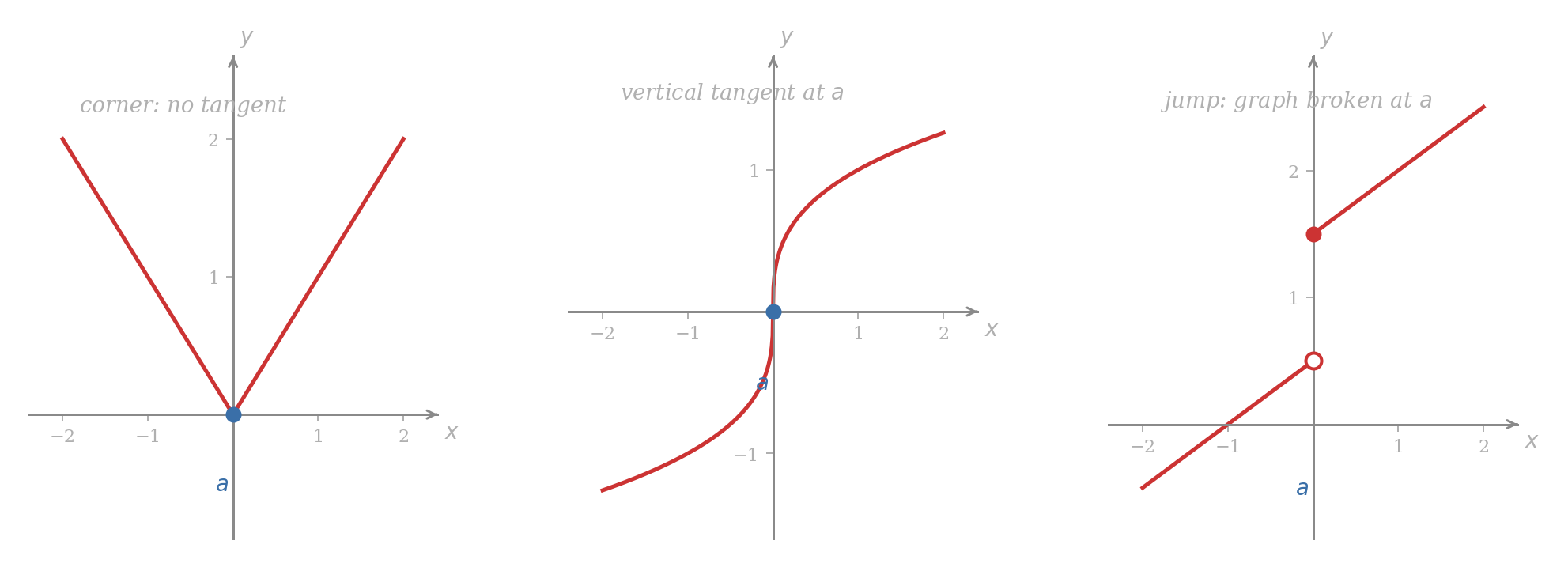
The three failure modes admit clean descriptions in the language already in place.
A corner at , like the absolute value graph at the origin from Lesson 1PM, has the property that the secant slopes computed from the right approach a different value from the secant slopes computed from the left. The difference-quotient limit therefore fails to exist and is undefined.
A vertical tangent at , like the cube root at the origin, has the property that the secant slopes grow without bound as approaches . No real number is approached, so once again the limit fails and is undefined; geometrically, slope is not defined for vertical lines.
A jump at leaves the function discontinuous there, and a discontinuity prevents differentiability outright by the theorem of the next subsection.
A piecewise tariff with a corner
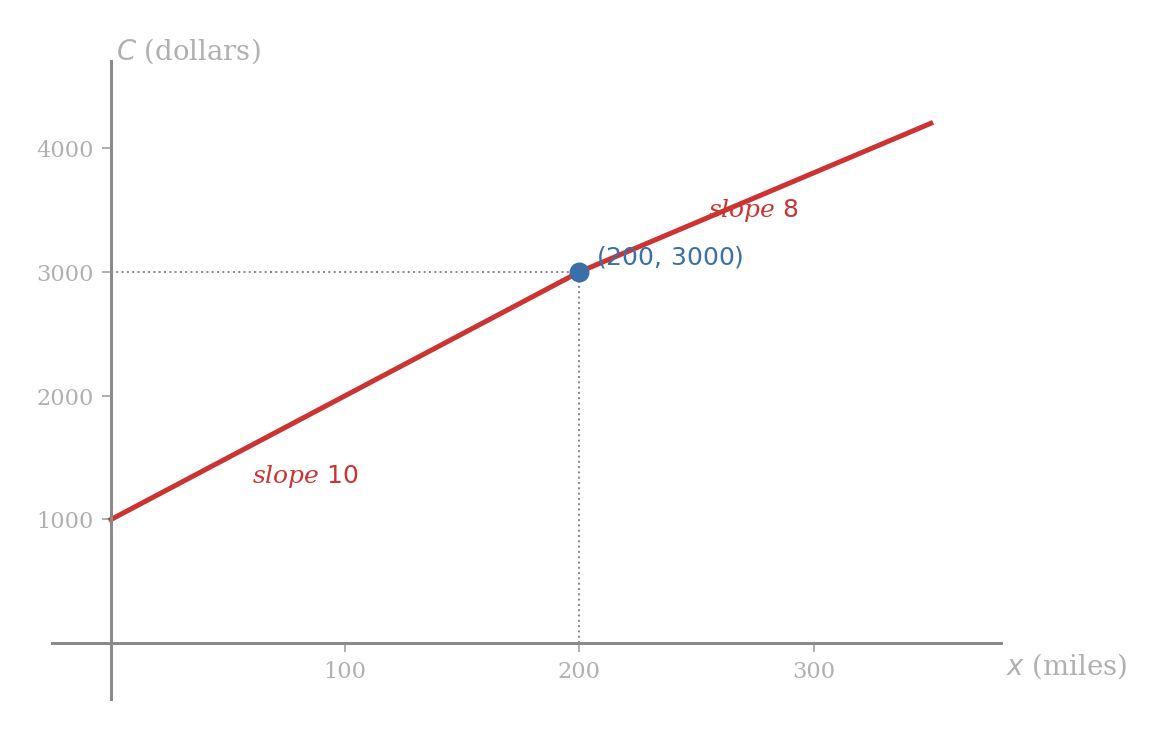
A goods rail operator quotes a flat handling fee of per wagon, plus per mile for the first miles and for each additional mile past . Writing for the total charge of sending a wagon miles,
where the second clause comes from . The two pieces agree in value at the boundary , both giving , so the graph has no jump.
The slopes of the two pieces are different: on the left, on the right. The graph therefore has a corner at , and is non-differentiable there even though it is continuous. Every tariff that switches its per-unit rate at a threshold has the same shape.
Problem 46
A delivery van charges per kilometre for the first kilometre and per kilometre after that, with no fixed fee. Write the cost of an -kilometre delivery as a piecewise function, sketch the graph, identify the input at which is non-differentiable, and explain why the two slopes are not equal there.
Continuity informally
Differentiability turned on the existence of a limit; continuity turns on a softer condition that the graph have no breaks. Informally, is continuous at when the graph passes through without lifting the pen from the paper. Many functions whose graphs have appeared so far are continuous on their natural domains even when they fail to be differentiable: the absolute value function is continuous at its corner, and the piecewise tariff above is continuous at its boundary despite the change in slope.
A discontinuity is more violent: the function value at either fails to exist or sits in a different place from the values nearby. The next example is honest about how this can happen in practice.
A piecewise schedule with jumps
A plant produces up to units in one -hour shift. Each shift carries a fixed overhead of for power, supervision, and the like, and the variable cost of materials and direct labour is per unit. Writing for the cost of producing units in a single day,
Each new shift adds another to the fixed overhead. At the boundary the first formula gives while the second formula gives at any value just above ; the jump of is the cost of opening a second shift. A second jump of the same size occurs at when a third shift becomes necessary.
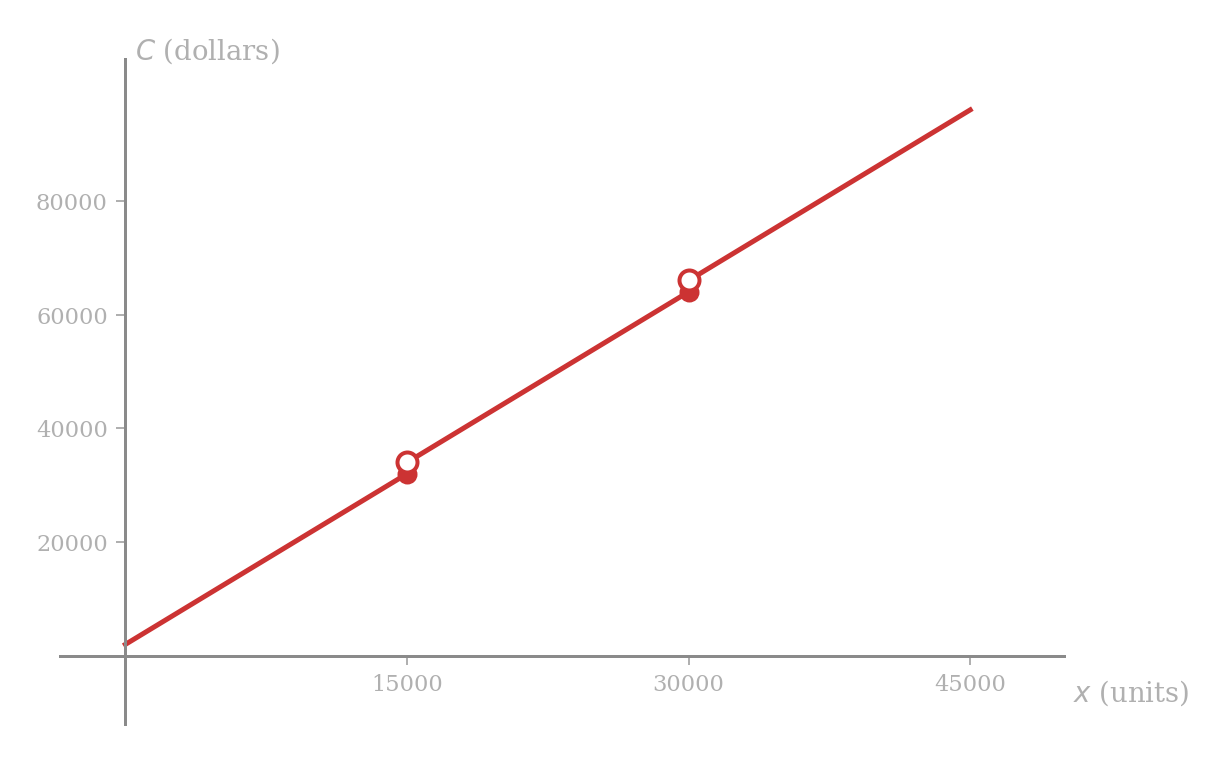
The graph has visible breaks at and . A factory manager facing the second of these breaks can either decline an order that would push production above the threshold or accept the overhead; the discontinuity is what makes that decision a discrete one rather than a marginal one.
Continuity in limit terms
The informal “no break” reading is captured precisely by the limit construction of the previous sections.
A function is continuous at the point if
The function is continuous on an interval, or on a specified collection of inputs, if it is continuous at every point under consideration.
For the equality above to hold, three separate conditions must be satisfied:
- must be defined; that is, must lie in the domain of .
- must exist.
- The limit and the value must agree.
A failure of any single condition produces a failure of continuity at .
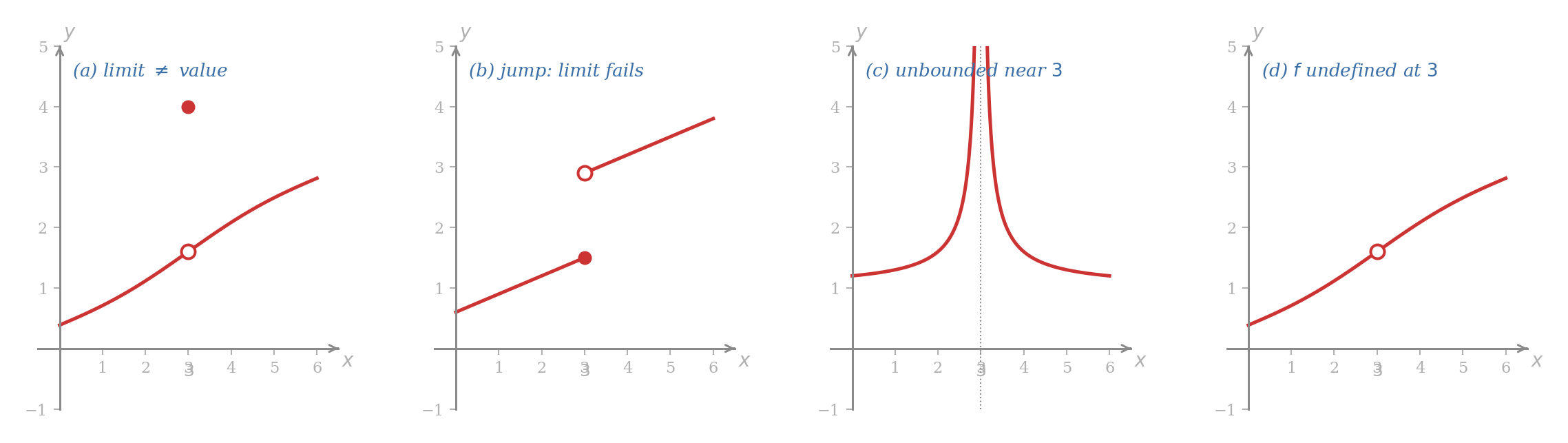
The four panels above each show a function that fails to be continuous at , illustrating different failure conditions.
Panel (a). exists, and is defined, but the two disagree. Condition 3 fails.
Panel (b). does not exist, the values approached from the left and right being different. Condition 2 fails.
Panel (c). does not exist, the values growing without bound on either side. Condition 2 fails.
Panel (d). is not defined; there is no value to compare the limit against. Condition 1 fails.
Problem 47
For each function below, state whether it is continuous at the indicated input, and if not, identify which of the three conditions in the continuity definition fails.
- at .
- at .
- at .
Continuity of polynomial and rational functions
The limit theorems of the polynomial and rational sections turn into continuity statements at every input of the natural domain.
Every polynomial function is continuous at every real number. Every rational function is continuous at every real number with .
For the polynomial case, Limit Theorem VII of the previous section gives at every real . The continuity definition asks for exactly this equality, so is continuous at every .
For the rational case, the natural domain of excludes precisely those with . At every other , Limit Theorem VIII gives , and the continuity definition is again satisfied.
■In particular, every algebraic function written as a polynomial or rational expression is continuous on its natural domain, and the same applies to power functions at every input where the power is defined. The exceptional inputs for which continuity must be checked individually include boundaries between piecewise definitions, roots of denominators, and other inputs where the formula changes its behaviour.
Differentiability is stronger than continuity
The two notions are related, but unequally so.
If is differentiable at , then is continuous at .
The converse is false. The absolute value function from Lesson 1PM is continuous at the origin (the two pieces agree in value there) but not differentiable there (the two pieces disagree in slope), and the haulage cost example above is continuous at but not differentiable there for the same reason. Continuity is the strictly weaker requirement.
Differentiability implies continuity. Suppose is differentiable at , so the limit
exists as a real number. The continuity condition at is , equivalently . Setting , with if and only if , the equivalent form becomes .
For we may write
By Limit Theorem V applied to the product on the right,
the first factor existing by the differentiability hypothesis and the second factor being trivially zero. Hence , equivalently , and is continuous at .
■Equivalently, a function that is not continuous at cannot be differentiable at . The manufacturing cost above is therefore non-differentiable at both and , where it is discontinuous; the railway haulage cost is non-differentiable at , where it is continuous but cornered.
The chain of implications and exceptions can be summarised in two sentences: if is differentiable at , then is continuous at ; if is continuous at , it does not necessarily follow that is differentiable at .
The direction matters. Honesty about it protects us from the standard error of trying to read off a graph that has a jump or a corner there.
Problem 48
For each function below, decide whether is continuous at , and whether is differentiable at . Use the failure mode (corner, vertical tangent, or discontinuity) where appropriate.
- at .
- at .
- at .
- at .