
Slopes and Rates of Change
Rates of Change
Lesson 1 isolated the slope of a linear function as the geometric record of how its output responds to its input. For the AM linear function definition fixed as the number of vertical units gained for each unit step to the right, and the picture made the sign of visible: rising lines have , falling lines have , level lines have , and the steeper the line the larger is. The same number admits a second reading.
The rate of change of the linear function is its slope . Concretely, when the input is increased by any amount , the output changes by exactly , regardless of the input from which the increase begins.
The constancy of this number is the defining feature of linearity: a single value of describes the response of at every point of its domain. Choosing any base point and shifting to ,
which depends on but not on . Dividing by recovers , the slope, on the nose. For this division we assume ; when the output change is but the quotient is undefined.
When the linear function carries a physical meaning, its rate of change inherits one too. The PM lesson’s printing-cost example is a typical case: a publisher whose total cost satisfies pays a fixed overhead of at the -intercept and an additional for each further copy, so the slope is the cost incurred when one more copy is produced. This unit-step reading of the slope is common enough in cost models to deserve a name of its own.
For a linear cost function giving the total cost of producing units of a commodity, the slope is called the marginal cost of the commodity: the additional cost incurred when production is raised from units to units, the same number for every .
Marginal cost is the cost-specific name for the slope; the underlying object is still the rate of change of . Two further examples display the rate-of-change reading in different physical guises.
A heated greenhouse is filled to capacity with litres of biofuel on the first morning of October, and the heating system draws fuel at a steady litres per day until the next delivery. Writing for the number of days since the fill and for the volume of fuel remaining,
The -intercept records the initial fill, and the slope records the rate at which the volume changes with time: each additional day removes litres, the negative sign signalling that the change in is downward. The same slope furnishes both the steepness of the graph and the consumption rate of the heater; in the linear case the two readings coincide.
The publisher of the PM lesson writes down the value of its main printing press for tax purposes by a fixed monetary amount each year. If the press was bought for and the agreed annual depreciation is , then years after purchase the book value is
defined on the interval , where first reaches zero. The slope records the annual rate of decrease, and the line meets the horizontal axis at , identifying the year in which the press is fully written down. Both numbers fall straight out of the linear form by the readings established above.
Problem 25
A reservoir contains cubic metres of water on the first day of a drought, and is drawn down at a constant rate of cubic metres per day until rains return. Write the volume of water remaining as a linear function of , state its slope and -intercept, identify the day on which the reservoir is empty if no rain has fallen by then, and compute .
The reading of the slope above rests entirely on the linearity of . Removing linearity destroys the constancy on which the definition relied: a curved graph does not gain a fixed amount per unit step, and the question how fast is changing? no longer has a single answer covering every input.
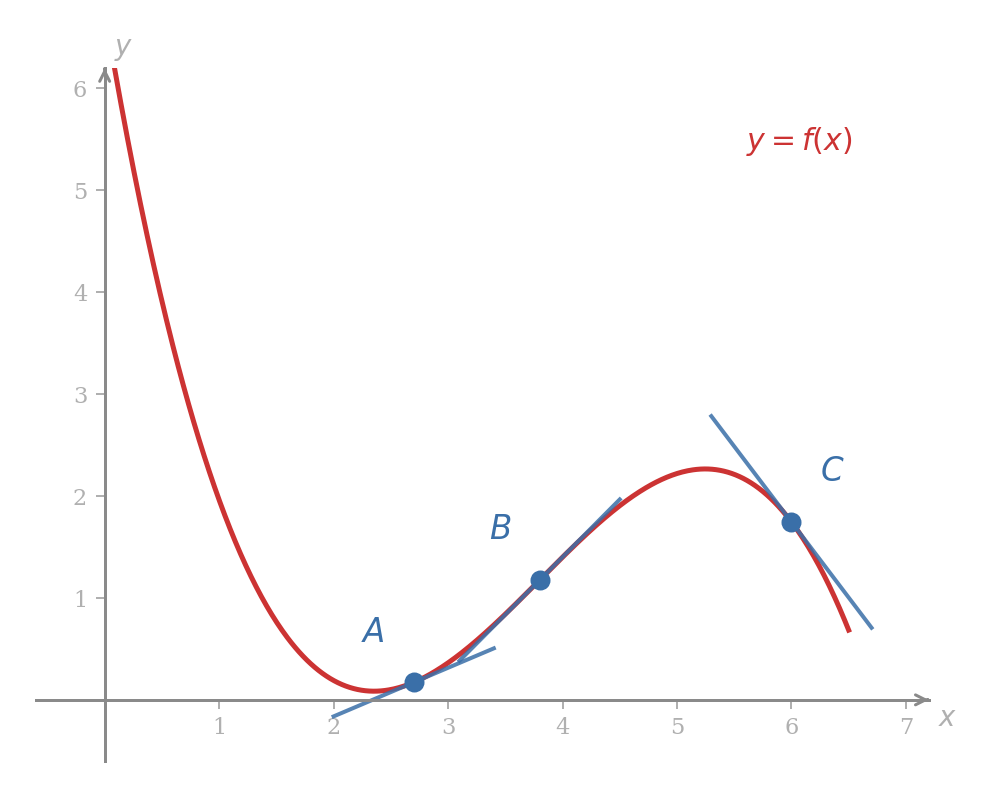
The graph above makes the point unmistakable. At the curve is rising, but only gently; at , further along, it is rising much more steeply; at it is falling. The eye reads three distinct rates of change at three distinct points of one and the same function. We have neither a definition that covers them nor a number to attach to any one of them; only the linear-case definition, which fails as soon as we drop linearity.
The way out is to look at two points on the graph rather than one. Through any pair of distinct points on the graph of there passes a unique straight line, and that line, being linear, has a slope to which the previous reading applies. Taking the two points to be and and computing the slope by rise over run gives
the difference quotient introduced at the close of the PM lesson. The smaller the gap between the two points, the more the connecting line resembles whatever line we would draw to capture the steepness of the graph at alone.
The intuition is that as shrinks towards zero the difference quotient should approach a single number describing the steepness of at . To make this precise we need a way to talk about the value an expression approaches as one of its inputs is sent to a limiting position, even when substituting the limiting value directly is not permitted; here is forbidden because the difference quotient divides by . The tool that supplies this is the limit, taken up by a coming lesson. Before approaching it, we settle a handful of properties of the slope that the limit argument and most subsequent calculations will rely on.
Properties of the Slope of a Line
Five properties of the slope recur throughout the course; together they amount to the whole working theory of straight lines on which the limit construction will sit. We collect the statements first, demonstrate each in a short example, and verify them at the end of the section.
Starting from any point on a line of slope and moving one unit to the right, returning to the line requires moving exactly units in the vertical direction.
This is the geometric content the AM linear function definition recorded as “each unit step in raises by exactly ”; it is restated here as a property of the line so that the verifications can speak about it cleanly.
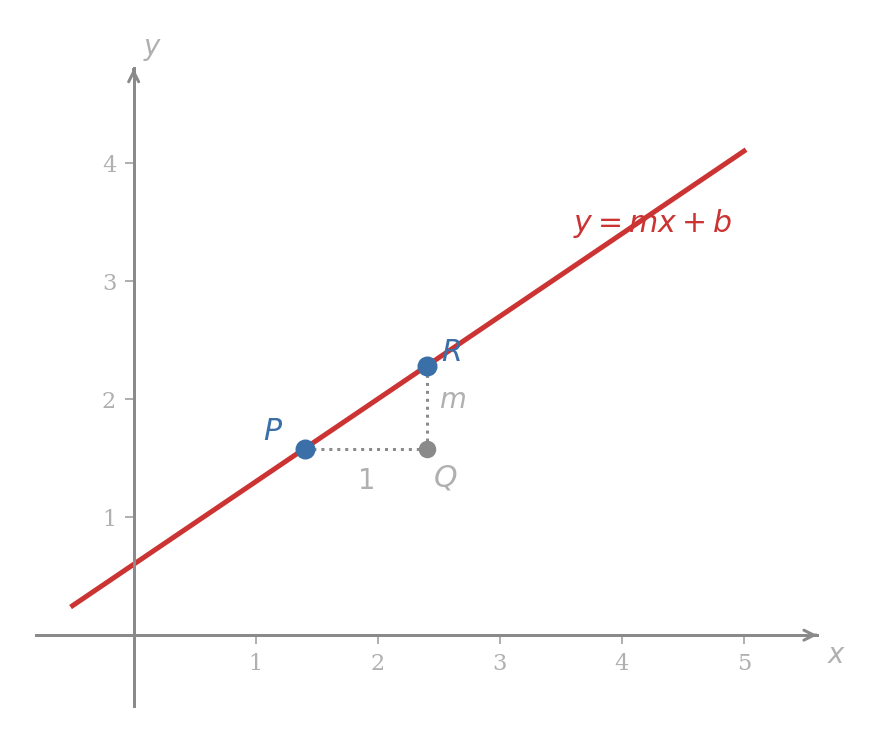
For two distinct points and on a non-vertical line of slope ,
The right-hand side is unchanged on swapping the roles of the two points: both numerator and denominator change sign together.
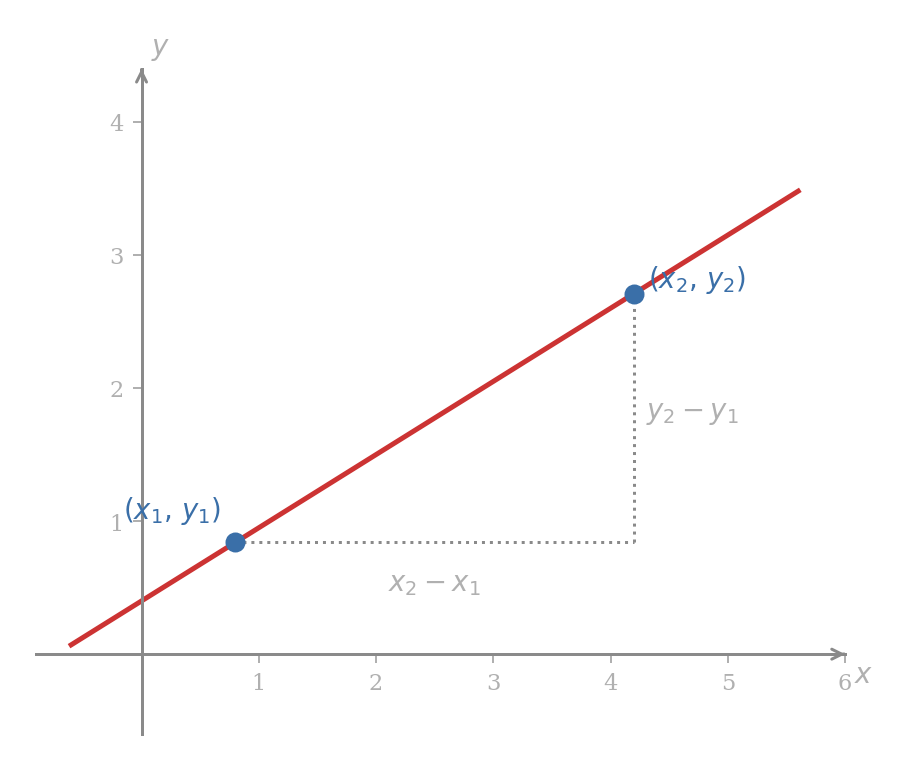
A non-vertical line of slope passing through the point has the equation
This equation is the point-slope form of the line.
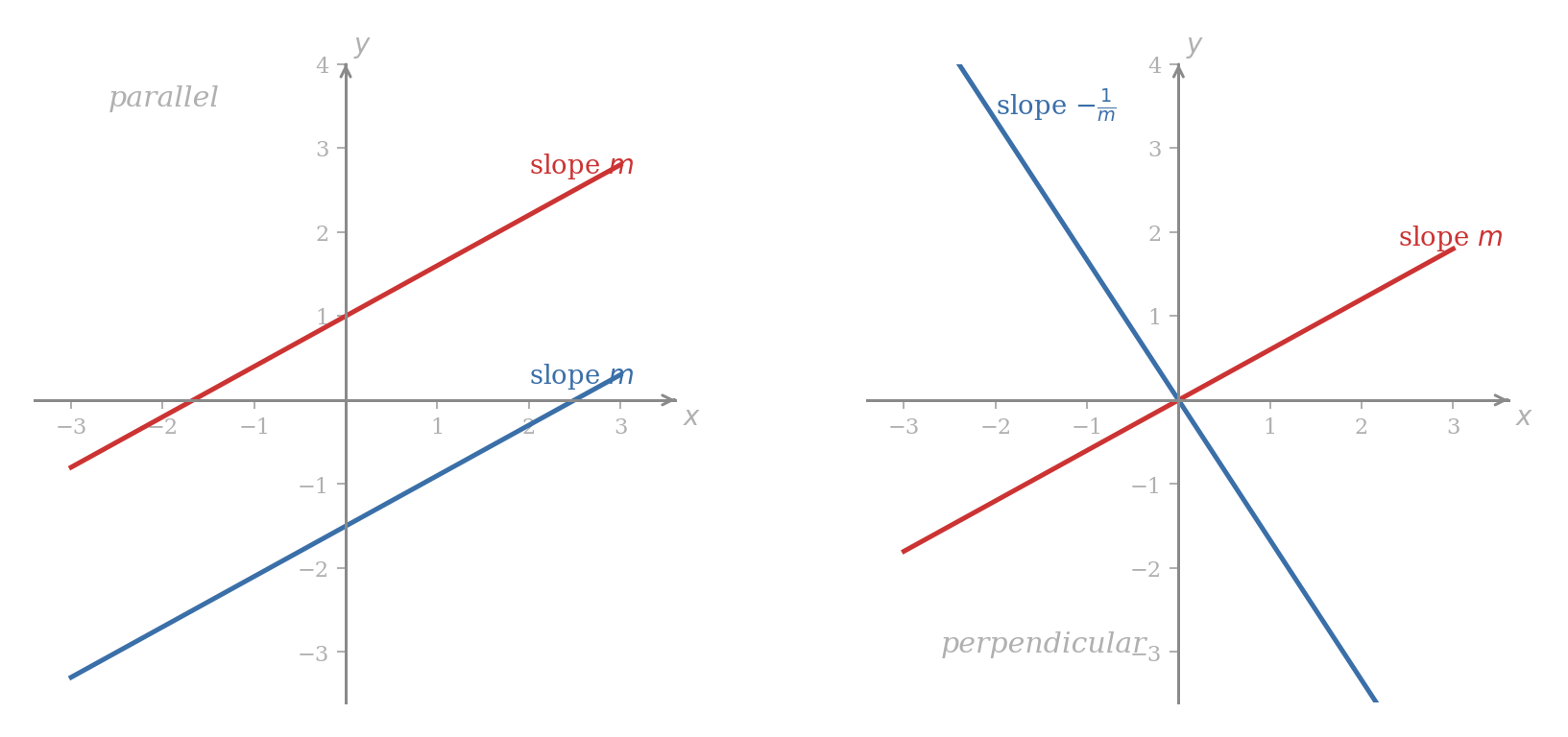
Two distinct non-vertical lines are parallel if and only if they have the same slope.
Two non-vertical and non-horizontal lines are perpendicular if and only if the product of their slopes is .
Calculations using the properties
Find the slope and -intercept of the line .
The line is non-vertical because the coefficient of is non-zero, so we may put the equation in the slope-intercept form of the AM lesson by isolating ,
The slope is and the -intercept is .
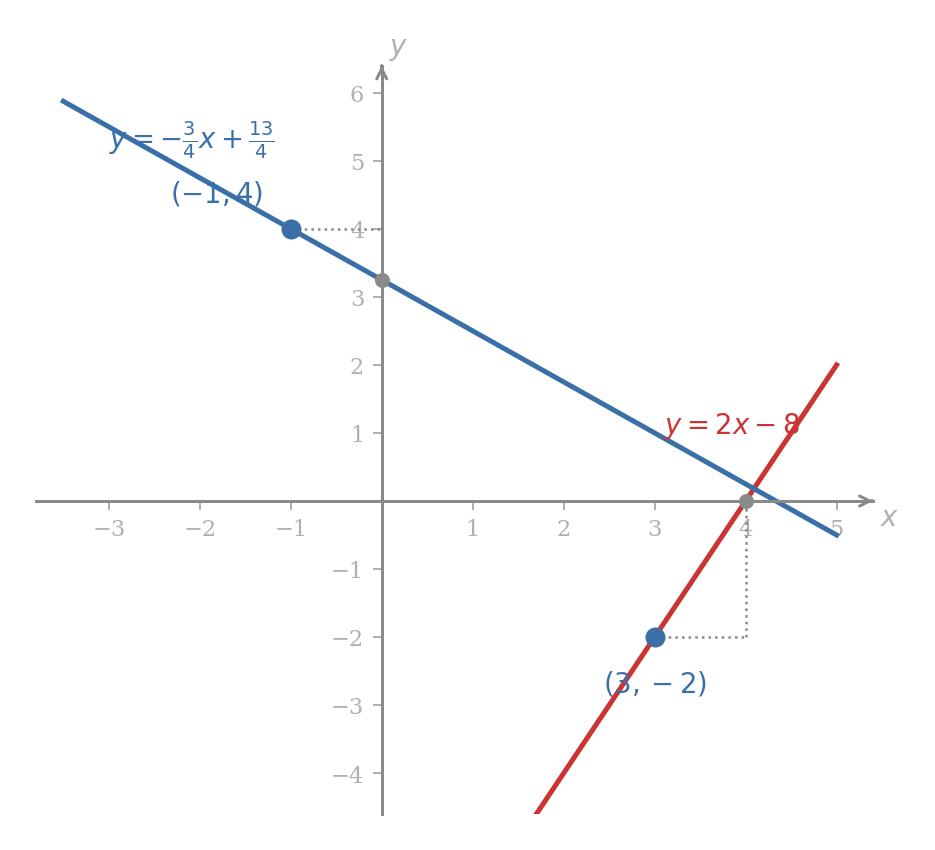
Sketch the line of slope through .
By slope property 1, starting at and moving one unit right lands at , off the line by an amount equal to the slope; moving units upwards from there lands at , which is on the line. The line is then drawn through and .
The same procedure with the slope through proceeds identically: from a unit step right reaches , and a vertical move of reaches , the second point used to draw the line.
Problem 26
Sketch the line of slope through by the unit-step procedure of slope property 1, identify a second point on the line by the same construction, and write the line in the form .
Find the slope of the line through and .
By slope property 2 with and ,
Reversing the labelling produces the same value, , in line with the symmetry noted alongside Property 2.
Problem 27
Find the slope of the line through and , and confirm that swapping the two points produces the same value.
Find an equation of the line of slope through .
Slope property 3 with and gives
The slope-intercept form follows by isolating , namely .
Find an equation of the line through and .
Slope property 2 furnishes the slope first,
and slope property 3 with the first point completes the equation,
A check using the second point: , as required.
Problem 28
Find an equation of the line through and in slope-intercept form, and verify your answer by substituting both given points back into it.
Find an equation of the line through parallel to .
First put the given line in slope-intercept form: , so , of slope . Slope property 4 says any line parallel to it has the same slope, and slope property 3 then gives
Find an equation of the line through perpendicular to .
The given line has slope . By slope property 5 the perpendicular slope satisfies , hence . Slope property 3 then supplies
Problem 29
Find an equation of the line through that is perpendicular to , and confirm by computing the product of the two slopes that slope property 5 holds.
Problem 30
For each of the lines below, state the slope and the -intercept.
- .
- .
- The line through and .
- The line through parallel to .
Slope as a Rate of Change Across an Interval
The previous section read the slope of as the unit-step rate of change. Slope property 2 upgrades this reading to arbitrary intervals: for , as runs from to , the value of runs from to , and the rate of change of over the interval is
by slope property 2. The slope is therefore the rate of change of over every interval, not only over a unit step. This constancy across all intervals is what makes a function linear; later lessons take up what happens when it fails.
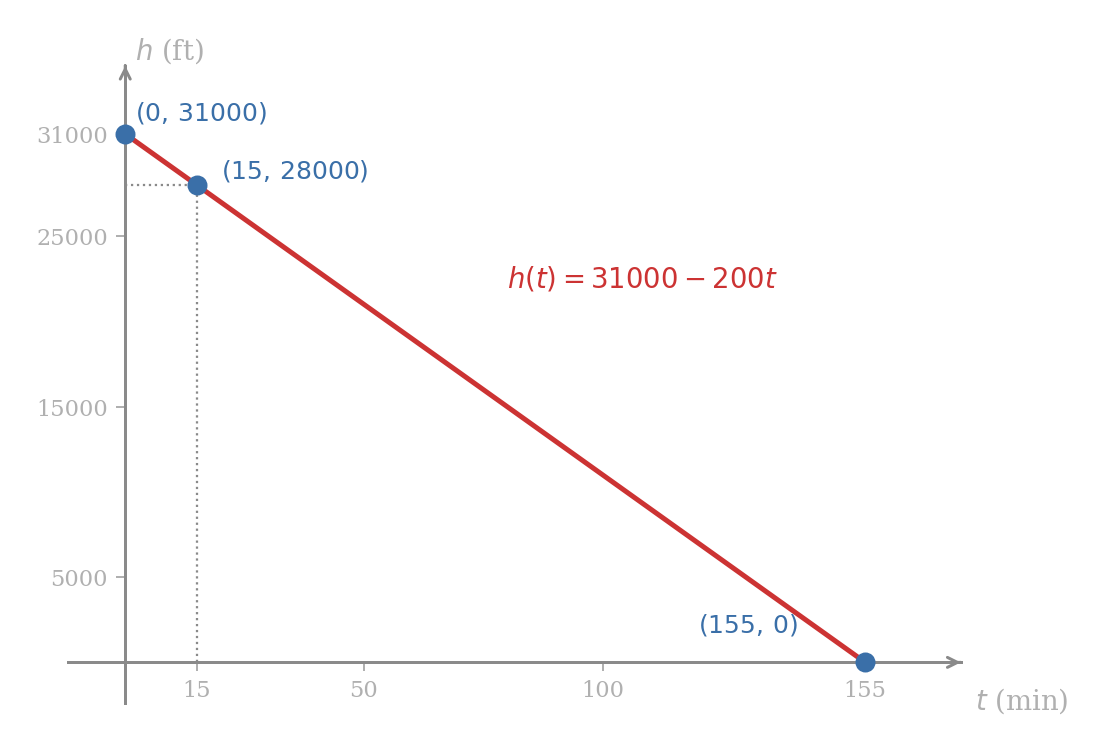
An airliner descends at a constant rate. Air traffic records show that at fifteen minutes into the descent the aircraft is at feet, and the descent rate is feet per minute. Writing for the number of minutes since the descent began and for the altitude, the constancy of the rate makes a linear function with slope , so for some constant . Substituting the recorded value ,
and the altitude function is . The starting altitude was feet, and the aircraft will reach the ground at the input for which , that is at minutes.
Problem 31
A storage cylinder of liquid nitrogen evaporates at a constant rate. At three hours past the start of an experiment the cylinder holds litres, and at seven hours past the start it holds litres. Find the volume as a linear function of the time in hours, identify the time at which the cylinder is empty, and state the volume at .
Verification of the properties
The verifications proceed in the order , , , , . The first three are pure algebra from the slope-intercept form; the last two require a small piece of plane geometry.
We use the Pythagorean theorem and its converse: in a right triangle with legs of lengths and and hypotenuse of length , one has , and conversely if then the angle opposite the side of length is a right angle. In the proof below we write for the length (distance) of the segment joining two points and .
Property 2. Let the non-vertical line have equation , and let and be two distinct points on it. Then and , and subtracting,
The two points being distinct on a non-vertical line forces , since equal -coordinates would force equal -coordinates by the slope-intercept formula. Dividing by ,
which is the claim.
■Property 3. Rewriting as
shows it is in slope-intercept form, with slope and -intercept , so it describes a line of slope . Substituting gives , so the point lies on this line. A line of slope is determined by any one of its points, so this is the unique such line through .
■Property 1. Let the line have slope and let be a point on it. The point obtained from by moving one unit to the right has coordinates , and we look for the height at which the line crosses the vertical line . By slope property 2 applied to the points and ,
Hence , which is the vertical displacement from to the line, as claimed.
■Property 4. Let two distinct non-vertical lines have equations and . They are parallel exactly when they fail to intersect, that is, exactly when the equation
has no solution in . Rearranging gives . If the equation has the unique solution , so the lines do meet, contradicting parallelism. If then the equation collapses to ; this holds for some only when , in which case the two lines coincide and are not distinct. The remaining case with leaves the equation with no solution, and the lines are parallel. Thus distinct non-vertical lines are parallel exactly when their slopes coincide.
■Property 5. Shifting both lines by the same horizontal and vertical amounts changes neither the slopes nor the angle between them, so we may shift each line so that it passes through the origin without altering perpendicularity or slope. Assume then that both lines pass through the origin with slopes and , neither vertical nor horizontal, so and are finite and non-zero. The first line contains the point and the second contains , and both lines pass through . The triangle has a right angle, if anywhere, at , since the sides and lie along the two lines that meet there. By the converse of Pythagoras’ theorem the triangle is right-angled at exactly when
Each squared side length is computed by Pythagoras on a right triangle with axis-parallel legs: from to to gives , the same construction with in place of gives , and since and share the same -coordinate, . Substituting,
which simplifies to , that is, . The converse retraces the same identity backwards, so if and only if the lines are perpendicular.
■The Slope of a Curve at a Point
Two of the readings established for a line, the rise-over-run formula and the rate-of-change interpretation, both depend on the line having a single slope. A curve has no single slope. The first task of this section is to attach a slope to a curve at one of its points; the second is to read that number, when it is available, as a rate of change at that point.
Tangent line at a point
The geometric idea is most familiar in the case of a circle. A line is tangent to a circle at a point if it meets the circle only at , leaving the circle entirely on one side. Looking at a small region around , the circle bends so gently that it is hard to distinguish from the tangent line itself; on closer inspection the circle bends a little, but increasing the magnification reduces the discrepancy without bound.
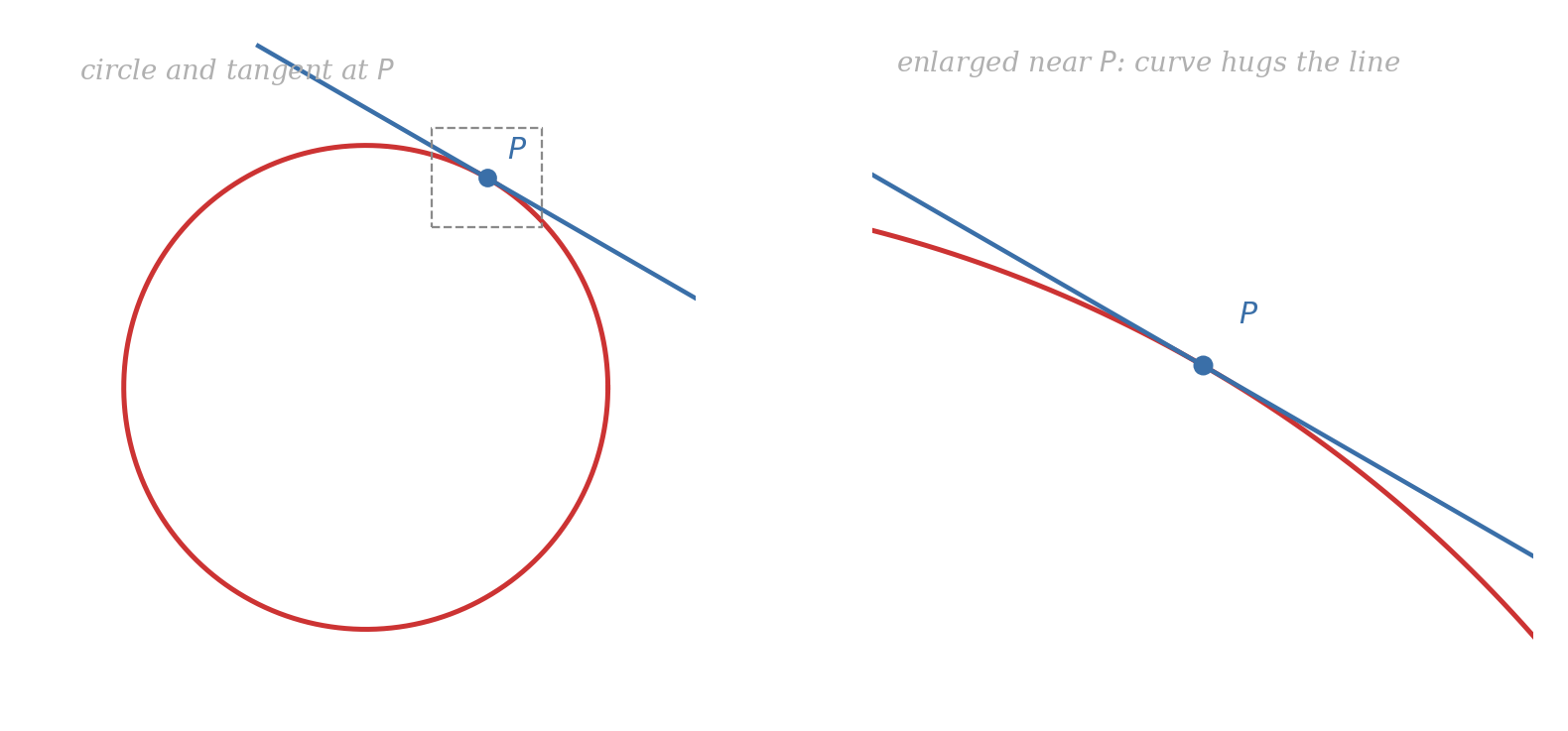
The same picture works for a smooth curve that is not a circle, provided the curve has a definite direction at . Zooming in repeatedly on a small region around makes the curve look straighter; under sufficiently strong magnification the curve becomes indistinguishable, on the screen, from a single straight line. This line is what we mean by the tangent line to the curve at .
The tangent line to a curve at a point on it is the straight line through that the curve approaches under successively higher magnification near . When this tangent line has a slope, the slope of the curve at is defined to be the slope of its tangent line at .
The phrase “approaches under successively higher magnification” carries the same intuition the difference quotient of the previous section gestured at: as the second point on the curve moves towards , the line through the two points approaches the tangent line. A coming lesson will replace this intuition with a precise construction by means of the limit, but the geometry is enough for the present section, in which we work from pictures and from one closed formula.
A curve does not always carry a tangent line. The absolute value graph from the PM lesson has a sharp corner at the origin: zooming in on never makes the corner straighten out, and no single line approximates the graph there. We will keep silent about such points until the limit machinery lets us speak of them precisely.
Reading slopes off a graph
When the tangent line is drawn on a graph, its slope can often be read directly by slope property 1 of the previous section: starting from the point of tangency, move one unit to the right and observe the vertical shift back to the line.
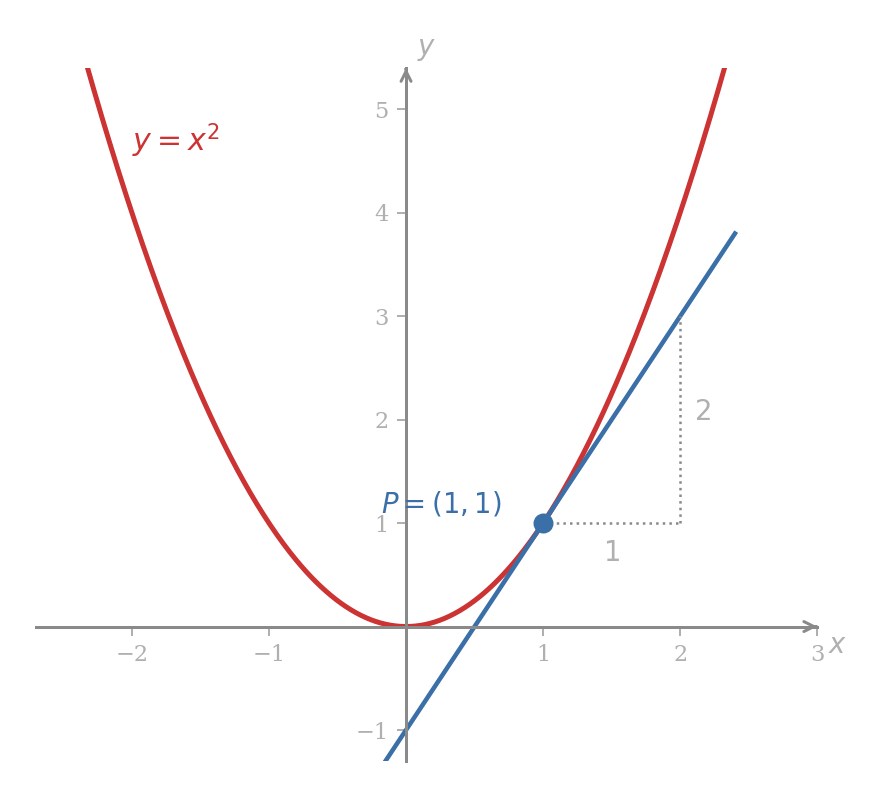
The graph of and its tangent line at the point are shown below. From the figure, a unit step to the right of takes the tangent line up by exactly units, so by slope property 1 the tangent slope is , and the slope of the curve at is therefore as well.
Problem 32
The tangent line to the graph of a function at the point is drawn alongside the graph and is observed to fall by units for every units of rightward motion. State the slope of at and give an equation for the tangent line in point-slope form.
The slope as an instantaneous rate of change
The previous section read the slope of a linear function as its rate of change, valid at every input because of constancy. For a curve, the slope at is defined as the slope of the tangent line at , and the tangent line is precisely the linear approximation of the curve near . Replacing the curve by its tangent line near , the same rate-of-change reading carries through, but now restricted to the single input .
The instantaneous rate of change of a function at a point on its graph is the slope of the curve at , that is, the slope of the tangent line at when that tangent line has a slope.
For a linear function the instantaneous rate of change at every input equals the slope , recovering the previous section’s definition. For a curve, the instantaneous rate of change varies from point to point and records how fast the function is changing at each individual input.
A hospital’s emergency diesel generator runs through a -hour period of heavy load, with its consumption monitored by a precision flow meter. Writing for the time in hours since midnight and for the volume of fuel in the tank in litres, the recorded curve is non-linear: the generator burns fuel faster during peak operating hours than during quieter ones. The point marks the volume at a.m.
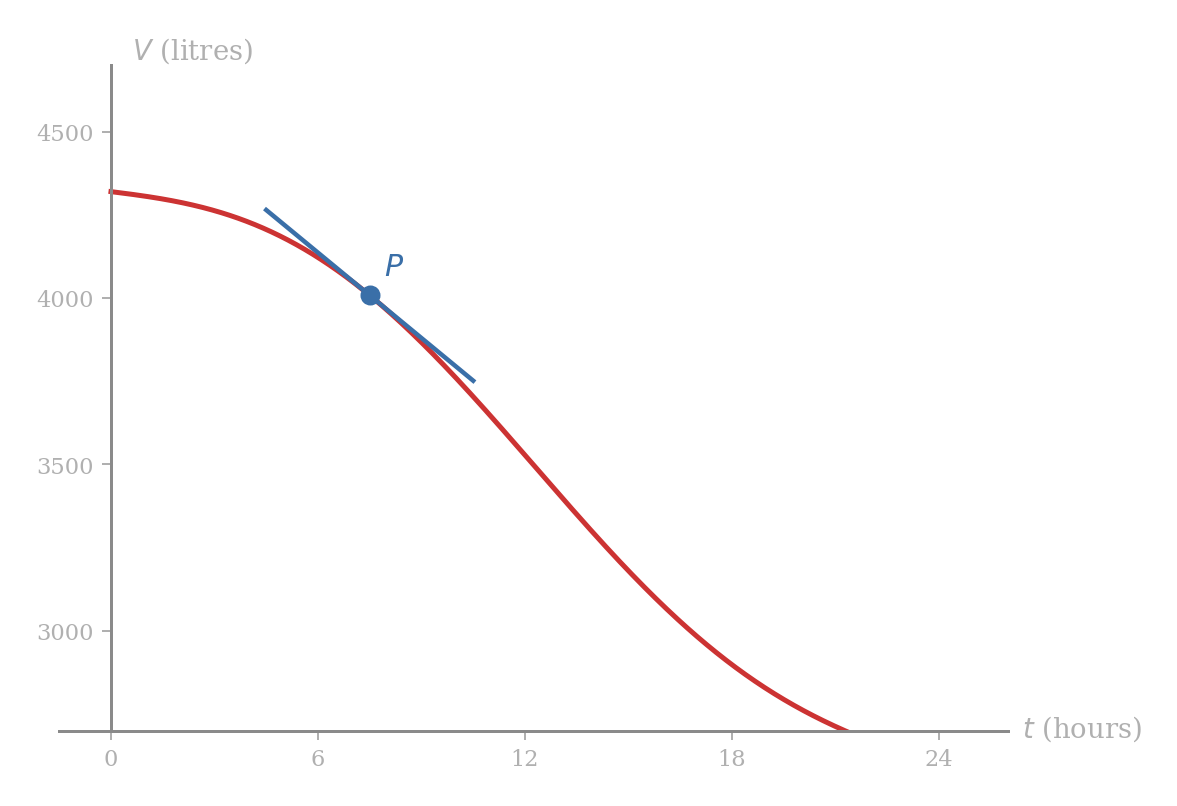
The tangent at falls clearly. Reading its slope off the figure as approximately litres per hour, the generator is consuming fuel at about litres per hour at that instant. At a quieter hour the tangent would be shallower and the instantaneous rate smaller; at noon, when the curve is at its steepest in the figure, the tangent slope is more negative still and the rate correspondingly larger. A linear model would replace the entire curve by a single straight line of constant slope and report only the average over the day, losing this detail.
Problem 33
A car’s odometer is recorded continuously during a journey and produces a graph of distance against time on which the slope at any point of the curve gives the speed of the car at that instant. If the tangent line at the point , where time is measured in minutes and distance in kilometres, has slope , state the speed of the car at the recorded instant in kilometres per minute and convert the answer to kilometres per hour.
A slope formula for
Reading slopes off a graph by eye is the right place to start, but it is too imprecise to be useful when the slope is needed at many points at once. For most curves the slope at each point can be packaged in a single closed formula; the derivation belongs to a coming lesson, but the formula for the simplest curved graph, the parabola , is worth stating and using now.
The slope of the parabola at the point is . Equivalently, the tangent line to at has slope and equation
The proof is deferred to a coming lesson, where the limit construction needed to obtain it will be in place.
The formula is consistent with the picture: at it returns slope , agreeing with the previous example; at it returns slope , agreeing with the horizontal tangent at the vertex of the parabola; for it returns a negative slope, agreeing with the left branch descending toward the vertex.
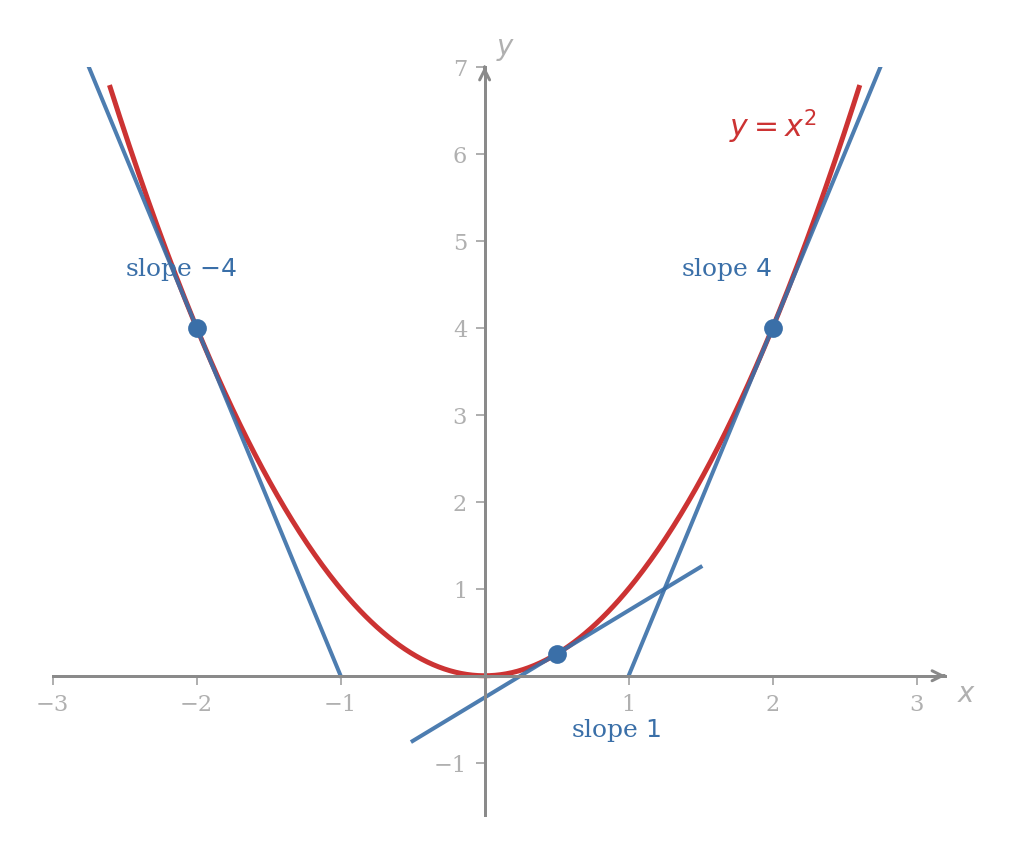
Find the slope of at the point , and write an equation for the tangent line at that point.
The -coordinate of the point is , so the slope formula gives slope . By slope property 3 of the previous section, the tangent line in point-slope form is
or, isolating , .
The slope formula gives at , so the tangent line to at the origin is horizontal, with equation . Geometrically, the parabola has its vertex at the origin and the horizontal axis just grazes it there, in agreement with the unit-step picture: any unit step from along the tangent leaves unchanged.
Problem 34
For the parabola :
- Find the slope at the points , , and .
- Write an equation of the tangent line to at the point in point-slope form, and convert it to slope-intercept form.
- At which point of the parabola is the tangent line parallel to the line ?