
Review of Functions, Continued
Lines in the Plane
The AM lesson introduced a straight line through its slope-intercept formula and read its graph directly as an instance of the linear function definition. That formula misses one family of lines, the perfectly vertical ones, and until we put them back we cannot say cleanly which equations in two variables describe graphs of functions and which do not.
Every line in the -plane satisfies an equation of the form
where , , are real constants and and are not both zero. When , we may divide by and solve for ,
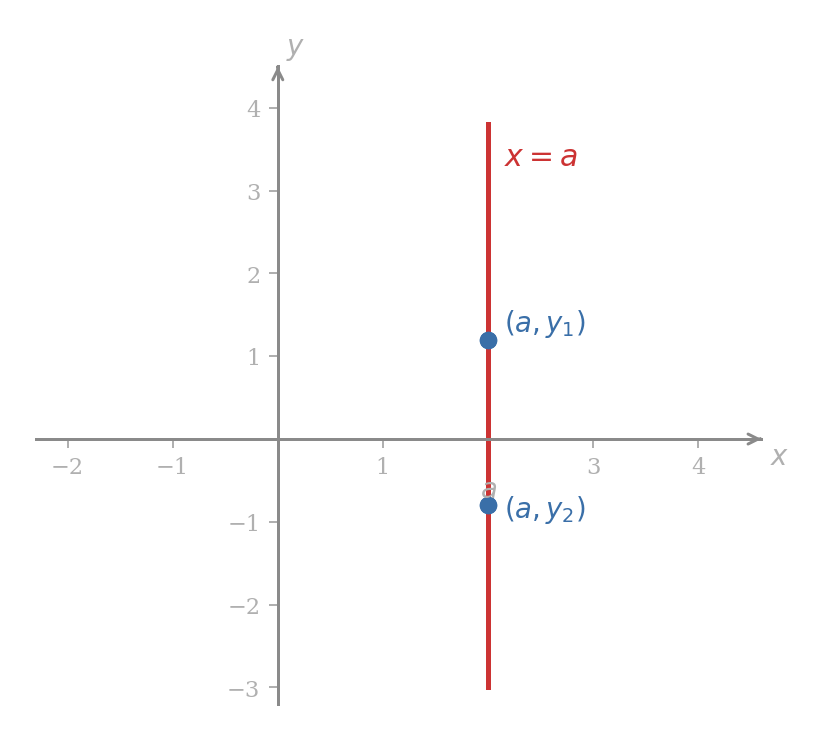
so the line is the graph of the linear function already named in the AM lesson. When , the equation collapses to ; since is then non-zero, dividing by it gives with . This last equation picks out every point whose -coordinate equals , and so traces the vertical line through .
A vertical line meets itself at every point on it, in particular at all heights above . The vertical line test of the AM lesson then rules at once that is the graph of no function of : a single input would have to carry infinitely many outputs, contradicting single-valuedness.
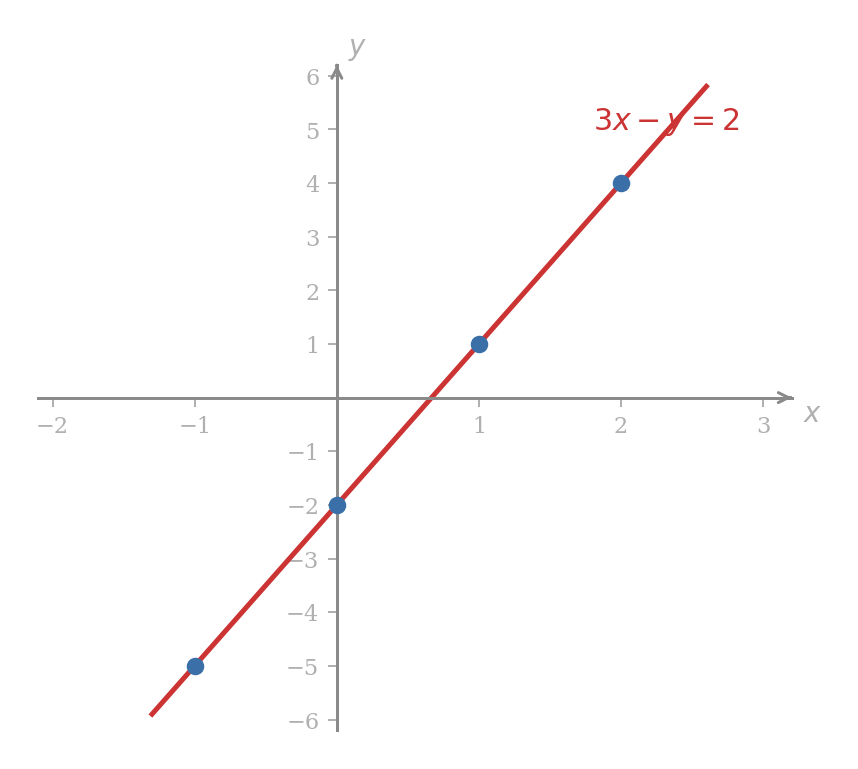
From a general equation to a sketch. To sketch the line , first solve for :
The equation is now in the form of the AM linear function definition, with slope and -intercept . Tabulating at four inputs to verify the slope and give a cleaner sketch,
| x | -1 | 0 | 1 | 2 |
|---|---|---|---|---|
| y | -5 | -2 | 1 | 4 |
each unit step in raises by exactly , consistent with the slope. The graph is the straight line through these points.
Problem 11
Put the equation in the form , identify its slope and its -intercept, and sketch the resulting line.
Intercepts
The AM linear function definition already names the point at which the line meets the vertical axis: if , then , so the -intercept is . The corresponding point on the horizontal axis has not yet been named.
An -intercept of the graph of a function is a point at which the graph meets the horizontal axis. Every point of the horizontal axis has -coordinate zero, so an -intercept has the form where is a real number in the domain of satisfying .
For a non-horizontal linear function with , the equation has the single solution , so the graph has exactly one -intercept, namely . If and the graph is a horizontal line at height and has no -intercept; if and the graph is the horizontal axis itself, and every one of its points is an -intercept.
Both intercepts of . Reading off the definition, the -intercept is . For the -intercept we solve , which gives , so the -intercept is . The two intercepts alone pin down the line.
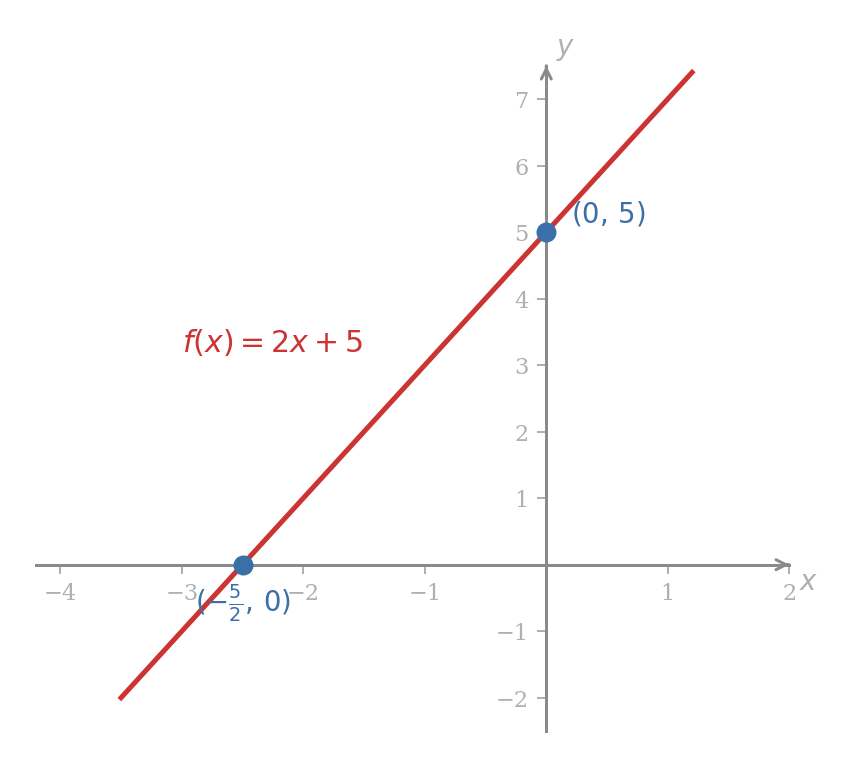
Reconstructing a line from two intercepts. Suppose a line is known to pass through and . These are, respectively, its -intercept and an -intercept, so and the slope is the rise divided by the run , that is . The line is .
Problem 12
Find both intercepts of the line and sketch it using only those two points.
Linear Models
Linear functions earn their prominence from the many real-world quantities that depend on one another by a constant rate plus a fixed offset. The derivative, which the lessons ahead will introduce, generalises the idea of a rate to curved graphs; the linear case is the template.
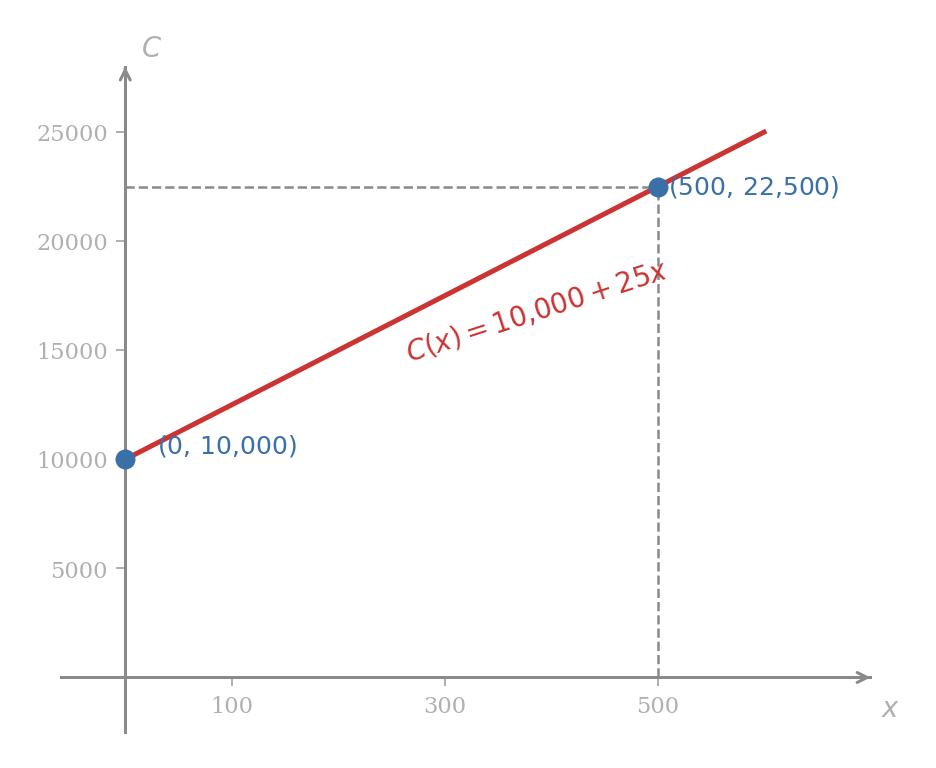
A monthly cost. A small publisher prints a bound booklet at a reproduction cost of per copy and pays fixed overheads of each month for premises, licences, and staff retainers that do not depend on the run size. Writing for the number of copies produced in a month and for the total cost in pounds,
The fixed overheads supply the -intercept , while the per-copy charge supplies the slope. At a run of copies,
Since counts physical copies, the admissible inputs are the non-negative integers; the formula is nevertheless defined on the full ray , and we draw the graph there for readability.
Problem 13
A courier has a fixed daily charge of and a per-kilometre rate of . Write the total daily charge for a route of kilometres as a linear function, state its slope and -intercept, and compute .
Piecewise Linear Functions
The piecewise construction introduced in the AM lesson, combined with the linear functions just revisited, gives a flexible class of graphs: straight on each piece of the domain and potentially bending or jumping at the boundaries. Such functions arise whenever one linear rule is replaced by another past a threshold, as in tariffs, tax brackets, and shipping charges.
A piecewise linear function with a jump. Define
For strictly less than the top clause applies and the function is constantly , so the graph is the horizontal ray at height approaching but not reaching the point ; the endpoint is drawn with an unfilled circle by the convention of the AM lesson. For the bottom clause applies; at the boundary , drawn as a filled circle, and the graph continues to the right as the linear ray of slope through . Three sample values,
confirm the switchover.
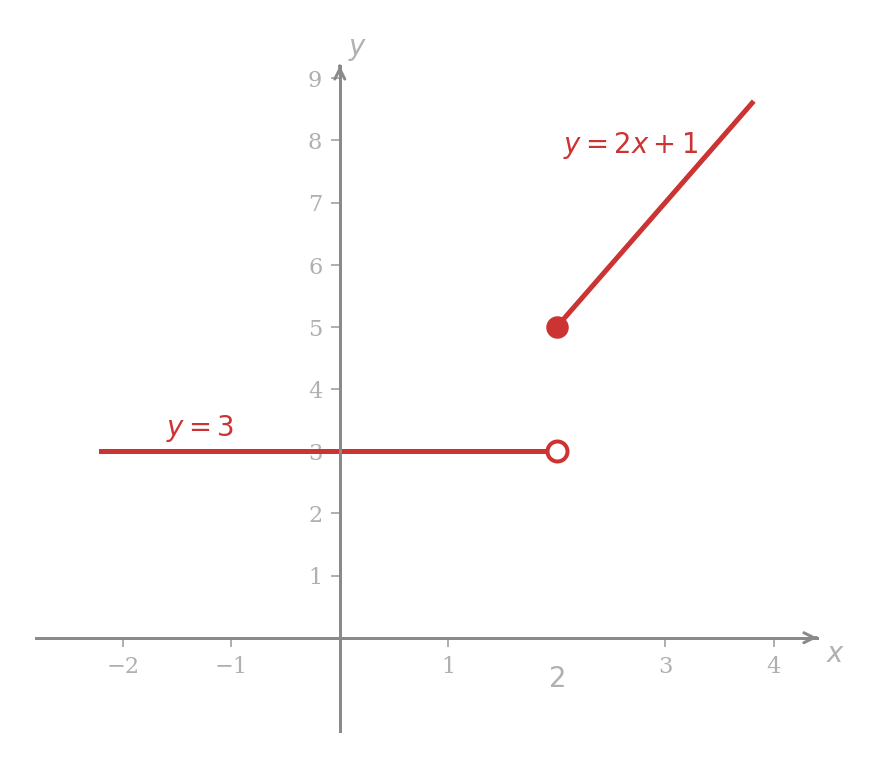
The visible gap between the two pieces at is a jump. The idea will return in the lessons ahead as the simplest way a function can fail to be continuous, and in turn to be differentiable. Piecewise linear functions are therefore our first and cleanest laboratory for the questions differentiation will ask.
Problem 14
Let
Sketch the graph of , state its natural domain, and compute , , and . Does the graph have a jump at ?
Problem 15
A phone plan charges per month for up to minutes of calls, and for each additional minute beyond the first hundred. Writing for the monthly charge in pounds as a function of the total call minutes , express as a piecewise function on and compute and .
Quadratic Functions
The parabola of the AM lesson is the simplest instance of a broader family. Quadratic functions arise as the first curved graphs for which the vertex, the intercepts, and the direction of opening are recoverable from the formula alone, and they will be the first curved graphs whose tangent lines the derivative will compute.
A quadratic function is a function of the form , where , , are real constants and . Its natural domain is the whole number line. The graph of a quadratic function is called a parabola; it opens upward when and downward when .
Every parabola has a single point at which the graph reverses direction, the highest point when the parabola opens downward and the lowest when it opens upward. Completing the square locates that point exactly.
A theorem is a statement we promise to back up with a proof. The box below states one, and the proof comes immediately after. Once proved, we can quote the theorem by name later on without redoing the argument.
A proof is that argument: a chain of steps showing the theorem follows from the definitions and earlier theorems already on the table. Each step has to lean on something already introduced, never on something later in the notes.
Let with . Then attains its extreme value at
The point
is called the vertex of the parabola.
Completing the square on the leading two terms of ,
The squared factor is non-negative and vanishes precisely when . If , the first summand is non-negative and so for every , with equality at ; the extreme value is therefore a minimum. If , the first summand is non-positive and the same calculation yields a maximum at the same . In either case , which is the claim.
■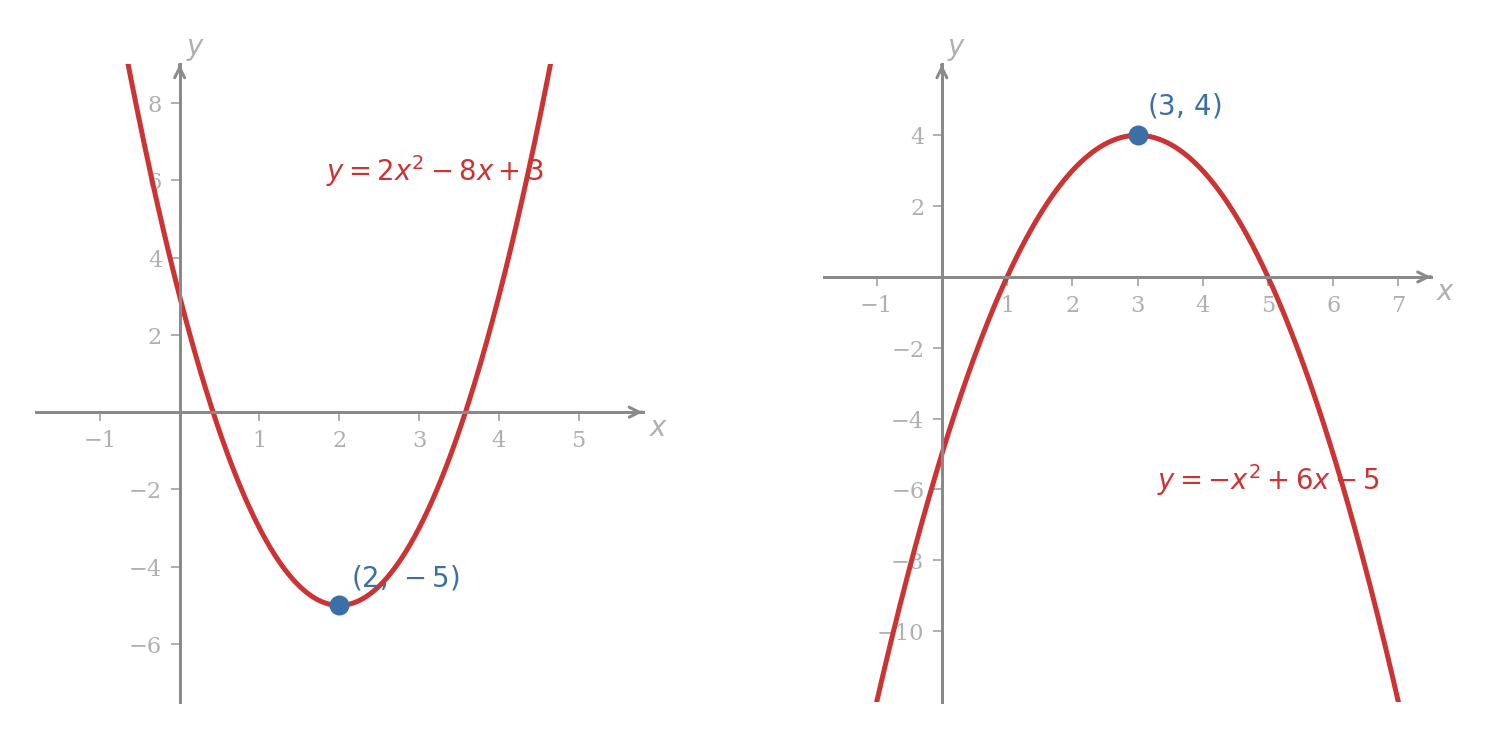
Vertex of . Here , , , and the vertex formula gives
So the vertex is . Since , the parabola opens upward and is the minimum value of .
A downward-opening parabola. For , we have , , , so
The vertex is , and because this is a maximum.
Problem 16
Find the vertex of and state whether it is a maximum or a minimum. Compute the -intercept as well.
Techniques for sketching a parabola from more general data will follow at once from the first derivative. Until then, the vertex together with the -intercept is usually enough to fix the shape by eye, provided the two points are distinct; when the vertex happens to lie on the -axis the two points coincide and one further value of is needed.
Polynomial and Rational Functions
Linear and quadratic functions share a single template: a finite sum of non-negative integer powers of weighted by constants. Isolating the template gives the family within which most of the functions in this course will live.
A polynomial function is a function of the form
where is a non-negative integer and are real constants. Its natural domain is the whole number line, since every operation in the formula is addition or multiplication of real numbers.
The AM linear functions are the polynomial functions with , and the quadratic functions of the previous section are the polynomial functions with and .
Each of
is a polynomial function. Each is defined at every real number and is built from powers of by the permitted arithmetic.
Taking quotients of polynomial functions produces the first systematic exclusions from the natural domain.
A rational function is a function expressible as a quotient of polynomial functions and , where is not the zero polynomial. By the natural domain convention of the AM lesson, its admissible inputs are exactly those real at which .
For
the respective denominators vanish at and at . The natural domain of is therefore every real , and the natural domain of is every real with and .
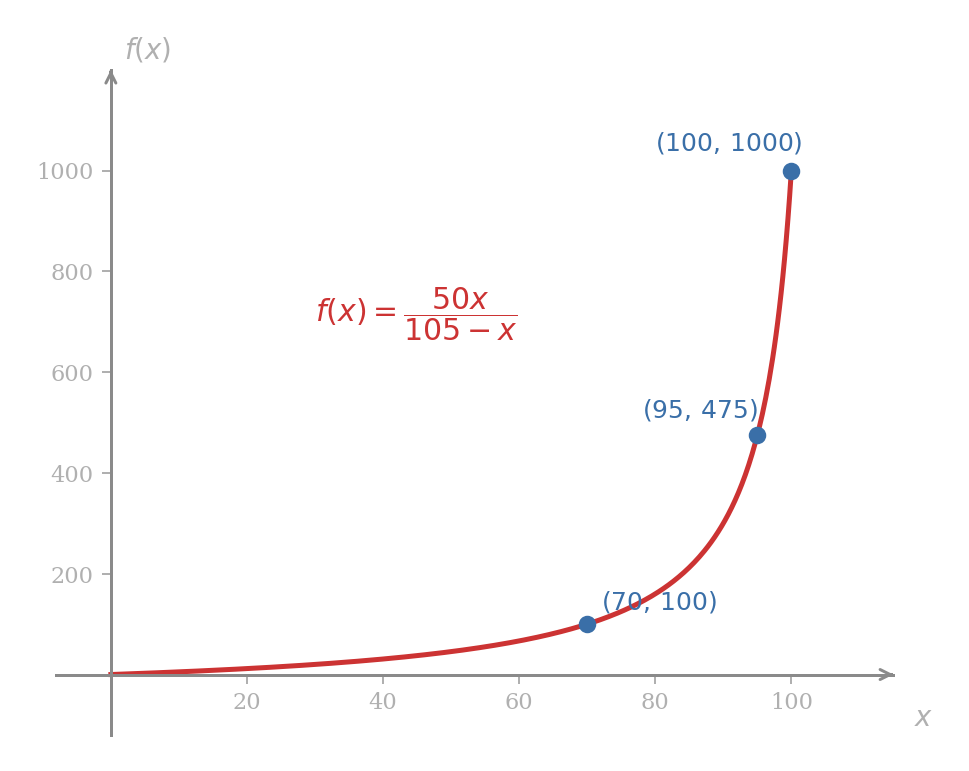
A cost-benefit model. Atmospheric scrubbers that remove a pollutant become disproportionately expensive as the residual fraction falls towards zero. A standard rational model for the cumulative cost is
where is the percentage of pollutant removed and the cost in millions of dollars. The denominator vanishes only at , outside the stated domain, so every admissible is genuinely assigned a real value. Direct substitution gives
Thus removing of the pollutant costs 100 million dollars. The cost of removing the final , from to , is
over five times the cost of removing the first .
Problem 17
With on as in the example, compute the additional cost of raising the removal percentage from to , and compare the result with the cost of removing the final from to .
Power Functions
A further family sits between the polynomial and the rational: functions given by a single power of the variable.
A power function is a function of the form , where is a fixed real constant called the exponent, interpreted on the real inputs where that power is defined.
When is a positive integer, denotes the product of with itself times and is defined for every real , so the power function is a polynomial function and its natural domain is the whole number line. When is a negative integer, means , and the natural domain excludes . The meaning of for non-integer , together with the resulting natural domain, will be recovered in a later lesson.
The Absolute Value Function
One function of this lesson is neither polynomial nor rational nor a single power, but it fits the piecewise construction of the AM lesson exactly.
The absolute value of a real number is the real number
and is non-negative for every .
Thus , , and . Regarding as a rule assigning each real a single real output gives a function in the sense of the AM Function definition.
The absolute value function is the function , with natural domain the whole number line. Its graph is the piecewise combination of the line on with the line on , the two pieces meeting at the origin.
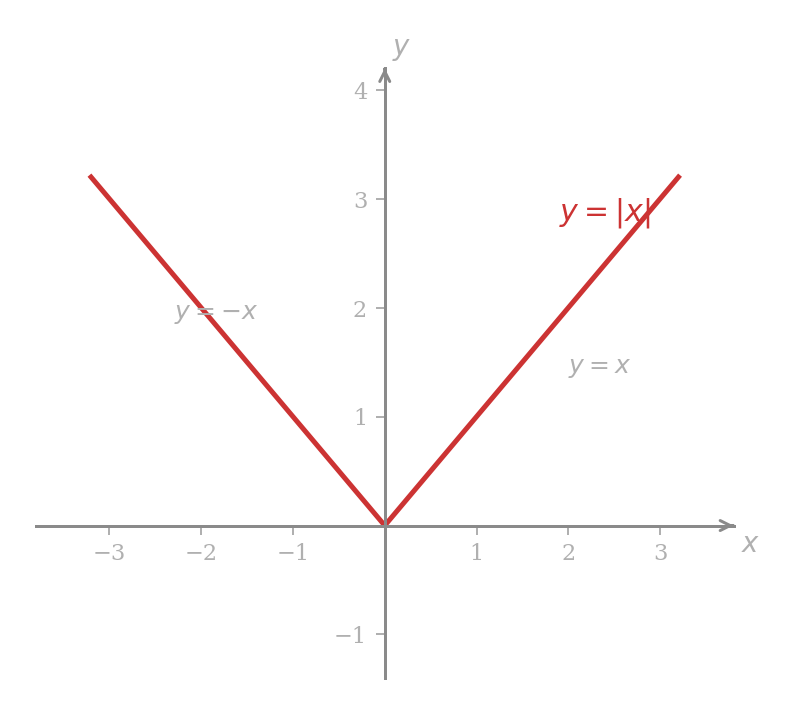
The two pieces agree in value at , so the graph does not jump in the sense introduced in the piecewise-linear section above; instead it has a sharp corner. This corner will reappear in a coming lesson as the first example of a function that is everywhere continuous but fails to be differentiable at a point.
Evaluating at three inputs, , , and . The non-negativity for every follows directly from the two cases: when the output is ; when the output is .
Problem 18
Sketch the graph of by applying a horizontal shift from the AM lesson to the absolute value function, and state its - and -intercepts.
Combining Functions
Many functions of practical interest are assembled from simpler ones by arithmetic. The prototype is a firm’s profit: if is the revenue from selling units of a commodity and is the cost of producing those units, the profit on the sale is
Writing in this form turns questions about profit into questions about the comparison of and . The firm runs at a profit on exactly those inputs at which , and the graph of lies above the horizontal axis precisely where the graph of lies above the graph of .
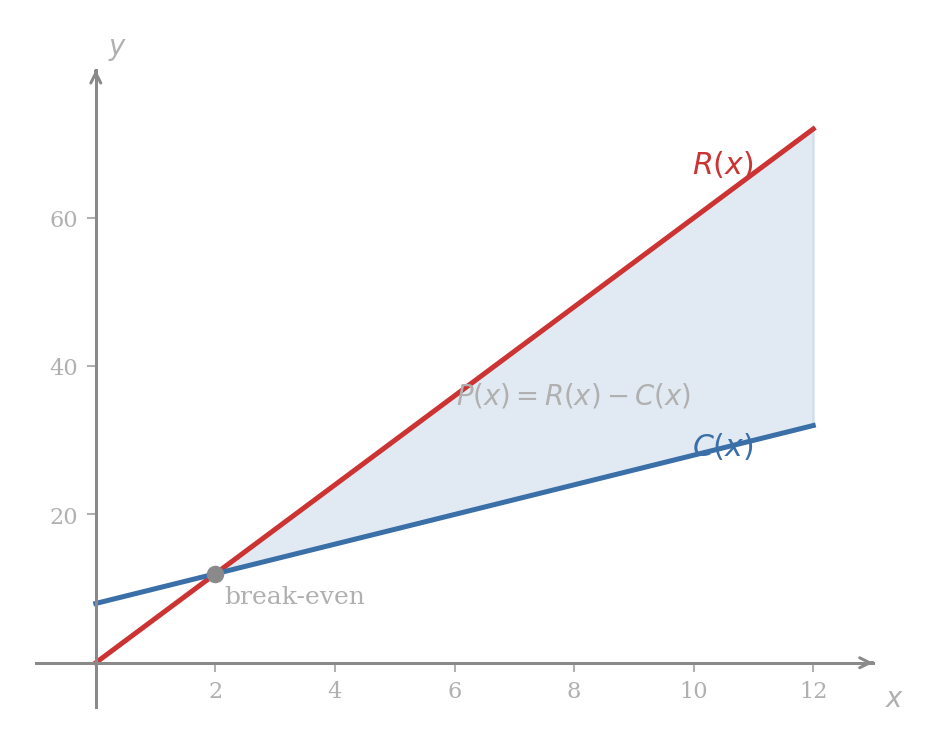
The construction generalises to the other three arithmetic operations.
Let and be functions. Their sum, difference, product, and quotient are the functions defined pointwise by
The natural domain of each of , , and is the intersection of the natural domains of and . The natural domain of is that same intersection, with the additional exclusion of every at which .
Addition, subtraction, and multiplication of functions are nothing but the corresponding operations on their values, admissible wherever both values are admissible. The quotient brings back the exclusion already familiar from the rational function section: the divisor must not vanish.
Fraction arithmetic
Before working examples, the five rules of fraction arithmetic needed in the sequel are worth stating in one place. Every letter appearing in a denominator is understood to be non-zero throughout.
For real numbers with non-zero as required,
Rule (iii) is most often applied in reverse: cancellation of a factor common to numerator and denominator. Rule (v) is the addition rule via a common denominator and is the single rule required for combining rational functions with different denominators.
A worked example: linear combinations
Let and . We compute the sum, difference, product, and quotient in their simplest forms.
For the sum and difference, corresponding terms are added or subtracted:
The difference is a constant: the graphs of and are parallel lines, each of slope , separated by units vertically.
For the product, expand by distributing each term of the first factor across each term of the second:
The four summands are, in order, the product of the First terms, the Outer terms, the Inner terms, and the Last terms; this order is commonly remembered by the acronym FOIL.
For the quotient, substitute the formulas and then factorise numerator and denominator before cancelling:
using rule (iii) to cancel the common factor of . Cancellation is legitimate here only because is a genuine factor of every term in both numerator and denominator; the tempting move of cancelling the that appears in both is invalid, because is not a factor of either expression but merely one term in a sum. The natural domain of the quotient is every real with , that is, every .
Problem 19
Let , , and . Compute each of the following, simplified to standard form, and state the natural domain in each case.
Adding rational functions
Rule (v) says that two fractions are added by passing to a common denominator. For rational functions the procedure is identical, with in place of the real letters.
Let
The natural domain of excludes and the natural domain of excludes , so the previous definition gives the natural domain of as the real line with both of these points removed. On that common domain, multiply each fraction by whatever unit fraction is needed to reach the common denominator :
The two fractions now share the denominator and combine directly:
The result is a rational function in the sense of the previous section, defined at every real distinct from and from .
Problem 20
Let and . Express as a single rational function in simplest form, state its natural domain, and find the real at which the numerator vanishes.
Problem 21
A firm selling units of a commodity earns revenue pounds and incurs cost pounds, valid for . Write the profit as a linear function, determine the break-even quantity at which , and state the collection of for which the firm makes a strictly positive profit.
Multiplying and dividing rational functions
The remaining two operations on rational functions follow rules (ii) and (iv) directly.
Multiplying. For
rule (ii) gives the product as numerator times numerator over denominator times denominator:
Expanding both numerator and denominator produces an equivalent expression:
The two forms are the same function; whichever one is used depends on the purpose. The factored form makes the excluded inputs visible at a glance, namely and , while the expanded form is occasionally more convenient for comparing coefficients.
Dividing. For
the natural domain of excludes and the natural domain of excludes . For the quotient we must additionally exclude every at which , which occurs exactly when , that is, . The natural domain of therefore consists of every real with , , .
On that domain, rule (iv) turns division into multiplication by the reciprocal:
Expanding gives the equivalent expression
Composition of Functions
The AM lesson already noted that any expression whose value is a real number may serve as the input of a function, and that most of the course’s functions are assembled by evaluating one inside another. Naming this construction cleanly is overdue.
Let and be functions. The composition of with , written or , is the function defined by
Its natural domain consists of every real in the natural domain of for which the value lies in the natural domain of .
The value of the inner function must be an admissible input of the outer function, so the natural domain of is in general smaller than that of . Order matters: and are different functions in most cases, and the example below demonstrates the point.
Let and . Substituting for every occurrence of in the formula for ,
Substituting for every occurrence of in the formula for ,
The two outputs are different polynomial functions, confirming that composition is not commutative in general.
Problem 22
Let and . Compute and , and state the natural domain of each.
The difference quotient
A particularly important composition takes the inner function to be a horizontal shift of the variable, for a fixed real . Then , the quantity that already drove the horizontal shift construction of the AM lesson. Combining this composition with the subtraction and division of the previous section produces the single expression in which the derivative, the object of the lessons ahead, will be born.
Let be a function and let be a non-zero real number. The difference quotient of at with increment is
It is defined at every for which both and lie in the natural domain of .
The numerator is the change in the value of as the input moves from to . Dividing by converts that change into a rate per unit increment. The derivative will be recovered by driving to zero.
Difference quotient of . Using the cube expansion, obtained by two applications of FOIL,
Subtracting ,
Every summand carries a factor of , so factoring it out and applying rule (iii) under the assumption ,
Cancellation is legitimate because ; at the original quotient is undefined, but the simplified expression remains meaningful and equals .
The value left over after the cancellation will turn out, in a coming lesson, to be the derivative of . The algebra of this section therefore already delivers the derivative of the cube, pending only the limit argument that makes the passage from to rigorous. The pattern repeats for every polynomial: the difference quotient factors, cancels, and what remains is the derivative. The whole of differentiation lives in that cancellation.
Problem 23
Let . Form the difference quotient , simplify it using , and state the value of the simplified expression at .
Problem 24
Let with , and suppose also that . Express the difference quotient
as a single rational function of and in simplest form, and state the value of the simplified expression at .