
Lesson assets
No linked assets.
Quadratics, Factoring, and Rational Exponents
Zeros of a Function
The PM lesson named the point at which the graph of meets the horizontal axis: the -intercept. In practice we also need a name for the input that produces it, independently of the graph.
A zero (or root) of a function is a real number in the domain of with . The -intercepts of the graph of are exactly the points for which is a zero of .
Locating the zeros of therefore locates the -intercepts of its graph, but the use goes further. Two graphs and meet at precisely those with , and writing in the sum-difference sense of the PM lesson converts this to the single condition . The break-even inputs of a profit function are exactly the zeros of . Every question of the form where does one quantity cross another reduces to finding zeros of a suitable combination of functions.
The PM lesson has already supplied the zeros of every linear function: if with , then the unique zero is . The next non-trivial case is the quadratic, and for it the technique of completing the square produces a closed formula.
The Quadratic Formula
Let be real with . The real zeros of the quadratic function are precisely the real solutions of the equation , and they are given by
The quantity is called the discriminant. The equation has two distinct real solutions when , a single repeated real solution when , and no real solution when .
Start from , move the constant across, and multiply both sides by , which is non-zero because ,
Adding to both sides completes the square on the left,
since by direct expansion. Hence
When the left side, a square of a real number, cannot equal a negative number and so the equation has no real solution. When the square root on the right is real, and the equation is equivalent to
Solving for gives the stated formula. The two signs coincide exactly when , producing a single repeated solution in that case and two distinct solutions otherwise.
■The discriminant governs the geometry. A parabola with two zeros crosses the horizontal axis at two distinct points; a parabola with one zero meets it tangentially at its vertex; a parabola with no real zero sits entirely above or entirely below the axis, according to the sign of .
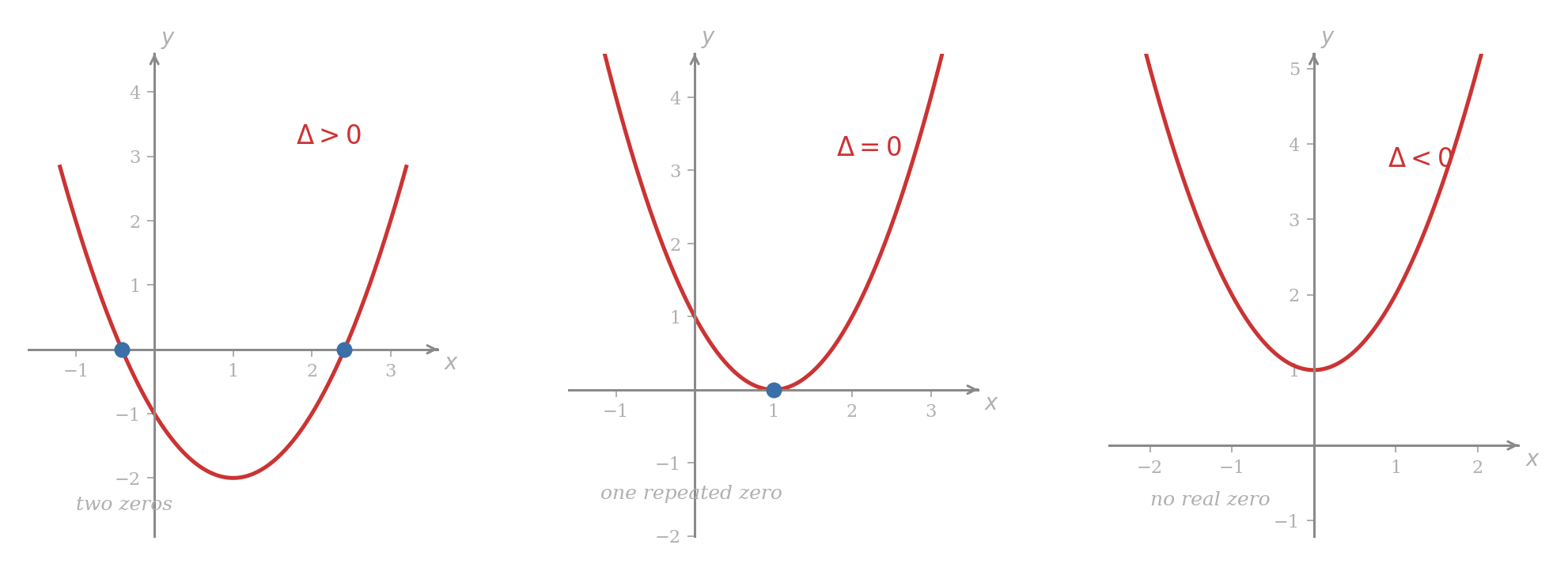
Solving .
Here , , , so
and the formula gives
The two zeros are and .
Solving .
Here , , , so
and the formula collapses to a single solution,
The parabola therefore has its vertex on the horizontal axis at , a special case of the vertex formula from the PM lesson.
Solving .
Here , , , so
and the equation has no real solution. The completed-square form
confirms that the graph sits at height at least above the horizontal axis, the minimum being attained at .
Problem 1
For each of the quadratic functions below, compute the discriminant, classify the number of real zeros, and find them when they exist.
- .
- .
- .
Intersection of Graphs
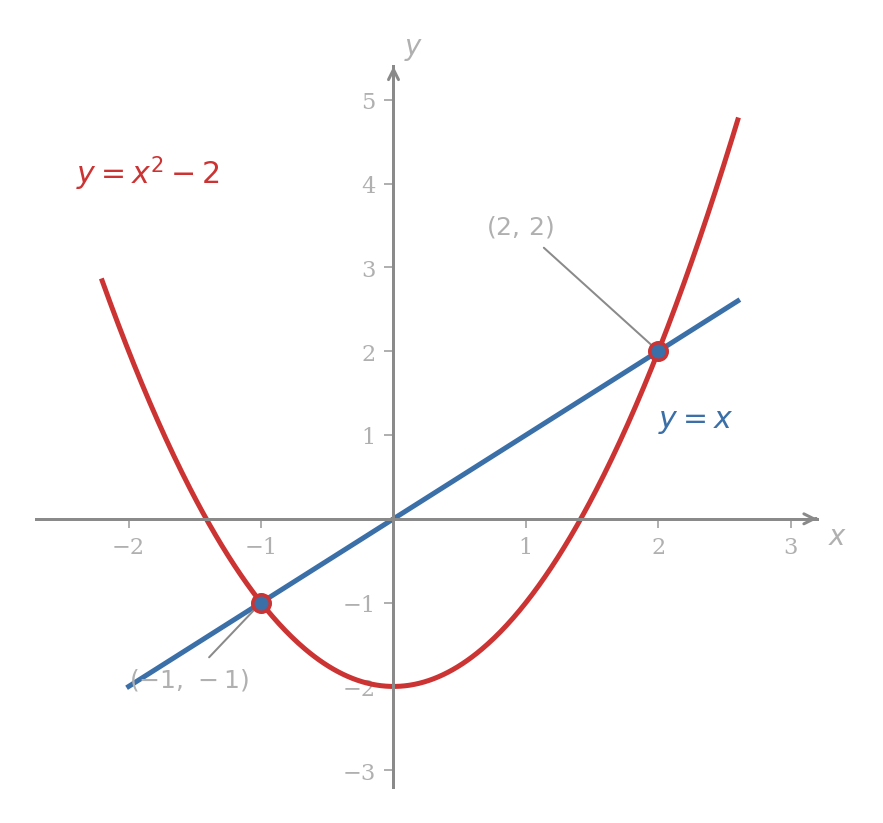
Asking where two curves meet asks for the common solutions of a pair of equations in and . When both curves are graphs of functions of , the two equations can be equated to eliminate , reducing the problem to a single equation in alone; if the resulting equation is quadratic, the formula above resolves it completely.
Find where the graphs of and meet.
A point lies on both graphs exactly when and hold simultaneously. Equating the two expressions for ,
Here , , , and , so
so or . Substituting each into the simpler equation gives the corresponding heights, and the two curves meet at and .
Problem 2
Find every intersection point of the graphs of and , and verify your answer by substitution into each equation.
Factoring
The quadratic formula reduces every quadratic equation to arithmetic, but where factoring is available it is both faster and more informative, because it displays the zeros directly in the form of the expression. Its force comes from a single algebraic observation.
A product of real numbers is zero if and only if at least one of its factors is zero. Applied to a polynomial written as a product of linear factors
the principle says the zeros of are exactly the numbers . The leading coefficient is excluded from being zero because setting collapses to the zero function, every real number of which is a zero. Factoring a polynomial therefore reads off its zeros by inspection.
Factoring a quadratic by inspection
For a quadratic with leading coefficient we look for integers with
Thus and must multiply to and sum to . The search terminates rapidly because has only finitely many integer factorisations.
- . We need and . Taking , works, so , and the zeros are .
- . Both numbers must be negative, since their product is positive and their sum negative. Taking , gives .
- . The two numbers have opposite signs, summing to and multiplying to . Taking , gives .
- . The same pair with signs reversed gives .
When the leading coefficient is not , the quadratic is most efficiently factored either by first pulling out any common factor from the three coefficients, or, when that fails and the discriminant is non-negative, by applying the quadratic formula to read off its real zeros and writing
When the quadratic has no real zeros and admits no factorisation into real linear factors.
Factor .
Extracting from every coefficient,
with the inner quadratic factored by inspection, since and . The zeros are and .
Standard identities
A handful of algebraic identities recur frequently enough to deserve names. Each is verified by multiplying out the right-hand side.
- , by difference of squares.
- , by the second perfect-square identity.
- , by difference of cubes.
- , by sum of cubes.
Higher-degree polynomials
Beyond degree two the quadratic formula no longer applies directly, but extracting a common factor of (or of a higher power of ) often reduces the problem to a quadratic once pulled out.
Factor .
Every term carries a factor of , so
the inner quadratic being factored by inspection since and . The zeros are .
Factor .
Pulling out and applying the difference-of-squares identity with ,
The zeros are .
Problem 3
Factor each of the following over the real numbers, and list the zeros.
- .
- .
- .
- .
- .
Rational Equations
A rational equation is an equation between two rational expressions in . By the rational-function convention of the PM lesson, each side is defined on the intersection of the natural domains of its constituents, so a candidate solution must lie in that intersection; any value at which an original denominator vanishes is forbidden in advance. The standard procedure is to clear denominators by multiplying through by a common denominator, solve the resulting polynomial equation, and then discard any candidate at which an original denominator vanishes.
Solve
The denominators and vanish at and respectively, so both values are forbidden. A common denominator for the three fractions is , and multiplying through by it,
Expanding both sides gives , which rearranges to
Here , , , and , so
so or . Neither value is forbidden, so both are solutions, a fact a direct substitution into the original equation confirms.
Problem 4
Solve each equation, discarding any value at which an original denominator vanishes.
- .
- .
- .
Exponents and Power Functions
The PM lesson named the power function and assigned a meaning to when is a positive or negative integer, leaving non-integer for later recovery. Rational exponents can be recovered now with very little extra effort, and once they are in place the familiar algebraic manipulations of become available for the rest of the course.
Rational exponents
Let be a real number. The meaning of when is a positive integer, or a negative integer with , was fixed by the PM lesson. We extend the definition in stages.
For any non-zero real number , we set .
The value is left undefined throughout the course. The stipulation is chosen so that the rule extends without exception to the case : setting on the right forces , and the only value of compatible with this equation for every is .
Let be a positive integer. When , the symbol denotes the unique real number satisfying . When is odd, this extends to every real : if then denotes the unique real number satisfying , which is itself negative. When is even and , no real satisfies , and is left undefined.
For this recovers the square root already familiar from the AM lesson: for . Numerically, , , , while is undefined.
Let and be positive integers with no common factor, and let be a real number for which is defined. Then
When is defined and non-zero, the negative rational exponent is defined by reciprocation,
The requirement that be in lowest terms matters when is negative. The same rational number can be written in many ways, and the definition of would disagree with itself if applied blindly. Take : written with denominator , the formula asks for , and is undefined. Reducing to its lowest terms first, the formula returns the well-defined value . Enforcing lowest terms in the definition keeps the output single-valued.
Working directly from the definition,
while
the evaluation being legitimate because the denominator is odd, so is defined.
Laws of Exponents
The integer laws familiar from arithmetic extend to every rational exponent for which both sides of each identity are defined.
Let and be rational numbers, and let , be positive real numbers. Then
Rule (ii) is the definition of the negative exponent rewritten; rule (iii) follows from (i) and (ii) on replacing by . The remaining laws reduce to the definitions once every expression is unfolded, and we take them for granted.
The positivity of (and of ) is essential: rule (iv), for instance, fails for negative bases even when both sides are defined. With , , and ,
The two expressions disagree because squares the cube root of , destroying the minus sign, whereas keeps it. The lowest-terms convention treats the exponents and as different computational recipes, and the two recipes need not agree when . For negative bases the laws are reliable only on a case-by-case basis; in the expressions that will arise in this course the base is almost always positive, and the blanket hypothesis above applies.
In the symbolic examples below, every simplification is read on the natural domain of the original expression. Thus a fractional power such as or implicitly requires , while a negative fractional power such as requires , and a negative integer power such as or requires .
Part (a). Using law (v) followed by a direct evaluation,
Part (b). Using law (i) inside the bracket and law (iv) outside,
Part (c). Writing and applying law (iii),
Part (a). By law (ii) with ,
Part (b). By law (iii),
Part (c). Writing and distributing over the sum,
Applying law (i) to each summand,
Let and , both power functions in the sense of the PM lesson. Using law (iii) throughout,
The natural domain of each combination is the intersection of the natural domains of and , with the divisor excluded where it vanishes. Since excludes and requires , the intersection is ; neither divisor vanishes on this common domain, so all three combinations have natural domain .
Problem 5
Evaluate or simplify, applying the laws of exponents step by step and stating which law is used at each step.
- .
- .
- for .
- for .
Factoring with fractional powers
When an expression is a sum of power functions with rational exponents, factoring becomes the algebraic mirror of the addition rule (i). Take the smallest exponent appearing and pull it out: every other term is then a product of the common factor with whatever power of is needed to recover the original exponent.
Again, the factorisation is understood on the natural domain of the original expression. In particular, any term with a negative exponent forces .
Factor .
The smaller exponent is . Factoring it out,
The exponent of the inner term, , is the product of reciprocation with addition, law (ii) combined with law (i), so no step departs from the table above.
Factor .
Since , the smaller exponent is . Factoring out,
using .
Problem 6
Factor each expression by pulling out the smallest exponent of appearing.
- .
- .
- .
Exercises
Exercise 1
Find all real zeros of , and sketch the parabola highlighting them together with the vertex and the -intercept.
Exercise 2
Determine every point at which the graphs of and intersect, and state the discriminant of the quadratic that arises in the solution.
Exercise 3
Factor and by inspection, and list the zeros of each.
Exercise 4
Factor using the difference-of-cubes identity, and confirm by expansion that the factorisation is correct.
Exercise 5
Solve each equation, discarding any value at which an original denominator vanishes.
- .
- .
Exercise 6
Evaluate and by applying the laws of exponents, stating which law is used at each step.
Exercise 7
Factor by pulling out the smallest exponent of , and express the inner factor as a polynomial in .