
Lesson assets
No linked assets.
Rules for Differentiation
Lesson 2PM verified the power rule for several special exponents and stated it for every rational , but the Rule reaches only the bare power function . Most functions of interest in this course are built from such powers by two further operations: multiplication by a constant, as in , and addition, as in . Each operation interacts with differentiation in a way fixed by the limit definition itself, and the resulting two rules are enough to differentiate every polynomial by inspection. A third rule, generalising the power rule from to an arbitrary differentiable expression , is recorded at the end of the section for use later in the course.
The constant multiple rule
Let be differentiable at in the sense of Lesson 2PM, and let be a real number independent of . Then is differentiable at and
A constant multiplier rides along through differentiation, untouched. The factor scales the rise of every secant of by exactly the same amount without altering its run, so the slope of every secant of is times the slope of the corresponding secant of , and the same factor survives the limit. The verification at the end of the section makes the remark precise.
For take and the inner function , whose derivative is by the power rule of Lesson 2PM. The constant multiple rule then gives
The same step handles a negative scalar without ceremony: .
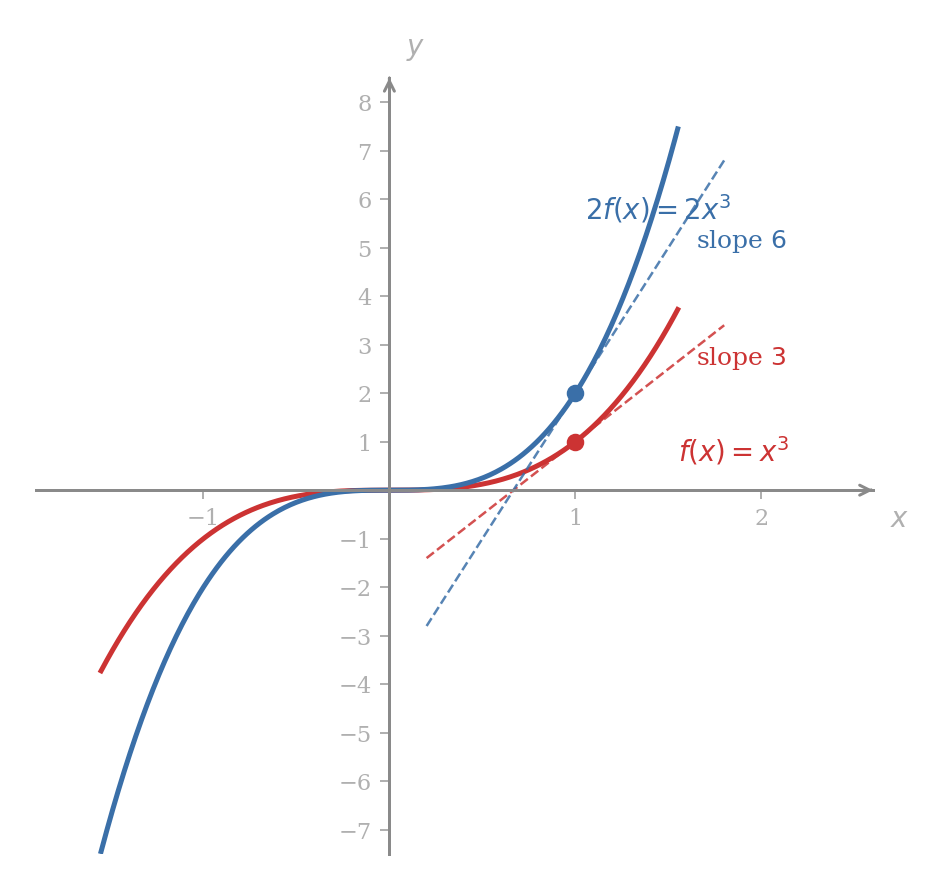
For on , write as in Recitation 1 and apply the power rule with ,
The constant rides along to the end and never participates in the differentiation itself.
Problem 1
Compute the derivative of each function below by the constant multiple rule and the power rule, stating the inputs at which the derivative is defined.
- .
- .
- .
- .
The Sum Rule
Let and be differentiable at in the sense of Lesson 2PM. Then is differentiable at and
The same identity, with the sign of the second term reversed throughout, gives the difference rule
The derivative of a sum is the sum of the derivatives, and the same is true for differences. Applied to a polynomial term by term, the sum rule together with the constant multiple rule and the power rule reduces every differentiation to the mechanical procedure of dropping each exponent by one and bringing it round to the front.
For the Sum and Difference Rules apply across the four terms, the constant multiple rule strips each leading coefficient, and the power rule handles each remaining power. The constant term contributes by the constant case from Lesson 2PM, so
With practice the intermediate steps fold into a single line of writing, and the derivative of any polynomial is read off by inspection.
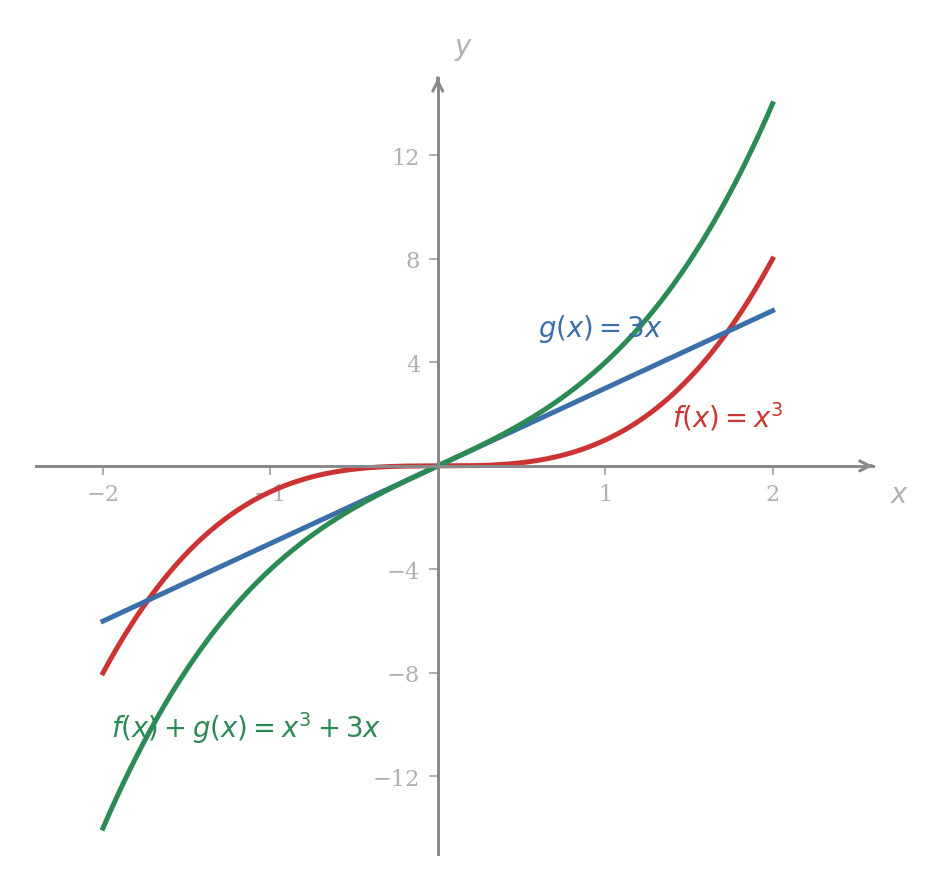
For on , rewrite the function in power notation as and apply the same machinery,
Care with the natural domain matches the power rule itself: the first term restricts to , the second to , and the intersection is the domain of .
The sum rule splits a derivative across and , and across nothing else. The corresponding statement for a product is false: writing and treating each factor separately would give , while the power rule supplies the correct . Products are governed by a separate rule developed in a later MA0A lesson, and until that rule is in place every product must be either expanded into a sum first, as in above, or left alone.
Problem 2
Compute the derivative of each function by combining the Sum, Constant-Multiple, and power rules.
- .
- .
- .
- , by expanding before differentiating.
The General Power Rule
The power rule of Lesson 2PM differentiates , the th power of the bare identity . When the inner expression is replaced by a more complicated differentiable function , the form of the answer survives essentially unchanged, with one extra factor.
Let be differentiable at and let be a rational number for which the power is defined on inputs near and at itself. Assume also that the outer power function is differentiable at ; this is automatic when is a positive integer or when , but zeros of require separate checking. Then is differentiable at and
The proof is deferred to a later MA0A lesson, where the chain-like manipulation needed to obtain it is treated systematically.
The factor is the answer the power rule would supply if were itself the variable; the additional corrects for the fact that the inner expression is itself changing with at its own rate. With the correction collapses to and the General Rule reduces to the power rule with no information gained; the gain comes when is genuinely non-trivial.
The Rule was stated without proof, but a small case can be checked directly. Take , with and . The General Rule supplies
On the other hand, expanding first as and differentiating term by term by the rules of the previous two sections,
The two procedures agree. The expansion method always works for an integer exponent and a polynomial inner function but becomes prohibitive even at modest powers; the General Rule is the closed-form answer to which the binomial expansion would, after pages of arithmetic, eventually collapse.
For take and . The inner derivative is by the linear case from Lesson 2PM, and the General Rule gives
Expanding first by the binomial theorem and differentiating term by term reproduces the same answer at greater length; the General power rule packages the entire expansion into a single line.
For on the whole real line take and . The Sum and power rules give , and the General Rule supplies
The base is positive at every real , so the half-power and the derivative are defined throughout.
For on , write and apply the General Rule with and :
The natural domain of is the same that itself carried, the squaring of the denominator preserving the exclusion.
For on the inputs at which , the outermost operation is multiplication by the constant , and the constant multiple rule pulls it through differentiation untouched. The remaining derivative is supplied by the General Rule with , , and ,
The derivative formula is defined only where ; at the boundary the original function is defined but the derivative is not. The cancellation of to is part of the calculation; the rules themselves do nothing more than authorise the chain of equalities.
The combination just performed arises often enough to be worth recording as a single identity. For any constant , any function differentiable at , and any rational for which is defined,
the right-hand side reading exactly as the General Rule output with the constant retained at the front. The identity is a corollary of the Constant-Multiple and General power rules and adds no new content beyond their conjunction; the cost-function example below is one further application of the same line.
Problem 3
Differentiate each function using the General power rule, stating the natural domain of the result.
- .
- .
- .
- .
Verifications
The Sum and constant multiple rules follow directly from the limit definition together with two of the limit theorems of Lesson 2PM. The General power rule needs heavier machinery and is left to a later MA0A lesson.
constant multiple rule. Let be differentiable at , with , and let be a real number independent of . The difference quotient of at is
for every , the factor pulled out by ordinary arithmetic. Limit Theorem I of Lesson 2PM, applied with the difference quotient of in place of the inner function, gives
which is the claim.
■sum rule. Let and be differentiable at . The difference quotient of at separates into two pieces by ordinary arithmetic,
valid for every . Both summands have a limit as , namely and , and Limit Theorem III of Lesson 2PM gives
which is the claim. The difference rule follows on replacing by and applying the constant multiple rule with .
■Applications
With the three rules in hand, every problem from Lesson 2PM that called for a derivative through the limit definition is settled by inspection, and the time freed is spent on the geometry the derivative is meant to capture.
Find the tangent line to at the point with .
The Sum, Constant-Multiple, and power rules give the derivative in a single line,
so the slope at is . The height there is , locating the point of contact at . By the equation of the tangent line at from Lesson 2PM, the tangent line is
Locate every point at which the curve has a horizontal tangent.
The derivative is by the rules of this section, and a horizontal tangent occurs exactly when . Factoring,
the product-zero principle of Recitation 1 gives or . The corresponding heights are and , so the curve has horizontal tangents at and and nowhere else.
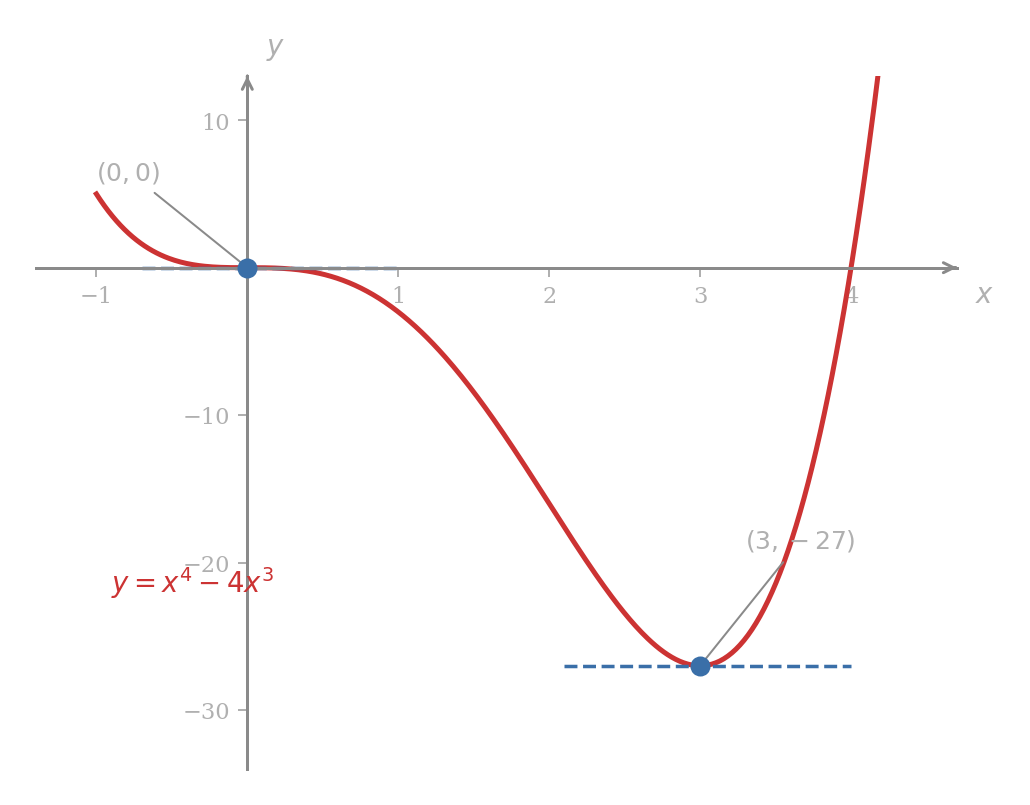
Find every point on at which the tangent line is parallel to .
The given line has slope , and parallelism by slope property 4 of Lesson 2AM forces the curve to have the same slope at the point of contact. The Constant-Multiple and power rules give
and the condition rearranges to , that is . The single point of contact is , and no other point on the curve has the required slope.
The publisher of Lesson 2AM treated a linear total cost , for which the marginal cost is the constant slope at every production level. A non-linear refinement of the same model replaces by
where additional production wears the equipment progressively faster. By the constant multiple rule and the General power rule with , , and ,
The marginal cost is now an increasing function of , in line with the wear interpretation: the cost of the next copy at production level exceeds the cost at any lower level. At the marginal cost is , and at it has risen to , the linear model’s constant losing all meaning.
Problem 4
For each curve below, compute by the rules of this section, then locate every point at which the tangent line is horizontal.
- .
- .
- .
Other Variables and the Second Derivative
The rules above were written in and , but the slope formula does not depend on the letters chosen for the input and output. Two minor extensions of the apparatus cover the situations that arise in practice: the input may carry a different name, and the derivative is itself a function and so may be differentiated again.
Independent variables other than
When the input is called rather than , the operator is replaced by throughout, and the prime notation is read as the derivative of with respect to . Transferring the slope formula for ,
the same arithmetic as before with in place of . The name of the input alters only the labelling of the axes; the geometry of the slope at a point is unchanged. The slope formula for the cubic, written in any letter,
records exactly the same statement three times over.
Compute .
The General power rule with and gives
the inner derivative supplied by the Sum, Constant-Multiple, and power rules in .
When several letters appear in one expression, the operator singles out as the variable and treats every other letter as a constant. The constant multiple rule then carries those letters through differentiation untouched, and the constant case from Lesson 2PM annihilates any term that contains no at all.
Compute , where , , are real numbers independent of .
Treating , , as constants, the Sum, Constant-Multiple, and power rules apply in turn,
the term vanishing because it contains no and so is constant from the standpoint of .
Problem 5
Compute each derivative, treating every letter other than the variable indicated by the operator as a constant.
- .
- for constants , , .
- for a constant .
The Second Derivative
The derivative produced by differentiating is itself a function, and may therefore be differentiated again. The result is the second derivative.
Let be a function such that is itself differentiable on a set of inputs containing . The second derivative of at is the derivative of at , written :
The function whose value at each such input is is itself called the second derivative of .
The first derivative records the slope of the graph of at each input; the second derivative records the rate at which that slope is itself changing, and so reads off the bending of the curve. The geometric significance is taken up systematically in the lesson on concavity to come.
Compute for each of the following.
- . Lesson 2PM gives , a constant function, and the constant case gives in turn.
- . Two applications of the Power and sum rules give and then .
- on . Writing , the power rule with gives , and a second application with gives .
Other notation
Differentiation does not enjoy a single standard notation. The two systems below denote the same objects throughout, and one should expect to read both fluently.
For , the first derivative may be written
and the second derivative
The placement of the exponent on top of the in the numerator and on the in the denominator is purely symbolic, recording that the operator has been applied twice; it is not a square in the algebraic sense.
The two systems coexist because each is shorter than the other in different circumstances. Prime notation is convenient when the function carries a name and the variable is implicit; the operator notation is convenient when no name has been given, or when several letters are in play and the variable of differentiation needs to be made explicit, as in the multi-letter example above.
Evaluating a derivative at a specific input
Two notations for the same number are in use. The first writes the value of the derivative at as , the slope of the curve at in the sense of Lesson 2PM. The second uses a vertical bar,
The bar carries no operational content; it is shorthand for first compute the derivative, then substitute .
For , compute .
Differentiating once,
Differentiating again,
Substituting ,
For , compute and .
The first derivative is
and substitution gives . Differentiating again,
and substitution gives .
Problem 6
For each pair below, compute the first and second derivatives in operator notation, then evaluate each at the given input.
- at .
- at .
- at .
The Derivative as a Rate of Change
Lesson 2AM read the slope of a linear function as the rate of change of its output per unit step of its input, a single number valid at every point. Lesson 2PM defined for a non-linear as the slope of the tangent line at , a number that varies with . Combining the two readings,
the qualifier at now genuinely needed because the rate is no longer constant. As the graph of passes through it changes at a rate of units in the direction for every one unit step in , the same reading the slope already supplied for a line.
Linear approximation by the tangent line
The tangent line at is the straight-line approximation of the graph near , in the sense of Lesson 2AM. For one unit step from to the tangent rises by exactly , by slope property 1 of Lesson 2AM. The graph rises by approximately the same amount, the approximation closer the smaller the step and the less the curve bends over .
For differentiable at ,
The right-hand side replaces the curve over the interval by its tangent line at , supplying an approximate value of one unit ahead from values already in hand at . The approximation is exact when is itself linear and progressively worse the more bends over the interval.
A later MA0A lesson generalises the formula to displacements other than one and quantifies the error.
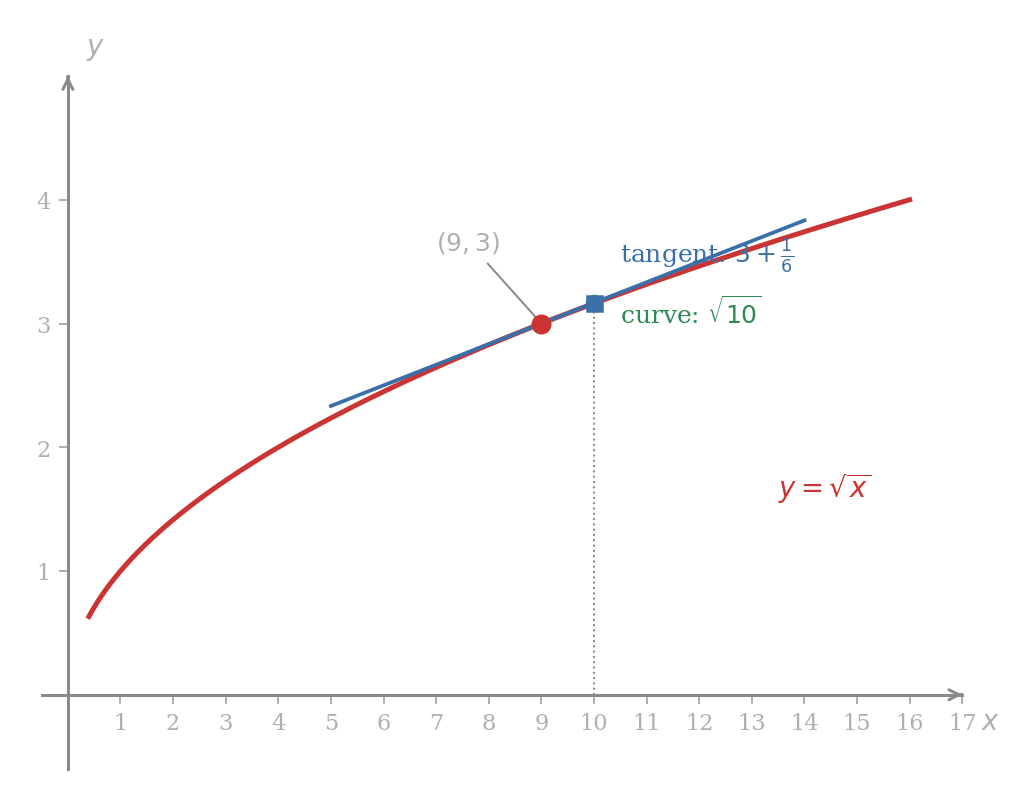
Estimate using the tangent line to at , and compare with the exact value.
By the power rule, , so at ,
The linear approximation supplies
The exact value is to four decimal places, so the approximation overshoots by about . The tangent line, drawn at with slope , sits a little above the curve over because bends downwards there.
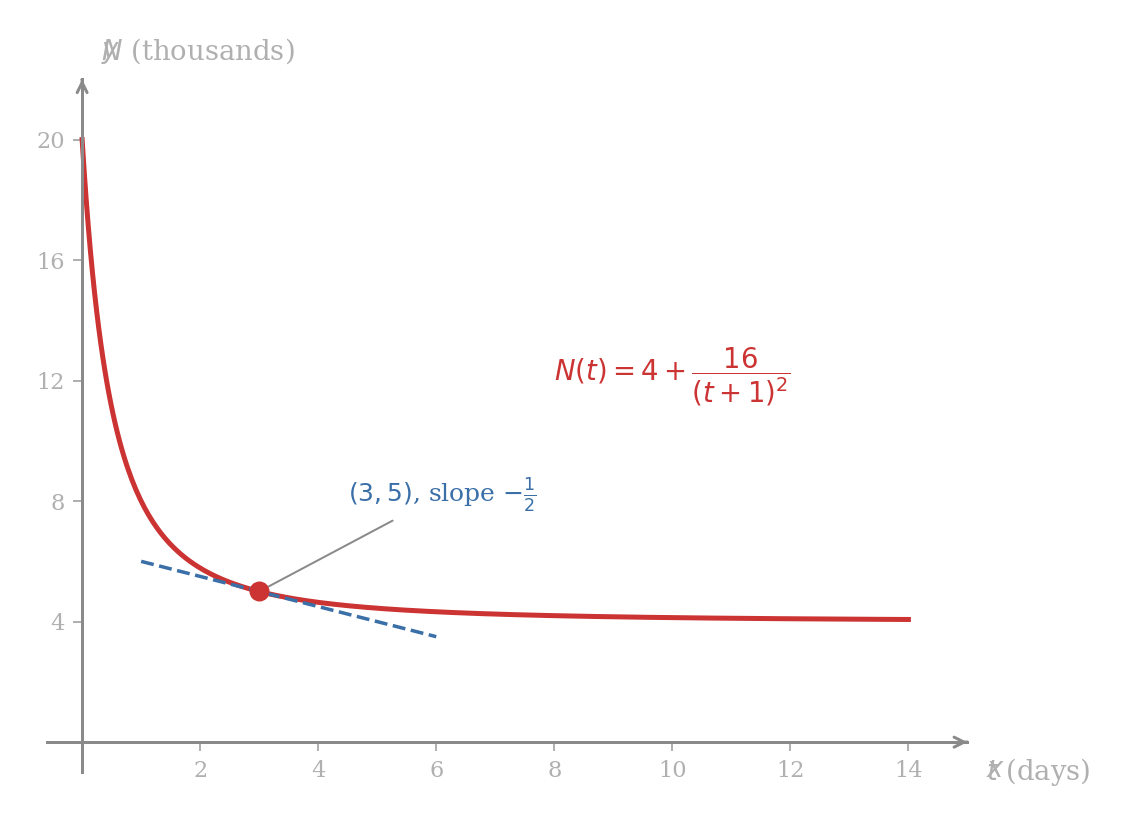
A small platform records the number of new sign-ups per day after launch. The empirical fit, valid for the first fortnight, is
with measured in days since launch and treated as a continuous variable, and in thousands of sign-ups per day. Compute and , interpret each, and use the linear approximation to estimate the daily sign-ups on day .
The height supplies the actual count on day ,
The slope is computed by writing the second term as and applying the constant multiple rule together with the General power rule with and ,
At this gives , that is sign-ups per day at that instant: the platform is losing half a thousand sign-ups per day from one day to the next. The linear approximation then estimates the day- count as
The exact value is thousand, so the approximation falls short by thousand, or sign-ups, the discrepancy explained by the bending of over .
Marginal cost
The publisher of Lesson 2AM had a linear total cost , and the marginal cost defined there was the slope , the additional cost of the next copy at every production level. For a non-linear cost the same reading carries through, but only at one production level at a time, and only as an approximation to the actual additional cost.
Let be the total cost of producing units of a commodity. The marginal cost function is the derivative . The marginal cost of producing units, , is by the linear approximation above approximately equal to , the actual additional cost incurred when production is raised by one unit from to .
The units of follow from the rate-of-change reading: when is measured in pounds and is a number of items, is measured in pounds per item, the same units the slope of a linear cost function carried in Lesson 2AM. The non-linear definition specialises to the linear one when is itself linear, in which case is constant and the approximation becomes exact.
A small ceramics studio has total cost
for a daily production of pieces. Compare the actual additional cost of raising production from to pieces with the marginal cost at .
The actual additional cost is , computed directly,
so pounds. The marginal cost at is the value of the derivative there, computed by the rules of the previous sections,
giving pounds per piece. The marginal cost approximates the actual increment to within about pound, the residual reflecting the small but non-zero bending of over .
Marginal revenue and marginal profit
The same construction applies to revenue and profit. If is the revenue from the sale of units and the cost of producing them, the profit is . The Sum and Difference Rules give
so marginal profit is marginal revenue minus marginal cost without further work.
For a revenue function and a profit function , the marginal revenue function is and the marginal profit function is . The marginal revenue of producing units, , approximates , and the marginal profit approximates .
The decision whether to raise production by one unit reduces, in linear-approximation terms, to the sign of the marginal profit at the current level: a positive predicts that the next unit increases profit, a negative one that it decreases it.
A workshop’s revenue from the sale of tables per week is thousand pounds, and its cost is
Direct measurement at the current production level gives and thousand pounds per table; the revenue is falling because the workshop is saturating its small local market. Estimate the change in revenue, the change in cost, and the change in profit on raising production to , and decide whether the increase is worthwhile.
The estimated additional revenue, by the linear approximation, is thousand pounds, so revenue is predicted to fall by about £600. The marginal cost is by the rules of the previous sections, giving thousand pounds per table, and the additional cost is approximately £800. The marginal profit is therefore
predicting a profit drop of about £1400 if production is raised to . Despite the workshop running at the level profit thousand pounds, the increase is not worthwhile: the next table is forecast to remove £1400 from the weekly profit. Level and rate of change tell different stories, and the marginal calculation reads only the second.
Problem 7
A small bakery’s daily total cost is
for a daily production of loaves. Compute by the rules of the previous sections, evaluate the marginal cost at , and compare with the exact additional cost .
Problem 8
A streaming service’s monthly revenue from the sale of thousand subscriptions is million pounds, with and million pounds per thousand subscriptions. The corresponding cost is million pounds.
- Estimate by the linear approximation.
- Compute and exactly, and compare the second with the marginal cost .
- Compute the marginal profit and decide whether raising production to thousand subscriptions is worthwhile.
Average Rates of Change
The previous section read as the rate of change of at , the slope of the tangent line at . A second rate of change is sometimes more natural: the average rate of change of over a whole interval, computed by dividing the total change in the output by the length of the interval. The two readings are linked by the secant construction of Lesson 2PM.
The average rate of change of over an interval with is the ratio
the change in divided by the length of the interval. Geometrically, it is the slope of the secant line through and .
When the length of the interval is , the change in is , and the ratio collapses to the difference quotient of Lesson 2PM,
the same expression whose limit as is . Letting the interval shrink to a single point therefore turns the average rate into the instantaneous rate, and the two are one construction read at its two extremes. From this point onwards, unless the qualifier average is used explicitly, the phrase rate of change will mean the instantaneous rate .
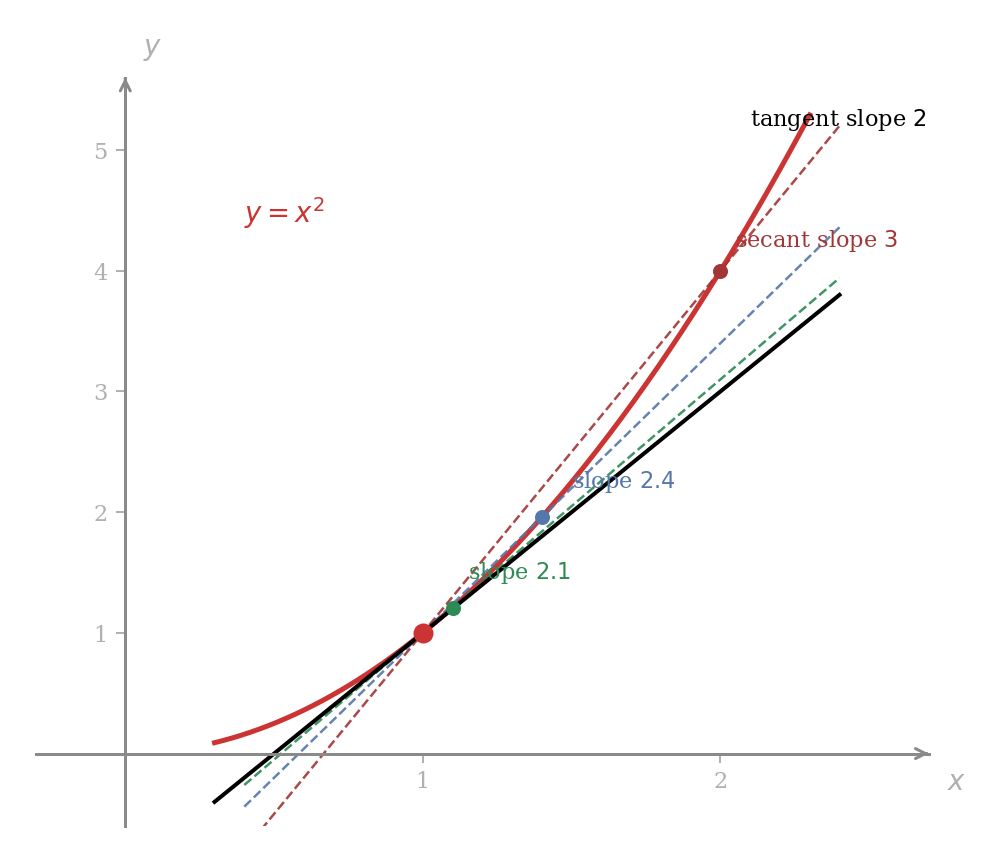
For , compute the average rate of change of over each of the intervals , , and , and compare with the instantaneous rate .
The power rule gives and . The three average rates are
The averages drop from to to as the right endpoint approaches , in agreement with in the limit. The pattern is the secant slopes of Lesson 2PM tending to the tangent slope as the second point slides towards the first.
Problem 9
For , compute the average rate of change over each of the intervals , , and , then compute by the power rule and verify that the averages approach it.
Reading rates from a graph
When is supplied by a graph rather than a formula, both rates can be read off without any algebra. The average rate over an interval is the slope of the secant line connecting the two endpoints, supplied by slope property 2 of Lesson 2AM. The instantaneous rate at a point is the slope of the tangent line at that point, read either by slope property 1 or, when a second point on the tangent is available, by slope property 2 again.
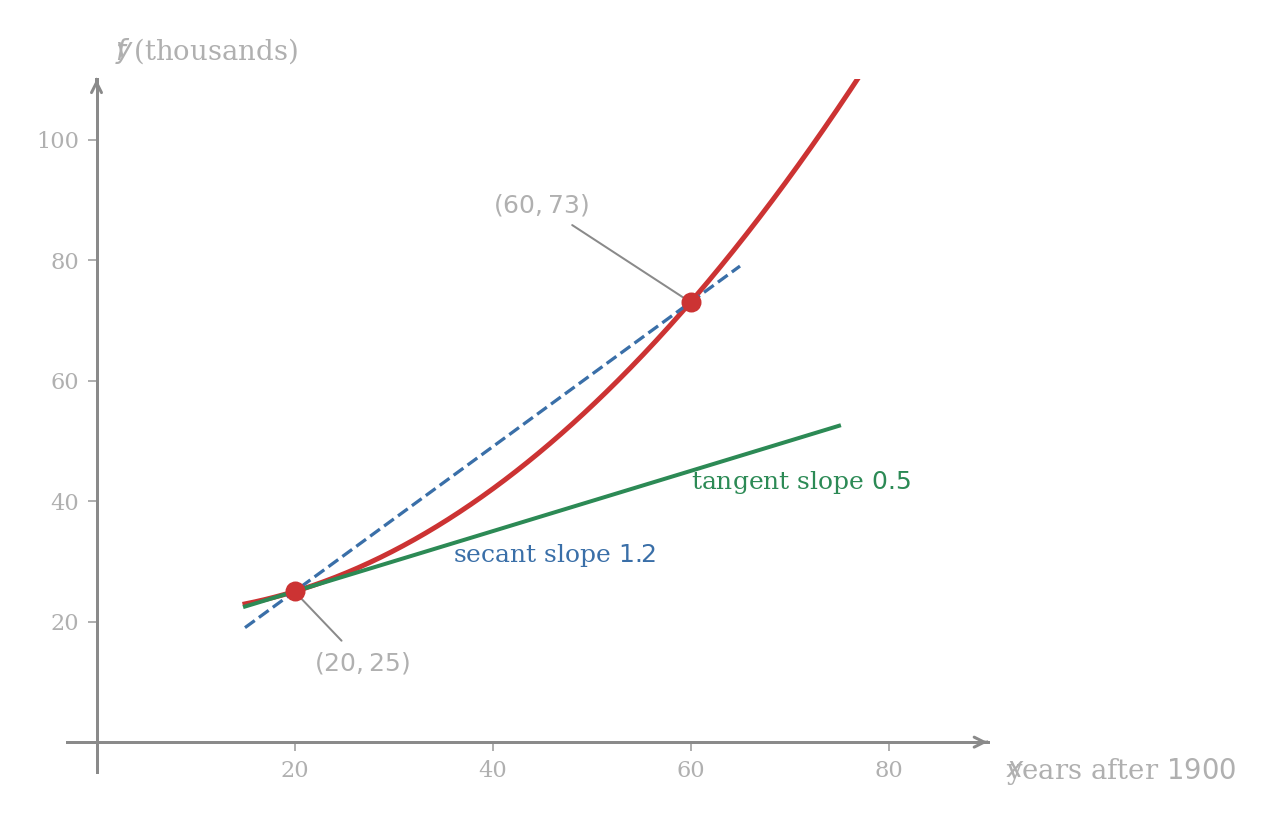
The function records the population of a coastal city, in thousands of inhabitants, years after . The graph of shows
and a tangent line drawn at passes through the further point .
(a) Average rate of growth from to . By the definition,
so over those forty years the city’s population grew on average at inhabitants per year.
(b) Rate of growth in . The tangent line at passes through , so by slope property 2 of Lesson 2AM its slope is
that is, in the population was growing at inhabitants per year.
(c) Comparison. The average over , per year, exceeds the instantaneous rate at the left endpoint, per year, indicating that the rate of growth was higher later in the interval than at the start: the curve is steepening as increases. The average rate is the slope of the secant from to ; the instantaneous rate at is the slope of the tangent at alone. The two coincide only when is linear over the interval.
Problem 10
A graph of fuel remaining against time over a four-hour generator run shows the values
in litres after hours, and a tangent line drawn at passes through .
- Compute the average rate of change of over the first two hours.
- Compute the average rate over the second two hours.
- Compute the instantaneous rate of change of at .
- Order the three numbers and explain what the ordering says about the bending of .
Velocity, Acceleration, and Estimating Changes
The rate-of-change reading of the derivative covers a family of physical settings in which one quantity is a function of another. Two recurring instances, important enough to fix names for, are the position of a moving object as a function of time, whose rate of change is velocity, and the velocity itself, whose rate of change is acceleration. A second extension, parallel to the marginal-cost discussion two sections back, generalises the one-unit linear approximation to a step of arbitrary length .
Velocity and acceleration
Suppose an object moves along a straight line, and let denote its directed position from a fixed reference point at time , with the convention that one direction along the line is positive and the other negative. Over a short time interval from to the object’s average velocity is
the average rate of change of position over in the sense of the previous section. Letting shrink to zero turns the average into an instantaneous velocity at the instant . Its absolute value is the speed.
Let be the position of an object moving along a straight line at time . The velocity of the object at time is the derivative . The acceleration at time is the derivative of the velocity, , equivalently the second derivative of the position,
A negative velocity records motion in the negative direction along the line, and a negative acceleration records that the velocity is itself decreasing in the chosen sign convention.
The acceleration uses the second derivative of two sections back: differentiating the position once gives the rate at which the position is changing, and differentiating again gives the rate at which that rate is itself changing.
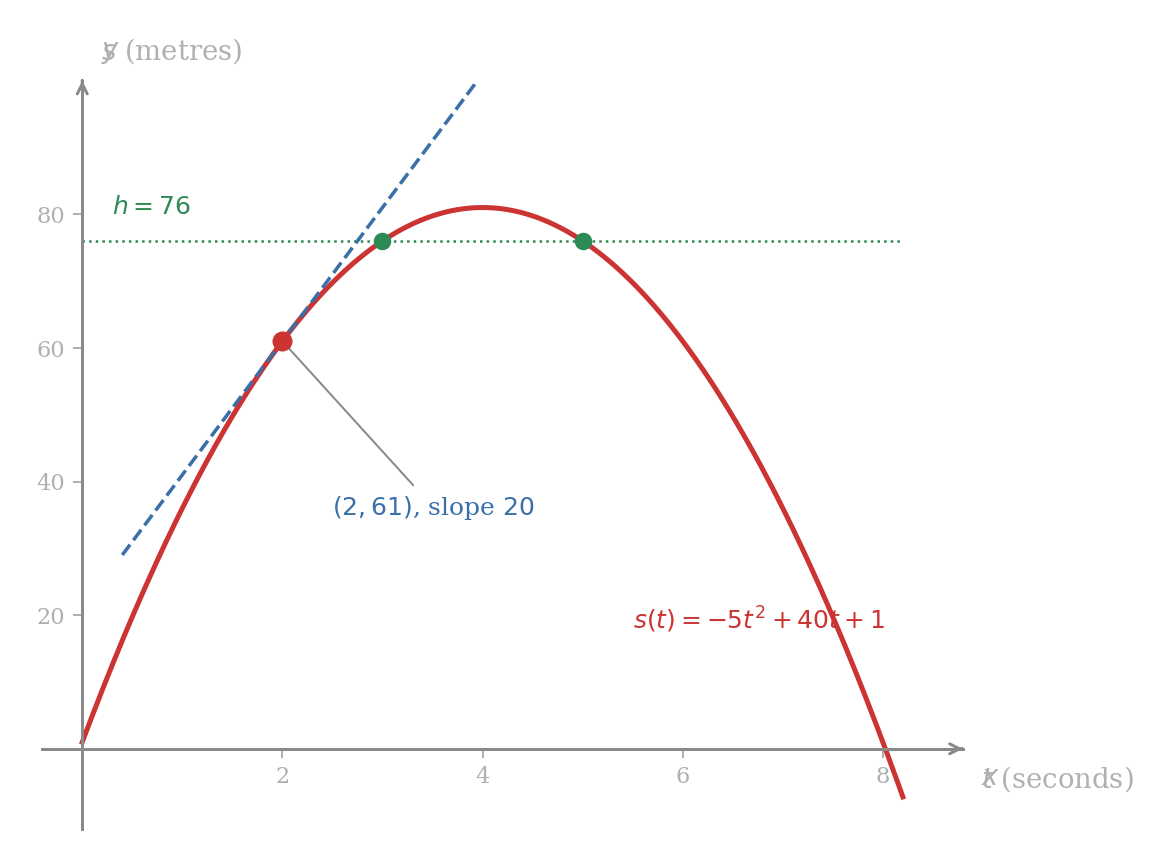
A stone is launched vertically upwards from a height of metre above the ground with an initial velocity of metres per second. Taking the upward direction as positive and ignoring air resistance, the height after seconds is
the coefficient being half the gravitational acceleration of about metres per second per second.
(a) Velocity at . The Sum and power rules give , so metres per second; the stone is rising at metres per second two seconds into its flight.
(b) Acceleration at . Differentiating again, metres per second per second for every . The acceleration is negative because gravity acts downwards, the convention having taken upward as positive, and is the same number at every because the gravitational pull does not vary over the flight.
(c) When is the velocity metres per second? Setting gives , so seconds. The negative sign records that the stone is now falling at metres per second.
(d) When is the stone at a height of metres? Setting gives
which factors as by the inspection of Recitation 1, so or . The stone passes through the height metres twice: once on the way up at seconds and once on the way down at seconds.
Problem 11
A bead slides along a straight wire with directed position metres at time seconds, .
- Compute the velocity and the acceleration as functions of .
- Find every time at which the bead is momentarily at rest, .
- Find the time at which the acceleration is zero, and state the velocity at that instant.
The change in over a step of length
The marginal-cost reading two sections back approximated the change in cost across a step of one unit by . The same construction extends to a step of arbitrary length, the only modification a multiplication of the rate by the length of the step.
For differentiable at and a small displacement , positive or negative,
Setting recovers the formula of two sections back. The right-hand side is the change in along the tangent line at over a horizontal step of , by slope property 1 of Lesson 2AM scaled by ; for small the curve stays close to the tangent line, and the change along the curve is well approximated by the change along the line.
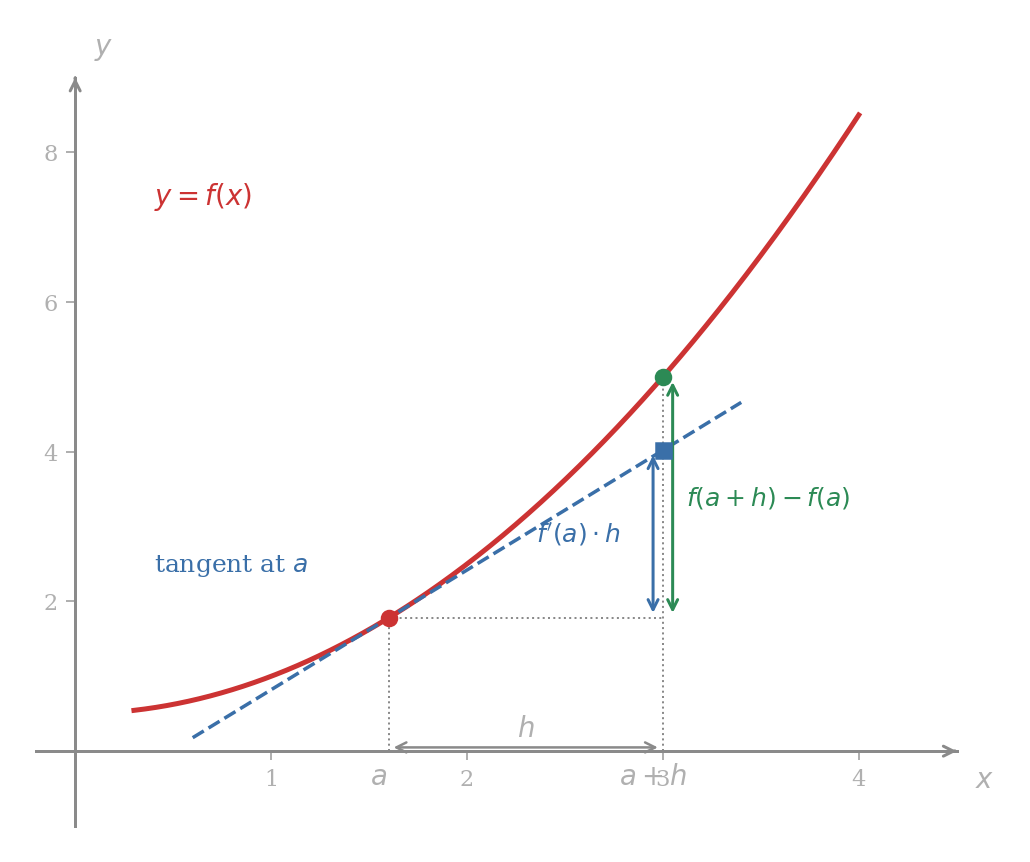
The same identity may be derived from the equation of the tangent line at written out in Lesson 2PM,
Replacing the tangent value by the curve value , valid only as an approximation, and substituting produces , the same formula obtained directly.
A textile mill’s daily output is garments when person-hours of labour are employed. Direct measurement at the current level gives
the slope measured in garments per person-hour. Interpret each value, and use the linear approximation to estimate the daily output at , at , and at .
The height records that person-hours of labour currently produce garments per day. The slope records that, at the current level, output rises at the rate of garments for each additional person-hour of labour.
For the displacement is , and the linear approximation gives garments. For the displacement is , and
For the displacement is , and the same formula gives
so reducing labour by one person-hour drops daily output by about garments. The negative displacement is handled by the formula without further work.
Marginal cost over a non-unit step
Specialising the new approximation to a cost function with displacement ,
For this collapses to the marginal-cost formula of two sections back; for the marginal cost is scaled in proportion to the length of the step.
A workshop’s total cost of producing units of a commodity is
Find the marginal cost function, evaluate the cost and the marginal cost at the production level , estimate the cost of the ninth unit, and estimate the additional cost of raising production from to units.
The Sum, Constant-Multiple, and power rules give , the marginal cost function in thousand pounds per unit. At ,
The cost of the ninth unit is , and by the marginal approximation with this is approximately thousand pounds. The additional cost of raising production from to has step , so the same formula gives
Halving the step size halves the predicted change in cost, a feature the unit-step formula of two sections back was unable to express.
Units of a rate of change
The rate-of-change reading fixes the units of from those of and . Because is computed as a change in divided by a change in , the units of are
The examples in this lesson supply several instances at once: position in metres against time in seconds gives velocity in metres per second; velocity in metres per second against time in seconds gives acceleration in metres per second per second; cost in pounds against units of production gives marginal cost in pounds per unit; output in garments against person-hours of labour gives marginal product in garments per person-hour. Stating the units alongside the numerical answer is part of the answer in any rate-of-change calculation.
Exercises
Exercise 1
Differentiate by the rules of this section, and evaluate .
Exercise 2
Find the equation of the tangent line to at , in slope-intercept form.
Exercise 3
Show that the curve has exactly three horizontal tangents, and locate each of them.
Exercise 4
Differentiate by the General power rule, and confirm the answer at by expanding to a polynomial in and differentiating term by term.
Exercise 5
Differentiate , state the natural domain of , and write the equation of the tangent line at the point .
Exercise 6
For on , compute by the General power rule, then verify by writing and applying the General power rule with instead.
Exercise 7
Differentiate with respect to , treating as a constant by the constant multiple rule. Recognising as the area of a disc of radius , identify the geometric quantity the derivative equals.
Exercise 8
Compute by the General power rule, and verify the answer by first writing and so , then differentiating the rewritten form.
Exercise 9
For , compute
by differentiating twice and substituting.
Exercise 10
After a publicity drive ends, the daily downloads of a mobile app, in thousands, are modelled by
days from the end of the drive. Compute the average rate of change of over the interval , and the instantaneous rate of change at .
Exercise 11
Let denote the number, in thousands, of headphones sold per month when the price is set at per pair. Suppose
Interpret each value, then estimate the monthly sales when the price is raised to per pair.
Exercise 12
Let denote the profit, in pounds, from manufacturing and selling specialty bicycles per month. Suppose
Interpret each value, and use the linear approximation to estimate the profit from manufacturing and selling bicycles per month.