
Advanced Curve Sketching
In Lesson 3AM, we discussed the main techniques for curve sketching using the first and second derivatives. We built a reliable three-step recipe that leaned heavily on relative extrema and inflection points to dictate the shape of a graph. Here, we add a few finishing touches and examine some slightly more complicated curves that test the limits of our previous rules.
The more points we plot on a graph, the more accurate the graph becomes. This statement remains true even for the simple quadratic and cubic curves we have seen. While the relative extrema and the inflection points dictate the overarching structure, the points where the graph crosses the axes, the - and -intercepts, often have immense intrinsic interest in an applied problem. They represent starting values, break-even points, or moments when a physical quantity runs out.
Intercepts and the Quadratic Formula
When is in the domain, the -intercept is straightforward to find: simply evaluate . It answers the question, “where does this process begin?”
To find the -intercepts on the graph of , we must find those values of for which . Since this can be a difficult (or sometimes impossible) algebraic problem, we shall compute -intercepts only when they are easy to find or when an application specifically demands them. When is a quadratic function, we can easily compute the -intercepts (if they exist) either by factoring the expression or by using the quadratic formula.
The roots of the quadratic equation are given by:
The sign tells us to form two expressions, one with and one with . The equation has two distinct roots if ; one double root if ; and no real roots if .
Sketch the graph of , identifying its extrema and all intercepts. For this function,
Since only when , and since is positive, must have a relative minimum at by the second derivative test. The relative minimum point is .
The -intercept is . To find the -intercepts, we set and solve for :
The expression is not easily factored by inspection, so we use the quadratic formula with :
The -intercepts are and . To plot these points, we use the approximation , giving -intercepts near and .
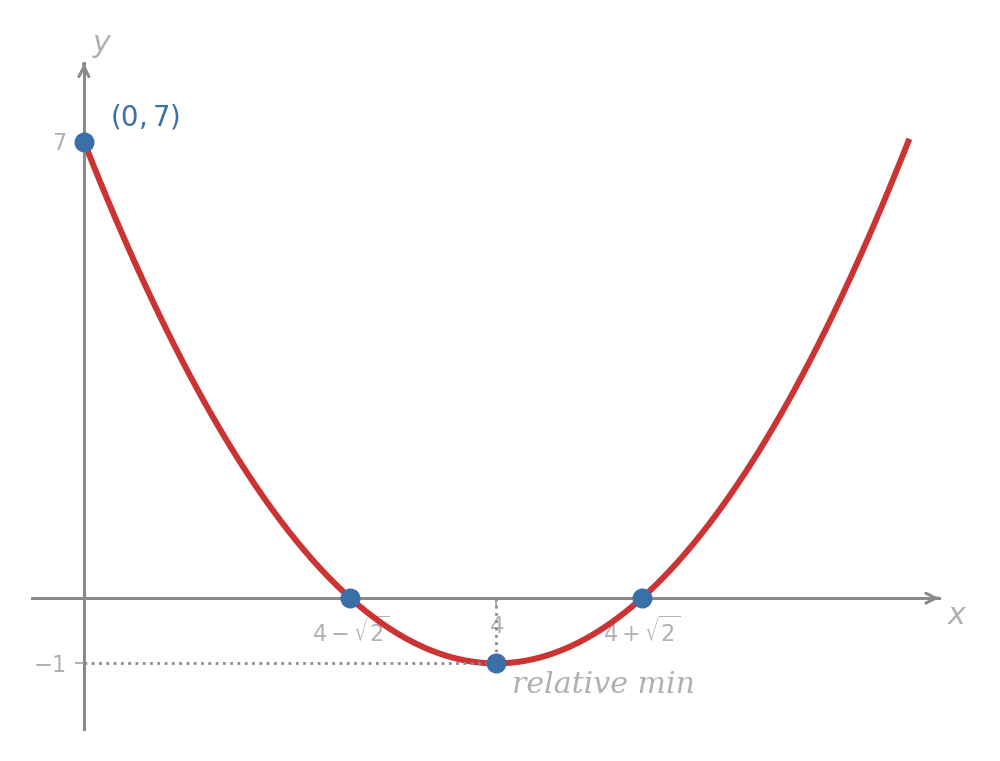
In an applied context, if this parabola modeled the height of an underwater drone over time, the -intercept would be its launch height, the minimum would be its maximum depth, and the -intercepts would be the exact moments it broke the surface of the water. This extra context turns a simple graph into a complete narrative of the drone’s journey.
Problem 90
Sketch the graph of . Find the relative extremum using either the first or the second derivative test, find the -intercept, and use the quadratic formula to find the -intercepts. What would these intercepts mean if modeled the profit of a business over time?
Functions with No Critical Points
Not every function has peaks or valleys. Some processes represent unceasing growth or decay. What does the derivative tell us when a function never turns around?
Sketch the graph of .
Searching for critical numbers, we set and try to solve for :
If we apply the quadratic formula with , and , we compute the discriminant . Because the discriminant is negative, there is no real solution to the equation. In other words, is never zero.
Thus, the graph cannot have relative extrema. Also, is an upward-opening quadratic with no real zeros, so since , the quadratic stays positive for every real . Therefore is increasing for all .
Even though there are no extrema, we can still analyze the concavity using .
- For : is negative, so is concave down.
- For : , concavity reverses.
- For : is positive, so is concave up.
Since changes sign at , we have an inflection point at . The -intercept is . We omit the -intercept because it is difficult to solve the cubic equation directly.
The quality of our sketch will be significantly improved if we draw the tangent line at the inflection point first. To do this, we need the slope of the graph at :
We draw a line through with slope and then complete the curve by smoothly transitioning from concave down to concave up through that point.
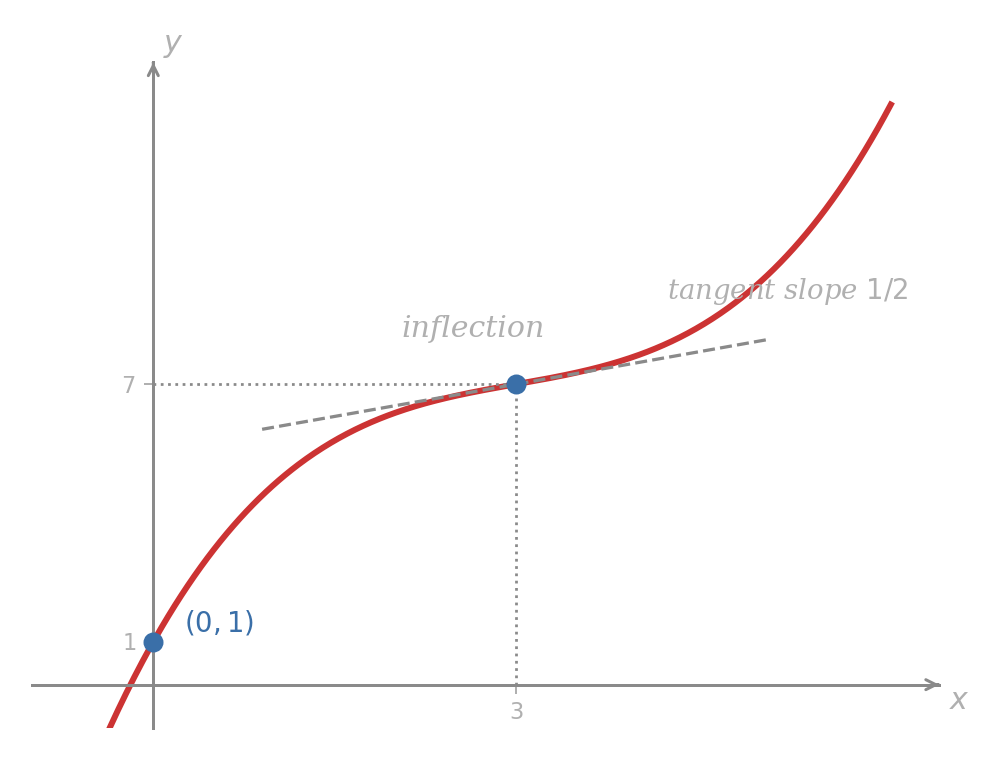
This model represents a process that is always growing, but experiences a brief period of “fatigue” where its growth slows down (concave down), hits a minimum rate of growth at the inflection point, and then re-accelerates (concave up). This is a common pattern in economic indicators or population models where growth continues despite a temporary recession in momentum.
Problem 91
Consider the function . Show that has no critical numbers and is always increasing. Find its inflection point and the slope of the tangent line there. Sketch the graph.
When the Second Derivative Test Is Inconclusive
In Lesson 3AM, we noted that the second derivative test fails when . When the second derivative vanishes at a critical number, the corresponding graph point could be a relative maximum, a relative minimum, or an inflection point. In these situations, returning to the first derivative test is essential.
Sketch the graph of .
Clearly, only if . So the curve has a horizontal tangent at .
We attempt the second derivative test: . Since the second derivative is zero, the test is inconclusive. To determine whether is a maximum, minimum, or neither, we must apply the first derivative test by checking the sign of around .
Note that:
since the cube of a negative number is negative and the cube of a positive number is positive. Therefore, as goes from left to right in the vicinity of 2, the first derivative changes sign and goes from negative to positive. By the first derivative test, the point is a relative minimum.
The -intercept is because . To find the -intercepts, we set and solve for :
Taking the fourth root of both sides gives two real solutions:
The curve resembles a flattened parabola.
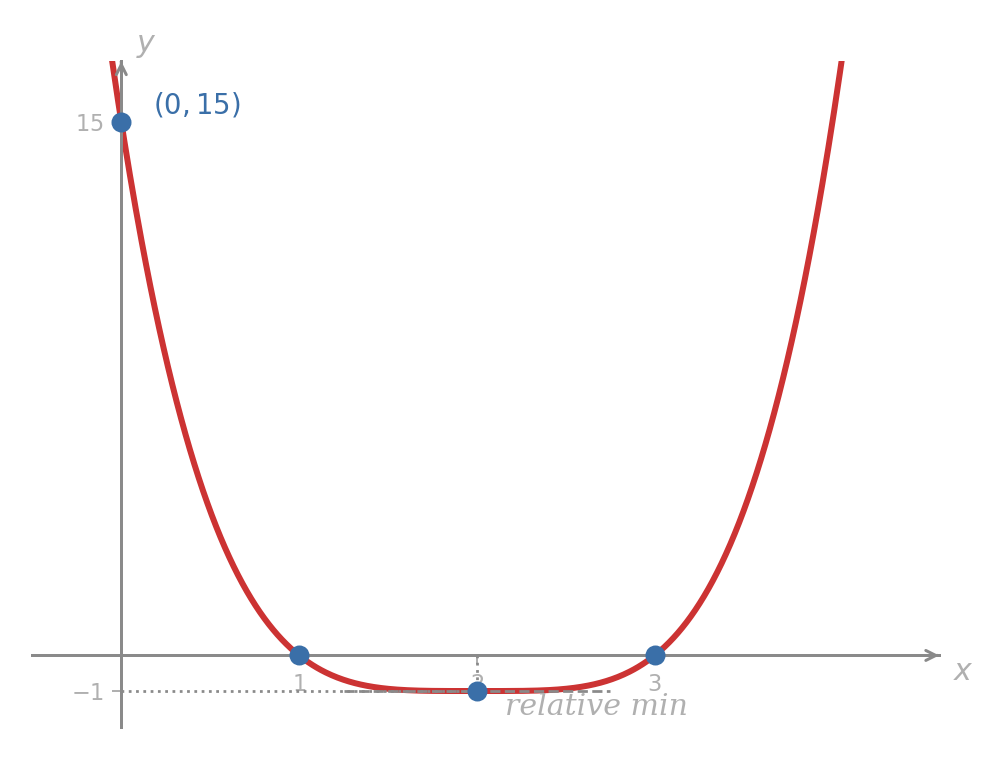
This flat-bottomed minimum is typical of physical structures designed for stability, where small deviations from the center produce almost no restorative force initially (because ), but larger deviations result in steep restoring forces.
Problem 92
Analyze the function . Find the critical number and corresponding point, show that the second derivative test fails, and use the first derivative test to classify the point. Find the - and -intercepts and sketch the graph. What does this shape imply about stability near ?
Curves with Asymptotes
The three-step procedure from Lesson 3AM, and the edge cases above, assume the function is smooth and defined at every real . Many real functions break that assumption: they blow up near some input, or their output never levels off but instead tracks a straight line for large . The final tool we need is a way to read both kinds of behavior from the formula.
Think about the cost of running a small delivery operation. You make trips per day. Each trip adds a routing cost that grows with (more trips means longer combined routes), but your fixed daily overhead of £1 is spread across all trips, contributing only per trip. Total cost per trip: .
For very small , the overhead term dominates because the fixed overhead is spread over very few trips. For very large , the routing cost dominates and the overhead contribution vanishes. There is a sweet spot somewhere in between, and the graph reveals it. It also reveals something structurally new: an oblique asymptote, a non-horizontal line that the graph tracks ever more closely as .
Recall from Lesson 3AM that a vertical asymptote at means function values grow without bound as , and a horizontal asymptote means as . An oblique asymptote is the third kind: a line such that the graph tracks the line more and more closely as becomes very large in size. The vertical distance between the graph and the line tends to zero.
Sketch the graph of for .
Since for all , the graph is concave up throughout, so there are no inflection points. Setting :
This gives . Since the domain is , the only critical number is .
Since , the second derivative test confirms a relative minimum at . Because the graph is concave up on its entire domain, this is also the absolute minimum: the lowest possible cost per trip is £2, achieved at exactly one trip per day.
Asymptotes. As shrinks toward from positive values, the term grows without bound, so the -axis is a vertical asymptote. For large :
The line is an oblique asymptote: the graph lies just above , hugging it ever more tightly. The overhead becomes negligible and cost per trip approaches pure routing cost.
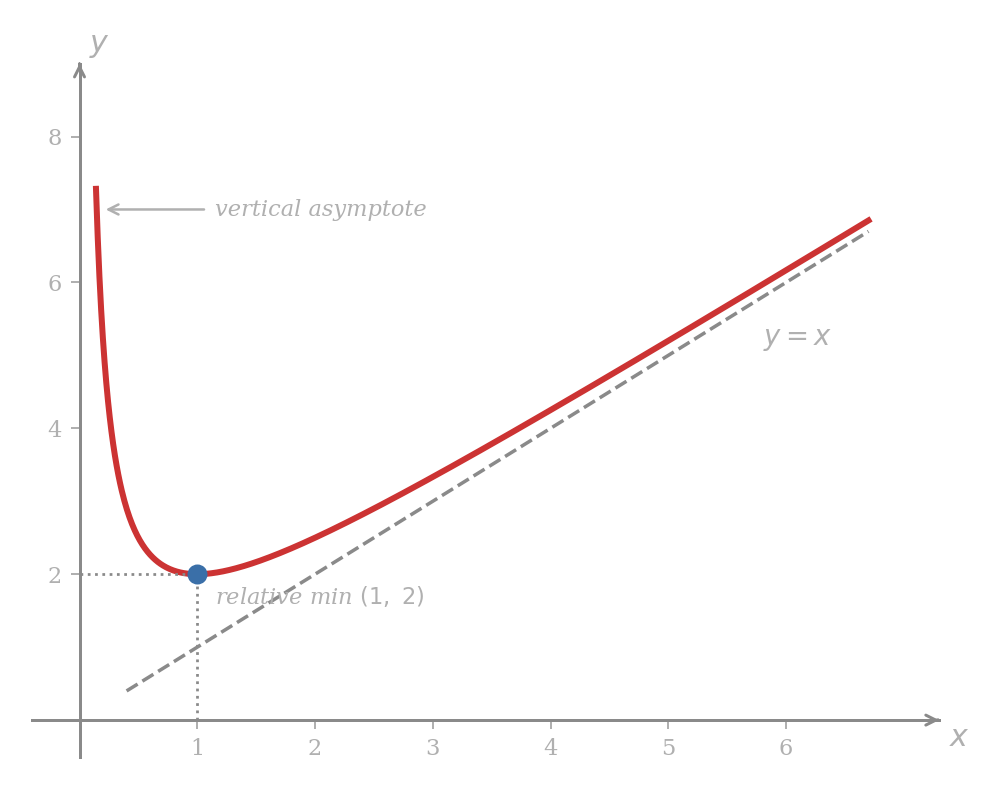
An oblique asymptote is read directly from the formula when splits as a linear polynomial plus a term that decays to zero as . When a function is given as a ratio of polynomials, polynomial long division separates these two pieces.
Problem 93
Consider for , which models the same delivery cost with a fixed daily overhead of £4.
- Compute and .
- Find the critical number, classify it using the second derivative test, and state the minimum cost per trip.
- Identify the oblique asymptote. What does it represent in the delivery model?
- How does this graph differ from ? What stays the same structurally?
The cost-minimization example in the Optimization section revisits this exact curve shape, , with a concrete construction problem attached. The sketch above is the prototype for that calculation.
The Complete Sketching Procedure
We now have every tool needed for a full graph. Combining the three-step procedure from Lesson 3AM, the edge cases from earlier in this lesson, and the asymptote analysis above gives the complete checklist.
- Compute and .
- Critical numbers. Set and solve. For each critical number : compute , plot the point, and draw a small horizontal tangent line through it. Then apply the second derivative test: if , sketch a small concave-up arc with as its lowest point (relative minimum); if , sketch a concave-down arc with as its peak (relative maximum). If , apply the first derivative test instead.
- Inflection points. Set and verify a sign change in on each side.
- Intercepts. The -intercept is when is in the domain. Compute -intercepts by solving when tractable (e.g., using the quadratic formula).
- Domain restrictions. Note any excluded inputs; these produce gaps or vertical asymptotes.
- Asymptotes. Evaluate for horizontal asymptotes. Near any excluded input , check whether for a vertical asymptote. If the graph gets closer and closer to a slanted line for very large positive or negative , that line is an oblique asymptote.
Problem 94
Sketch the graph of for .
Carry out the full procedure: compute and , find the critical numbers and classify the corresponding points, identify the oblique asymptote by writing , and mark the vertical asymptote at .
Optimization Problems
Everything in this chapter, derivative tests, sign charts, and the full sketching procedure, was machinery in service of this section. An optimization problem asks: which value of the input makes some quantity as large or as small as possible?
The calculus is what we already know: write the function, find where , classify. The challenge in applied problems is building the function in the first place. Almost every optimization problem involves two ingredients:
- an objective equation, expressing the quantity to be optimized in terms of the available variables;
- a constraint equation, a relationship the variables must satisfy.
The constraint eliminates all but one variable from the objective, producing the one-variable function whose critical numbers give the candidate answers.
The first two examples below are warm-ups where the function is handed to us directly. The remaining three require setting it up from scratch.
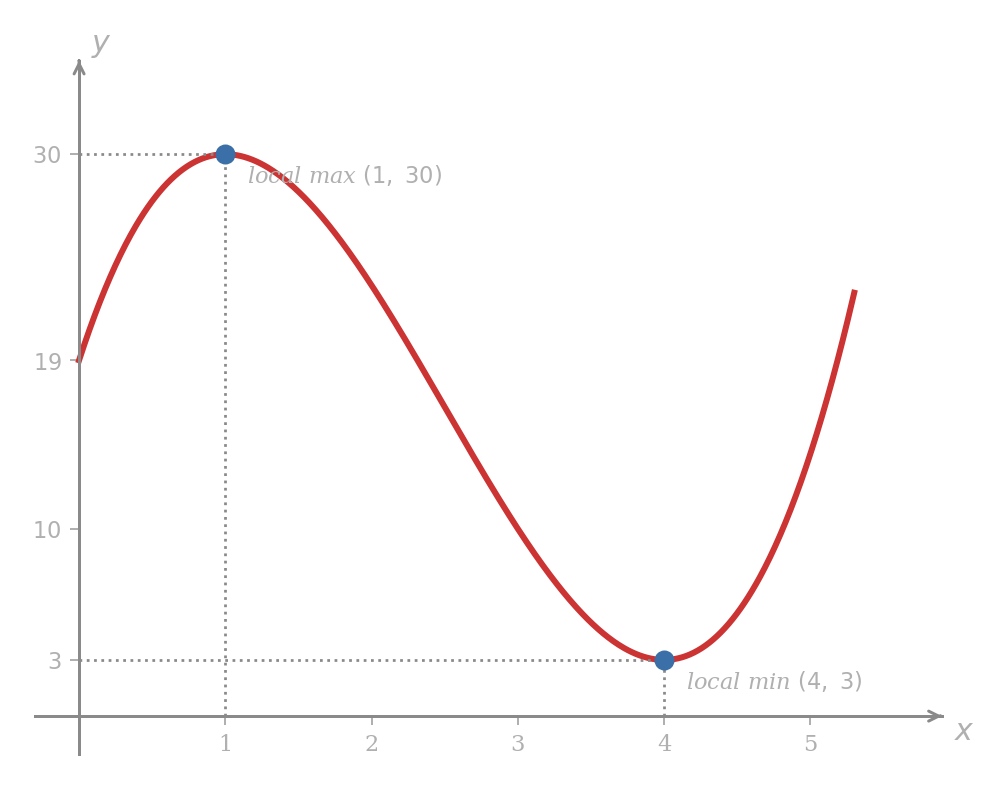
A firm’s daily production cost (in hundreds of pounds) is modeled by
where is thousands of units produced. Find the production level that minimizes cost.
Critical numbers: and . Values:
Second derivative test:
so there is a local maximum at .
so there is a local minimum at .
The endpoint value is , and for large the positive cubic term forces upward. Thus the local minimum at is the absolute minimum on the restricted domain .
The minimum cost on is £300, achieved at thousand units per day.
Problem 95
For :
- Find the inflection point and confirm the concavity change on each side.
- On which interval is simultaneously decreasing and concave up? What does this phase mean economically: is the cost improving, and is the improvement accelerating or slowing?
- Evaluate and . Comparing these with the critical values, what is the global minimum of on ?
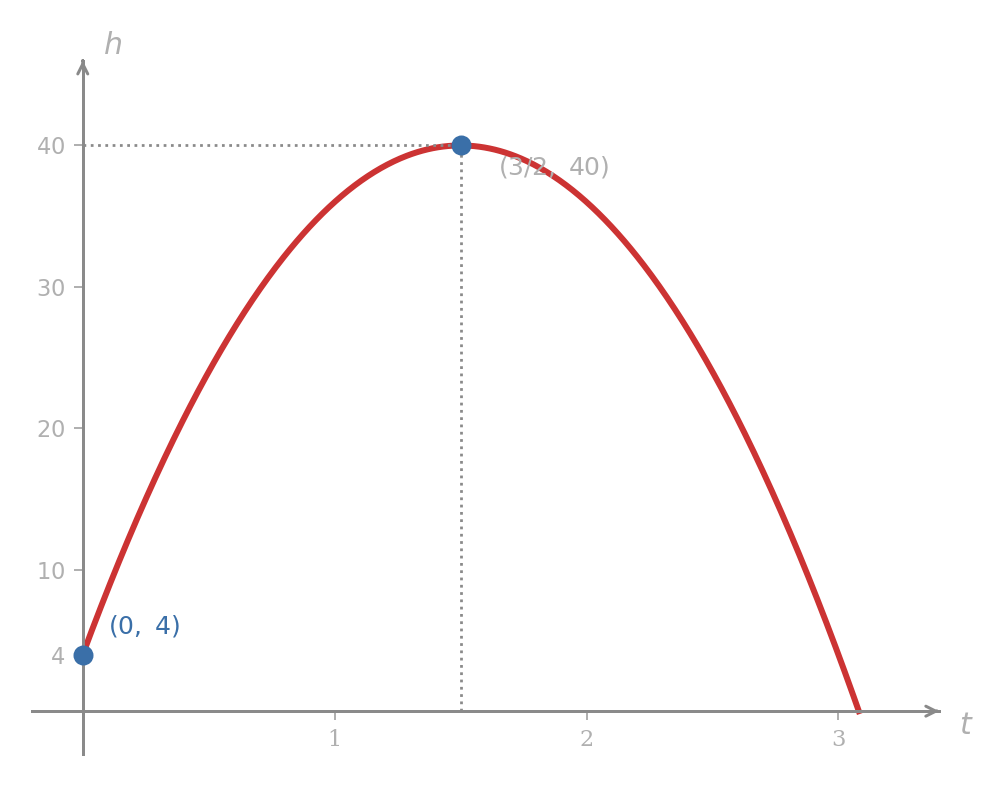
A ball is thrown vertically from a platform so that its height after seconds is
How long does it take to reach maximum height, and what is that height?
Since the coefficient of is negative, is a downward-opening parabola with a single global maximum. Setting :
so . Since , the second derivative test confirms a maximum. The maximum height is
The ball reaches its maximum height of 40 feet at 1.5 seconds. The graph below is height as a function of time, not a picture of the physical path, which is a vertical line.
Problem 96
For :
- Use the quadratic formula to find both -intercepts. What does each root represent physically? One root is negative; does it belong to the model?
- A second ball is launched from the ground with the same initial speed: . At what time does it peak, and what is its maximum height? Why does it peak at the same time but lower?
The next three examples each require building the objective function from a description. That is the central skill.
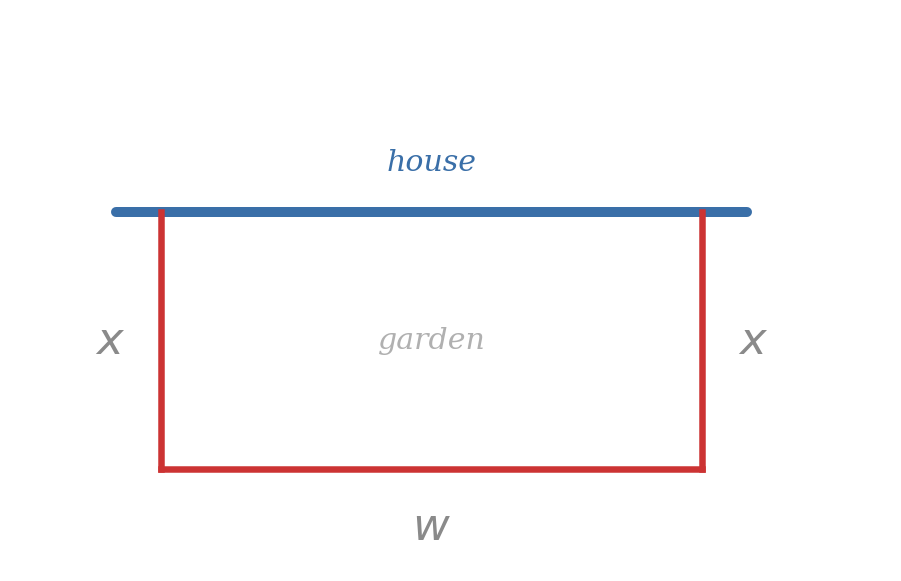
You want to plant a rectangular garden along one side of a house, fencing the other three sides. Find the dimensions of the largest garden that can be enclosed with 40 feet of fencing.
Before setting up the general case, notice that 40 feet of fencing can be arranged in many different ways. For instance: a plot ft deep and ft wide uses ft and encloses sq ft; a plot ft deep and ft wide encloses only sq ft; a plot ft deep and ft wide encloses only sq ft. The enclosed area is not fixed; it depends heavily on the choice of dimensions. Calculus will tell us exactly which choice is best.
Let be the depth (perpendicular to the house) and be the width (parallel to the house).
Objective: maximize the area,
Constraint: the fencing totals 40 feet,
Solving for and substituting into :
Setting gives . Since everywhere, the parabola is concave down and this is an absolute maximum. From : .
The garden of maximum area measures ft deep and ft wide.
![Graph of A(x) = 40x − 2x², a downward-opening parabola on [0, 20]. The maximum is at (10, 200) with dotted reference lines.](/pdfs/MA0/Imgs/ma0-4-5.png)
Equation is the objective equation; equation is the constraint equation. This two-equation structure is the template for every optimization problem that follows.
Problem 97
You have 60 feet of fencing for a rectangular plot against the same house wall.
- Write the objective and constraint equations using the same variable names.
- Express the area as a function of alone and state the domain.
- Find the dimensions that maximize the enclosed area and compute that maximum.
A storage yard needs a 600-square-foot rectangular enclosure. Three sides will be redwood fencing at £14 per running foot; the fourth side will be a cement wall at £28 per running foot. Find the dimensions that minimize total cost.
Let be the length of the cement side and be the length of an adjacent side.
Objective:
Constraint:
Substituting into :
This is the same structural shape as the asymptote example: a linear term plus a reciprocal term, concave up on all of , with a single minimum inside the allowed range. Setting :
Since , we get . Since , the second derivative test confirms a minimum. From : .
Minimum cost: . Optimal dimensions: ft, ft.
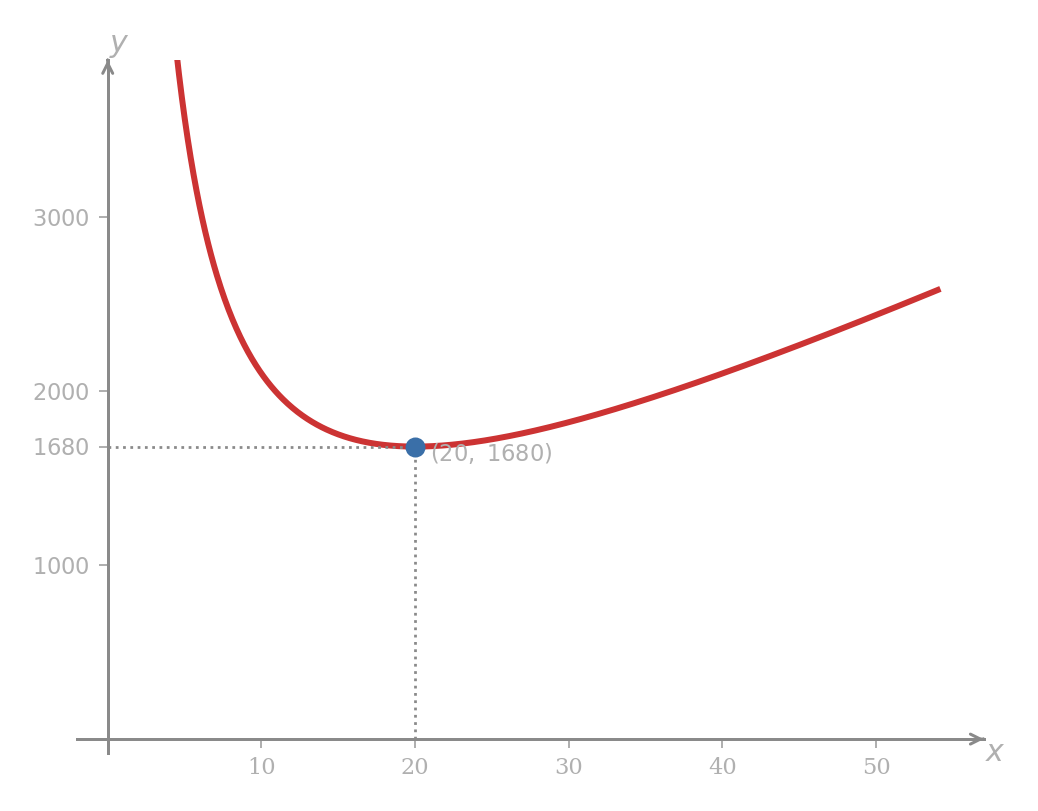
The cost function is structurally identical to the delivery model : concave up everywhere, blowing up near , linear for large , single minimum inside the allowed range. Recognizing this family means the minimum always satisfies , turning a messy-looking cost problem into a routine derivative calculation.
Problem 98
A farmer encloses a rectangular pen of area 400 square meters against a barn wall (no fencing on the barn side). Two parallel sides cost £12 per meter; the front side costs £20 per meter.
- Let be the length of the front side and be the depth. Write .
- Find the dimensions that minimize cost.
- Confirm the minimum with the second derivative test.
Postal regulations state that the length plus girth of a parcel may not exceed 84 inches. Find the dimensions of the cylindrical package of greatest volume satisfying this rule.
Let be the length and the radius of the circular cross-section.
Objective:
Constraint: the girth of a cylinder is the circumference , so
Substituting into :
Setting :
The endpoint gives zero volume, so the useful critical number comes from , namely .
Since , the second derivative test confirms a maximum. From : inches.
The optimal package has radius inches and length 28 inches.
![Graph of V(r) = 84πr² − 2π²r³ for r ∈ [0, 42/π]. The volume is zero at both endpoints and peaks at r = 28/π with dotted reference lines.](/pdfs/MA0/Imgs/ma0-4-7.png)
Problem 99
The postal authority changes the constraint to 108 inches of length plus girth.
- Write under the new constraint.
- Find the radius and length of the largest mailable cylinder.
- Does the ratio (length to girth) stay the same as under the 84-inch constraint? What does this suggest about the general shape of the optimal cylinder?
- Draw a diagram where geometry is involved.
- Identify the quantity to be maximized or minimized.
- Assign variable names to the quantities that may vary.
- Write the objective equation: as a function of those variables.
- Write the constraint equation: the relationship the variables must satisfy.
- Use the constraint to reduce the objective to a function of one variable. State the domain.
- Find the critical numbers by solving and by recording any inputs where does not exist while is defined. If the domain has endpoints, check those too. Classify using the second derivative test where it applies, otherwise use the first derivative test. Compare all candidate values when needed, and answer in terms of the original problem.
Problem 100
A 12-inch square sheet of cardboard is used to make an open-top box by cutting equal squares of side from each corner and folding up the sides.
- Write the volume of the resulting box.
- State the domain of .
- Find the value of that maximizes and compute the maximum volume.
Problem 101
A manufacturer wants to produce a closed cylindrical tin holding exactly 500 cubic centimeters. Material cost is uniform per square centimeter across the curved side and both circular ends. Find the radius and height that minimize the total surface area, and verify with the second derivative test.
| Shape | Formula |
|---|---|
| Rectangle | Area , Perimeter |
| Box | Volume |
| Circle | Area , Circumference |
| Cylinder | Volume |