
Lesson assets
No linked assets.
Logarithmic Derivatives, Elasticity, and Bounded Growth
Lesson 5AM produced as the solution family of the rate equation , and Lesson 5PM introduced the derivative together with logarithmic differentiation. The chain rule applied to recasts the same machinery in two further directions. The logarithmic derivative measures a relative rate of change, which is the natural language for comparing percentage growth in economics and which gives the demand-side notion of elasticity. The substitution turns the rate equation into , so the equation inherits a closed-form solution at no cost; this is the shape underlying bounded learning curves, mass-media diffusion of news, and the approach to steady state under intravenous infusion. This recitation applies both extensions, ending with the logistic family .
The Logarithmic Derivative
For any positive differentiable , the chain rule for gives
The right side compares the rate of change to the current value , so it has units of fraction per unit of . Multiplied by , the same quantity reads as a percentage.
The relative rate of change of a positive differentiable function at time is the logarithmic derivative
Multiplied by , the same quantity is the percentage rate of change of at time .
An absolute change in money is meaningful only against an absolute base value. If beef costs per kilogram and is rising at per year while a car costs and is rising at per year, the slopes and are not directly comparable. The percentages
are, and show that the beef price is rising slightly faster in relative terms than the car price.
A simple model for a country’s gross domestic product, measured in trillions of pounds and timed in years from January 1, 1990, takes the form
Find the percentage rate of change of on January 1, 1990, and on January 1, 1991.
By the sum rule and the formula for with ,
The percentage rate of change is . At ,
or about per year; the economy is contracting. At ,
or about per year; the economy is growing. The transient term controls the early dynamics; once it has decayed, and the relative growth rate is approximately , positive but slowly decreasing as grows.
The value of a certain investment is modelled by
with in years. Use the logarithmic derivative to express the percentage rate of growth in closed form, and evaluate it at and years.
We take of both sides first; by LI and LIV from Lesson 5PM,
Differentiating, with the power rule,
At the relative rate is , that is, per year. At it is per year. The investment is still growing at every , but its fractional growth rate falls toward zero as increases (a hallmark of that distinguishes it from pure exponential growth , whose relative rate is the constant ).
Worked this way, the logarithmic derivative saves us the work of differentiating directly and then dividing: would contain a stray factor of that immediately cancels. Our trick (take first, then differentiate) is exactly the logarithmic differentiation of Lesson 5PM, here serving as a measurement rather than as a simplification.
If for some constant , then , which is the rate equation of Lesson 5AM. Its solutions are . A constant relative rate of change is therefore equivalent to exponential growth (or decay, when ): there are no other functions with that property.
Problem 1
A country’s population is described by , with in millions and in years from .
- Compute .
- Find the percentage rate of growth at and at , in closed form, by evaluating at each time.
- As grows large, which of the two terms dominates ? Use that to predict the long-run percentage rate of growth, and check the prediction against .
Problem 2
The price-level index of a small economy is modelled by
with in years.
- Take , then differentiate, to express as a single closed-form expression without ever computing directly.
- Evaluate the percentage rate of change at , , and .
- Show that as , and explain in one sentence why the linear factor’s contribution vanishes.
Problem 3
A function satisfies and for every .
- Identify the ODE that satisfies and write its closed-form solution using the solutions theorem.
- Find the time at which , in closed form involving .
- Express the same time using instead.
Elasticity of Demand
A demand function expresses the quantity that a market will buy at price . We write with positive and decreasing on the relevant range. Its derivative is negative, but for us the meaningful comparison is the relative rate of change , which reads as quantity’s percentage response per unit of price.
The relative rate of change of price itself, with respect to , is
Our ratio of the two relative rates is
This quantity is negative for every decreasing demand function, so economists multiply by to keep their bookkeeping positive.
For a demand function with , , and , the elasticity of demand at price is
Demand is elastic at when and inelastic when .
The demand for a certain metal is (in millions of kilograms) at price pounds per kilogram, with .
- Compute in closed form.
- Evaluate and , and interpret each.
- Find the price at which .
With , , so
At , . A price increase from per kilogram will reduce quantity demanded by about . Demand is elastic.
At , . A price increase from will reduce quantity demanded by only about . Demand is inelastic.
The unit-elastic price solves , that is, , so .
The economic significance of elasticity is its tie to revenue. With , by the product rule,
Since , the sign of matches the sign of :
- where demand is elastic (), , so a price increase lowers revenue;
- where demand is inelastic (), , so a price increase raises revenue.
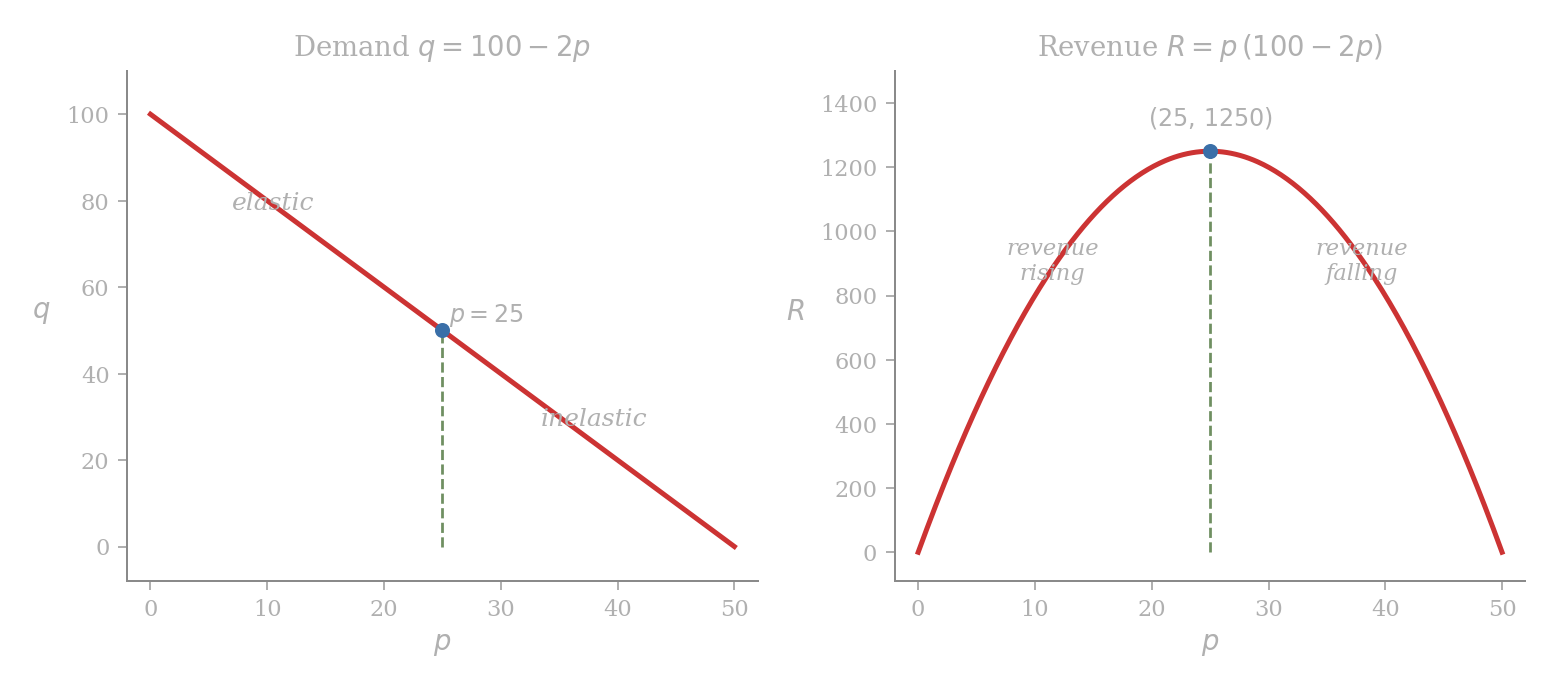
The revenue parabola peaks at exactly , the unit-elastic price. The second derivative test confirms the peak: , , everywhere, so the unique critical point is a global maximum on the relevant range.
Problem 4
For the demand function on , compute elasticity for :
- Find in closed form.
- Evaluate and , and state whether demand is elastic or inelastic at each.
- Find the price at which , and verify it is the price at which the revenue is maximised.
Problem 5
The demand for a fashion item is at price pounds.
- Use the logarithmic-derivative form to show that .
- Find the price at which demand is unit-elastic.
- Compute the elasticity at and at , and interpret each.
Problem 6
A demand function has constant elasticity for every , where is a positive constant.
- Rewrite the elasticity condition as the logarithmic-derivative equation .
- Verify directly, by computing using LI and LIV, that satisfies this equation for every positive constant .
- For , show that the revenue is constant on the entire domain.
Bounded Growth: the Family
A natural variant of replaces the right side with , where and are fixed constants. The variable acts as a ceiling: our rate of change is proportional to how far still lies below , so growth is fastest when is small and tapers off as approaches .
We let . Then , and so
The right-hand equation is the rate equation of Lesson 5AM with growth constant . By the solutions theorem, for some constant , and therefore
If , then and the closed form simplifies to .
For fixed constants and , every solution of
has the form for some constant . The solution with is
When , the curve grows upward toward the ceiling . If the starting value is already above , the same formula describes decay down toward instead.
Our substitution above converts the ODE into , whose solutions are by Lesson 5AM. Hence . The initial condition gives , so and .
To verify the differential equation directly, differentiate by the formula for : . On the other hand . The two expressions agree.
■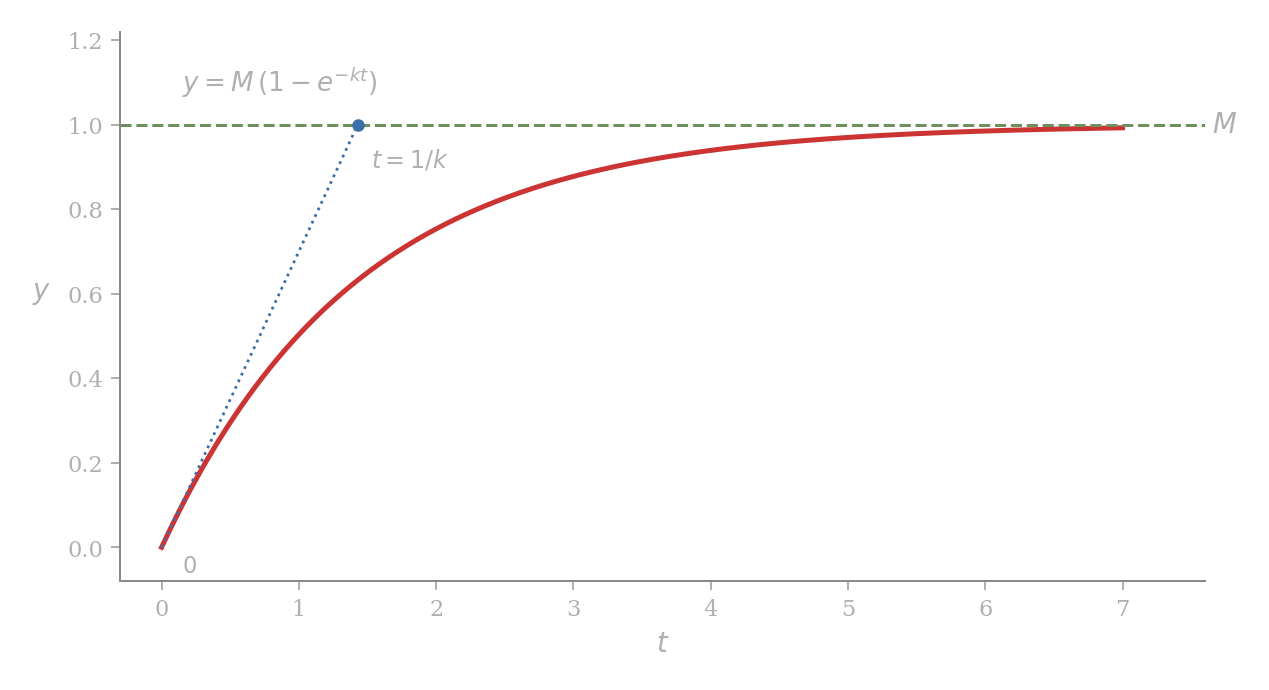
Three numerical features of our curve follow at once, mirroring the time-constant analysis of Lesson 5R:
- The initial slope is the largest slope of the curve, since decreases in .
- The tangent at meets the line at ; the curve at that time has height .
- as ; the curve never reaches the ceiling but settles arbitrarily close to it.
In a controlled experiment, a subject can memorise at most nonsense syllables in a row given enough study time. After minutes of study the subject can correctly memorise syllables, and satisfies
The subject can memorise syllables after minutes. Find and predict the number retained after minutes of study.
By the theorem, . The reading at gives
Taking and applying LII,
With this ,
The subject can memorise syllables after minutes, three half-lives of the deficit removed from the initial gap of syllables.
If we reframe this as ” minutes of study halves the remaining gap,” our problem turns into a half-life problem in disguise: the deficit is itself a pure exponential decay with the same constant . Lessons 5PM and 5R apply unchanged to that deficit.
In a city of residents, news of a public official’s resignation is broadcast continuously by radio and television. The number of residents who have heard the news by time (in hours) satisfies
because the rate at which new people hear is proportional to the number who have not yet heard. Half of the residents have heard the news hours after release. When will have heard?
By the theorem, . The half-population condition at gives , so and .
The threshold solves
Taking ,
About hours after release, of the city has heard the news.
Problem 7
A patient receives a continuous intravenous infusion of glucose. The excess glucose level above the equilibrium satisfies
where is the (constant) rate of infusion in milligrams per minute and is the metabolic clearance constant.
- Rewrite the ODE as , identifying in terms of and .
- Use the bounded-growth theorem to write in closed form.
- With mg/min and per minute, find the limiting level , then find the time at which first reaches , in closed form involving .
Problem 8
A skydiver’s downward velocity satisfies with , where is the terminal velocity and . The skydiver’s velocity reaches half of terminal in seconds.
- Find in closed form involving .
- Find the time at which the velocity first reaches .
- Show that the acceleration is itself a pure exponential decay , and identify its half-life.
Problem 9
For the bounded-growth family :
- Compute and in closed form. Confirm is everywhere positive and everywhere negative on .
- Find the relative rate of change in closed form, and show it is not constant in , unlike for pure exponential growth.
- Show that on any interval , covers exactly half of the gap remaining at the start of the interval. (Bounded growth as “half-of-what’s-left”.)
Logistic Growth
Our bounded-growth family handles populations that fill toward a ceiling at a rate proportional to the remaining gap. We meet a different shape (the S-curve) when the growth rate is also throttled by the size of the population itself in the early stage: a small population produces few offspring even with abundant resources, and an almost-full population grows slowly because the ceiling is near. The two effects together give us the logistic family
with positive constants , , . As , and ; at , , which is small whenever is large.
The logistic function satisfies
We write , so and . By the chain rule,
On the other hand, using ,
so
which matches .
■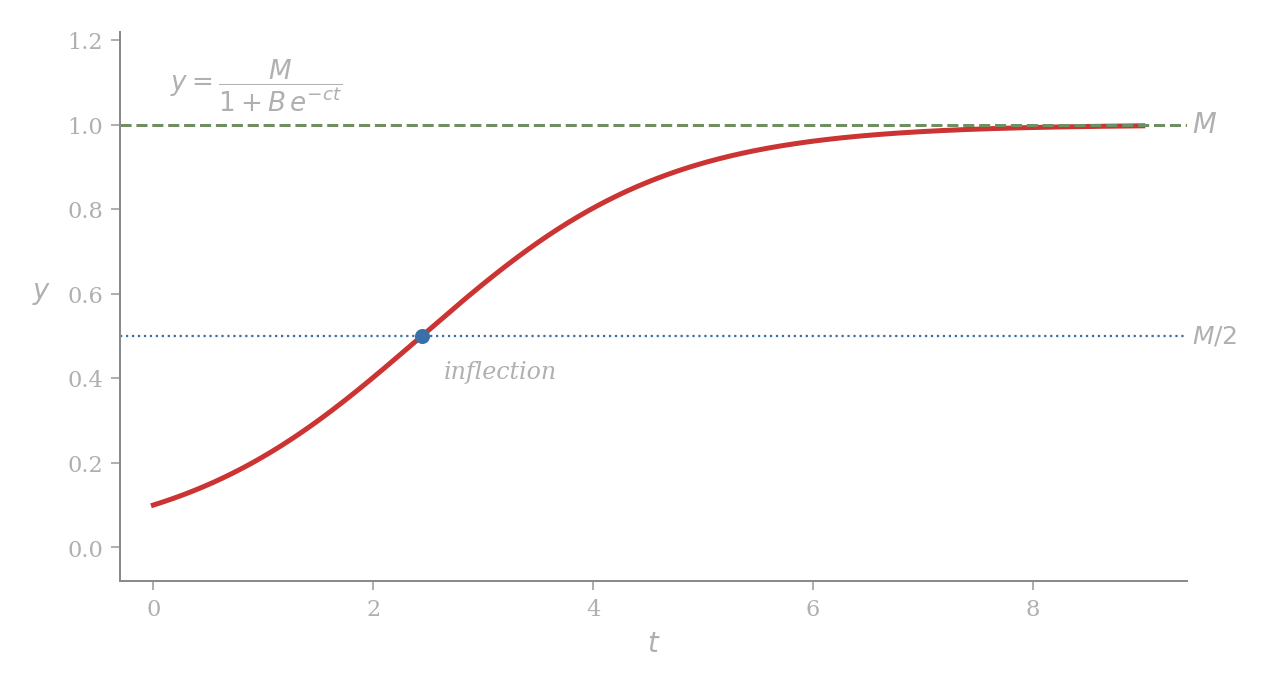
The right side of our logistic ODE is largest when the quadratic is largest. That product, viewed as a function of , is maximised at . So the logistic curve grows fastest at exactly half-capacity, and its graph has an inflection point at . Solving gives us the time of inflection .
A lake is stocked with fish. Three months later there are fish. An ecological study predicts the lake can support a long-run population of fish. Find a closed-form for the population months after stocking, using the logistic model with ceiling .
By the logistic form,
Our initial condition gives
The reading at gives
Taking and applying LII gives , so . Therefore
The inflection point (the moment of fastest growth) occurs at
at which time fish. After month , growth slows.
In a city of residents, an epidemic of a long-lasting flu is monitored. At the start of the first week, cases are known, and new cases are reported during the first week. Using the logistic model
estimate the number of infected residents at the end of the sixth week.
The condition gives
At , :
So . At ,
About residents are infected after six weeks.
The logistic family is used by sociologists for the spread of a rumour and by economists for the diffusion of knowledge about a new product, with an “infected” individual representing one who has heard the rumour or knows the product. The spreading mechanism is interpersonal contact rather than mass media; the mass-media setting of the previous section uses the bounded-growth family instead. Bounded growth has no inflection point: its slope is largest at and decreases monotonically.
Problem 10
For the logistic function with :
- Show and that as .
- Show the inflection point of occurs at , at height .
- Show the maximum growth rate is , attained at the inflection point.
Problem 11
A fruit-fly culture follows the logistic model with capacity . The culture starts with flies and reaches flies after days.
- Determine from the initial condition.
- Determine from the reading at , in closed form.
- Find the time at which the population first reaches (the inflection point), and check it equals from part 1 of the previous problem.
Exercises
Exercise 1
A start-up’s revenue is modelled by in millions of pounds, with in years from the founding.
- Compute by the product rule.
- Take and differentiate to express as a single closed-form expression.
- Find every at which the percentage rate of growth equals exactly per year, in closed form.
Exercise 2
The demand for a particular software licence is at price pounds, valid on .
- Find in closed form and show .
- Find the price at which demand is unit-elastic, in closed form.
- The price is currently . Is demand elastic or inelastic at ? Will a small price increase from raise or lower revenue? Justify with the identity .
Exercise 3
For the demand on :
- Compute in closed form and verify that elasticity is constant in .
- Conclude that revenue has the same value at every price , and compute that value.
- State, for a general demand of the form with , the elasticity in closed form, and explain in one sentence why is the dividing case between rising and falling revenue.
Exercise 4
A city’s monthly volume of landfill waste follows
where , is the long-run steady-state value, and .
- Verify satisfies for any choice of .
- The city’s data are tonnes, tonnes, and tonnes (one year after monitoring began). Find in closed form involving .
- Find the time at which first reaches tonnes.
Exercise 5
A glucose IV is set to a fixed rate , with metabolic clearance constant . The excess glucose satisfies
and we write .
- State in closed form using the bounded-growth theorem.
- The IV is shut off at time , at which point . After shutoff the body clears glucose with the same constant , so the post-shutoff dynamics are . Find in closed form involving .
- Express the time required, after shutoff, for the excess glucose to fall back to , in closed form involving .
Exercise 6
A bounded-growth process and a pure exponential decay are connected. Let be the bounded growth, and let be the residual gap.
- Show satisfies with (pure exponential decay).
- State the half-life of in closed form, and show it equals the time at which first reaches .
- Show that on any interval with , the curve covers exactly half of the deficit remaining at the start of the interval, regardless of .
Exercise 7
In the early stage of logistic growth, when is small compared with , the logistic ODE
nearly coincides with a pure exponential growth equation.
- Show that if is negligible compared with , then .
- Conclude that the logistic curve initially looks like a pure exponential with growth constant , and verify this by computing in closed form for the logistic family .
- Show that approaches as , that is, when the initial population is a very small fraction of the ceiling.
Exercise 8
A rumour spreads through a community of people according to the logistic model with parameters and . Initially people know the rumour; after days, know.
- Determine from the initial condition.
- Determine in closed form involving .
- Estimate the day on which the rate of new infections is maximal, and the cumulative number of people who know the rumour on that day.
Exercise 9
A demand function on has . Show that satisfies this elasticity condition for every positive constant , by computing directly for this and verifying that the result equals .